
Home › Temecula Junk Removal › Homeless Encampment Cleanup
Temecula & Southwest Riverside County
Homeless Encampment Cleanup Temecula: Sharps, Biohazard, Debris and Structures
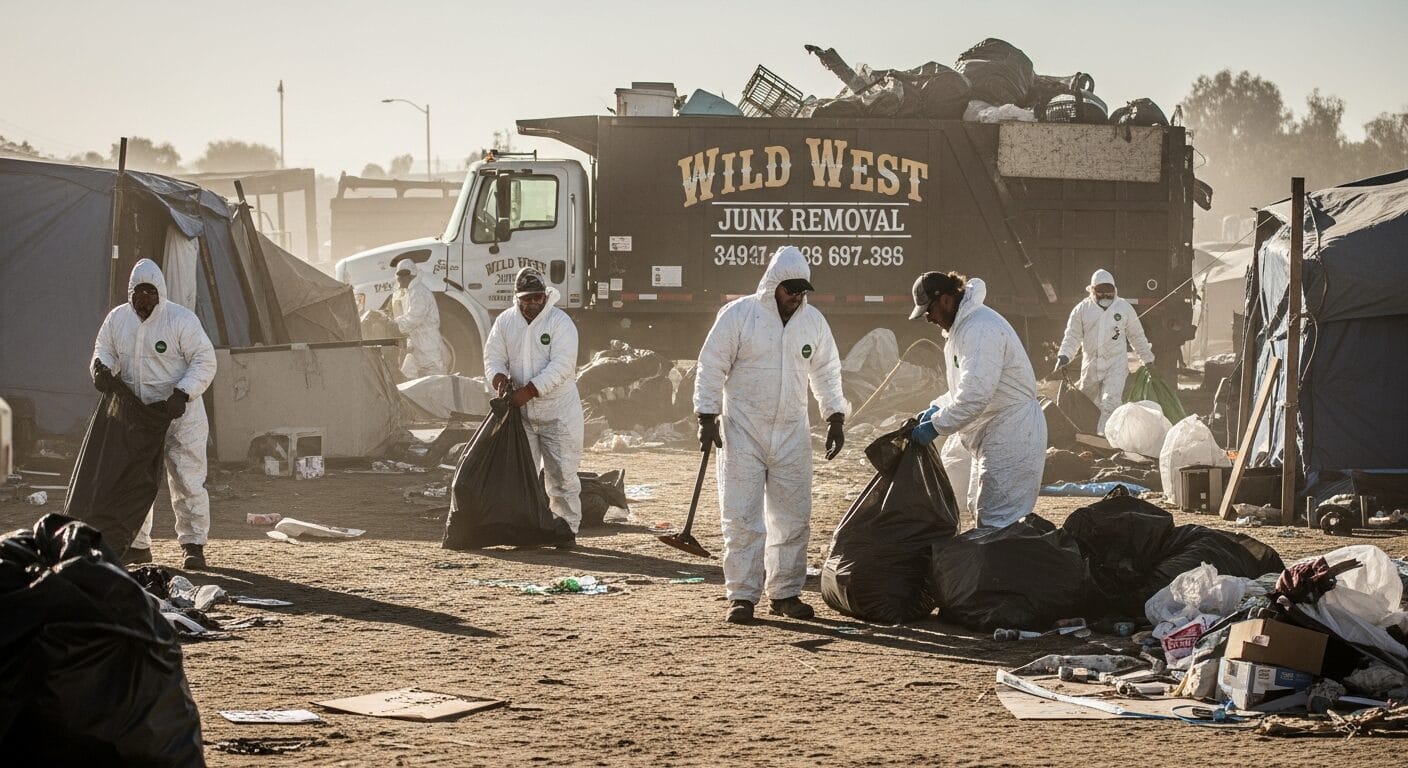
An encampment cleanup is two jobs stacked on one site. The biohazard comes out first, in full PPE, headed for a licensed medical waste processor. Then the tents, pallets, mattresses and trash. We do both, we keep them apart, and you get the price in writing before anybody touches anything.
Family-owned since 2021 · Licensed and insured · Weston on every encampment job · Chain-of-custody sharps disposal · Written estimate before we start
Wild West Junk Removal · 41713 Niblick Rd, Temecula, CA 92591 · (951) 837-8072
Mon to Sat: 7AM-7PM · Sunday: Closed · Family-owned, licensed and insured · Serving Temecula, Murrieta, Menifee and southwest Riverside County
The short version
This is not a garage cleanout with a different address
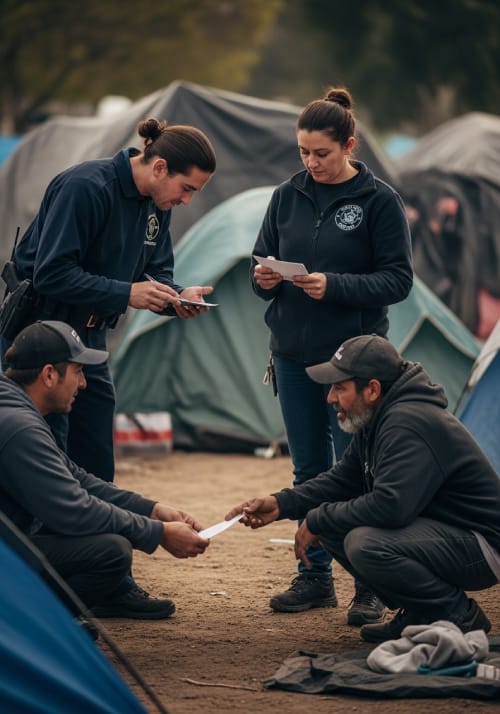
Most people who call us about an encampment have already walked the site, counted the tents, and priced it in their head like a bulky trash run. Then we get there and the first thing under the sleeping bag is a pile of needles.
That is the whole difference. A homeless encampment cleanup in Temecula has two waste streams on one footprint, and they cannot ride in the same load. The biohazard side is sharps, human waste, blood-contaminated bedding and clothing, and drug paraphernalia. It gets collected in full PPE, containerized, and driven to a licensed medical waste processor. The transfer station will not take it and should not.
The other side is everything you can actually see from the fence line. Tents, tarps, pallet walls, plywood shelters, bikes, mattresses, furniture, food waste, and weeks of accumulated trash. That comes out after the biohazard is off the site, not alongside it.
Hire us and you get one crew doing both, keeping them separated, and handing you paperwork on where each load went. We do not farm out the needle work. If you own or manage property in the valley and you are looking at a cleared camp right now, call or text (951) 837-8072 and tell us what you see.
From the owner
Why I'm on every one of these
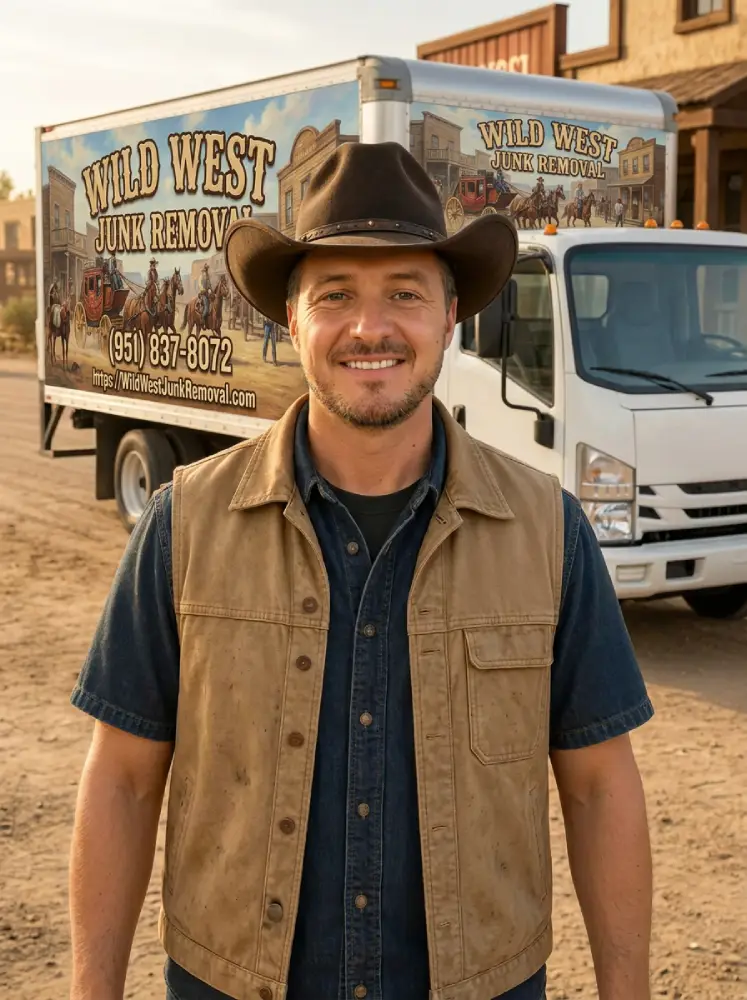
Weston Molitor
Owner, Wild West Junk RemovalI started Wild West in 2021. Of everything we haul, encampment work is the job I'm most careful about, because a shortcut here doesn't cost you a bad review. It puts one of my guys in an emergency room with a needle stick.
So before I take one of these calls I want three things: the site vacated, the authorization confirmed, and an honest description of what's on the ground. Photos help more than anything you can tell me over the phone.
I've cleared creek beds off the Murrieta Creek Trail, utility easements behind commercial buildings on Jefferson, greenbelts on the back side of HOA fence lines, and drainage channels that flood every winter and fill right back up by spring. The sites change. The order doesn't. Biohazard first, every time, and I supervise that part myself.
Call me and you'll get a straight answer on whether this is our job or somebody else's. Sometimes the honest answer is that you need the city's outreach team first, or a remediation contractor for a structure we shouldn't be touching. I'd rather tell you that than take your money.
What we find
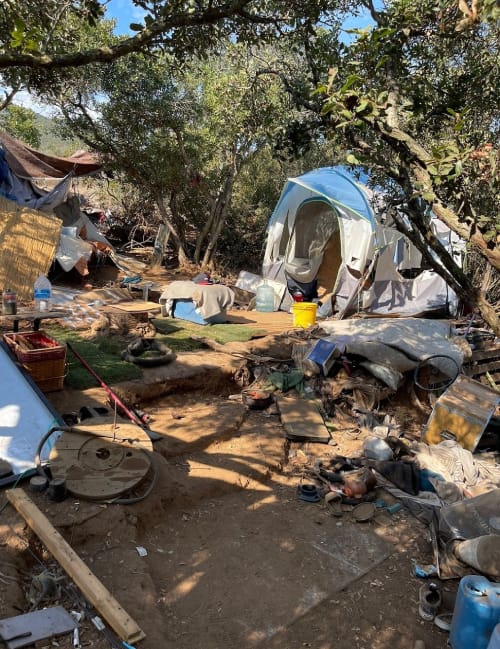
Six things that show up at a Temecula encampment, and how each one moves
How bad the hazard profile is depends on three things: how long the site was lived in, how many people used it, and whether it sits near water. We read that at the assessment, before a crew and a trailer are committed to anything.
Sharps and needles
The highest-risk item on most sites. Mechanical grabbers only, never a gloved hand, straight into sealed puncture-resistant containers, then to a licensed medical waste processor under chain of custody.
Human waste
Builds up fast anywhere there's no sanitation, which is every creek corridor we've ever worked. Respirators and fluid-resistant coveralls, separate containment. Owners underestimate this one more than anything else.
Blood and bodily fluids
Contaminated bedding, clothing and surfaces count as potentially infectious material. Separate handling, separate transport, separate disposal from the debris load. No exceptions for small volumes.
Drug paraphernalia
Pipes, foil, cookers, and residue-bearing containers. Picked up with tools and containerized. It stays out of the general waste stream no matter how little of it there is.
Structures and bulk debris
Tents, tarps, pallet walls, plywood shelters, mattresses, furniture, bicycles, general trash. Torn down and hauled once the biohazard is secured and off the property.
Rodent and animal waste
Sites with resident animals or heavy rodent activity get the same precautions as human waste. Dried waste that gets kicked up is an airborne exposure, not just an unpleasant mess.
One thing we will not do: enter an occupied site. If people are still there, the cleanup hasn't started yet, and no amount of scheduling pressure changes that. Outreach and notice come first, handled by the city or by you, and we come in behind it.
How it runs
Four stages, same order, every site
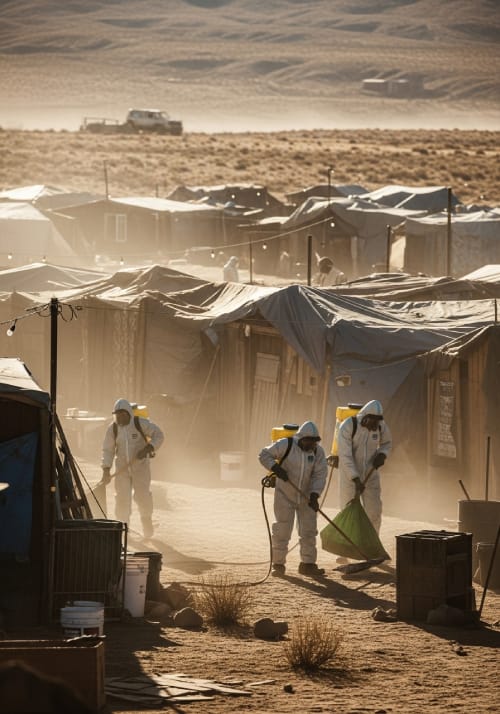
Volume and access change the pace. They don't change the sequence. Text photos to (951) 837-8072 ahead of the assessment and we can size the crew and the PPE instead of guessing at it.
Call and describe the site
Where it is, rough footprint, how many structures, whether sharps are visible, and whether a truck and trailer can get near it. We confirm you have authority to authorize the work.
On-site assessment and written estimate
We walk it, sort the waste streams, flag anything outside our scope, and put a number in writing. Nothing starts until you approve it.
Biohazard out first, in full PPE
Sharps and biohazard material get collected and containerized before the crew touches ordinary debris. Anything that looks like personal property gets staged to the side.
Debris out, site swept, paperwork issued
Structures come down, debris gets loaded, each stream goes to the facility licensed to take it. Waste-volume and disposal records on request.
What's included
Every piece of our encampment cleanup service
Serving Temecula, Murrieta, Menifee, Wildomar, Lake Elsinore, Canyon Lake, Winchester and French Valley. Anything with a biohazard component is quoted after we walk the site.
Sharps and needle removal
Mechanical collection, certified containers, licensed medical waste processor, documented chain of custody. Available on its own as a parking lot or greenbelt sweep.
Biohazard waste removal
Human waste, bodily fluids, contaminated bedding and clothing. Handled in full PPE and kept completely out of the solid debris load.
Solid debris and trash removal
Bulk trash, food waste, cardboard, bikes and accumulated junk, loaded once the biohazard stream is secured and gone.
Construction debris removal →Structure demolition and removal
Tents, tarps, pallet walls, plywood shelters and makeshift construction torn down and hauled to licensed disposal facilities.
Demolition cleanup →Creek, channel and easement cleanup
Creek beds, drainage channels and riparian corridors, with Flood Control or Fish and Wildlife coordination confirmed before we go into an active channel. Overgrowth on the same site pairs with yard waste.
Yard waste removal →Personal belongings staging
Likely personal property identified and staged separately from waste so the agency or the owner can meet retention obligations.
Commercial and multi-site accounts
Retail centers, industrial parks and property management portfolios with repeat exposure. Bundles with tenant turnover cleanouts.
Commercial junk removal →Recurring maintenance
Scheduled follow-up for sites with a known pattern of coming back. Monthly, quarterly, or triggered when conditions change.
Before we roll
Authorization, vacancy and personal property
Two things have to be true before a truck leaves our yard. The site is vacated, and somebody with authority has authorized the cleanup. On public property that means the coordinating agency finished its notice process and confirmed the site is clear. On private property it means the owner or an authorized manager confirms vacancy and gives us the go-ahead.
We don't do occupied-site removals, and we don't make legal determinations about what counts as somebody's personal property. Our crew stages likely belongings to one side and the agency or the owner handles retention, notice and retrieval from there.
For public land inside Temecula, the city's Homeless Outreach Team and the Temecula Resource Center at (951) 240-4242 run outreach and referrals. We show up after that, provide waste-removal documentation for the file, and stay in our lane. If you want the full picture on notice periods and retention rules before you call anybody, our homeless camp cleanout tips guide covers the planning side in depth.
Riverside County secured $12.6 million in state funding for encampment removal, shelter and housing navigation along the Murrieta Creek corridor, running 2025 through 2027. That corridor cuts straight through our service area. We provide the physical cleanup piece for private owners along it and for agency-coordinated public land work, with Riverside County Flood Control coordination confirmed before anything happens in-channel.
Doing it yourself
What a self-service cleanout actually costs you
| Doing it yourself | Wild West licensed cleanup |
|---|---|
| Work gloves and contractor bags, which is direct sharps and bloodborne pathogen exposure | Full PPE under the OSHA bloodborne pathogens standard, sharps collected mechanically only |
| Sharps and biohazard mixed into the debris load and driven to a transfer station | Separated streams, certified containers, licensed medical waste processor |
| Nothing on paper for city files, lender packets or property management | Written waste-volume and disposal-routing documentation on request |
| Belongings thrown out with the trash, which is wrongful-disposal exposure | Likely personal property identified and staged separately from waste |
| No coordination with outreach, law enforcement or Flood Control | Coordinates with authorized city and county agencies as the job requires |
| Two weekends, a rented trailer, and the site still isn't clear | Crew, trailers and disposal in one scheduled mobilization |
Straight pricing
What encampment cleanup costs in Temecula
Anything with a biohazard component gets quoted individually after an on-site assessment. Medical waste handling and licensed disposal carry costs that volume pricing doesn't cover, and you get the number in writing before we start.
If the site is debris only, meaning an abandoned camp already swept for sharps or a dumped pile on an easement with nothing biological in it, it prices on our standard tiers:
Quarter load
About 3 cubic yards
$195
Minimum pickup
Half load
About 6 cubic yards
$350
Loaded and hauled
Three-quarter load
About 9 cubic yards
$495
Typical cleared camp
Most commonFull load
12 cubic yards
$595
Full truck
What can change the price
- Stairs
- $150 on loads up to one-half truck load, $300 on loads over one-half truck load, for carrying items up or down stairs. Tell us the floor level when you call and the figure goes in your written estimate.
- Appliances
- $30 each. Covers refrigerant handling and the separate disposal stream refrigerators, freezers and AC units legally require.
- Mattresses
- $15 each, any size.
- Extra loading time
- A full load includes one hour of loading. Beyond that hour, $75 per hour per crew member.
- What a full load means
- 12 cubic yards in a 12ft x 8ft x 4ft dump trailer, loaded by a two-person crew.
How to tell which one you have
If there's any chance of sharps, human waste or blood-contaminated material on the ground, it's a biohazard job and it gets an assessment. Text photos to (951) 837-8072 and we'll tell you which bucket you're in before you commit to anything.
Before you call
Run through this and the assessment goes twice as fast
Authority confirmed. Agency authorization for public land, or proof of ownership or authorized management for private property.
Site is vacated. The camp is no longer occupied. We don't do occupied-site removals.
Notice process finished. On public property, required notice has been given and documented by the coordinating agency.
Personal property plan in place. The agency or the owner has a documented retention and retrieval process.
Photos taken. Wide shots plus close-ups of anything that looks like sharps or biohazard, texted to (951) 837-8072.
Waterway status confirmed. For creek-adjacent sites, whether Flood Control or Fish and Wildlife coordination applies.
Access sorted. Vehicle and trailer access, gate codes, and any weight or hours restrictions on the property.
Stairs and carry distance noted. Tell us the floor level and how far the crew has to walk, so the stair figure lands in the estimate instead of on the invoice.
Documentation needs stated. Whether you need disposal records for city, lender or management files.
Site history noted. How many times this spot has been occupied, so we can talk about cadence.
Point of contact identified. Who on your side can approve the estimate and let the crew in.
Reviews
What Temecula Valley customers say
Encampment and biohazard jobs get quoted privately, so what follows are verbatim five-star Google reviews from our general junk removal work. Same crew, same response speed, same standard we leave a site at.
Weston and his team are on it. I run a commercial operation and sometimes we need to bring in some professionals to get rid of some insane types of junk. They respond as fast as any company I have seen, and get the job done 100% of the way with no shortcuts. Good people over at Wild West, recommend highly without any reservation.
Wild West Junk Removal is the real deal! They showed up on time, worked fast, and were super professional. The crew was friendly, respectful, and went above and beyond to make sure everything was cleaned up perfectly. Fair prices, great service. I highly recommend them to anyone needing junk gone fast.
I hired this company to come pickup some stuff I no longer wanted! They came within hrs and the gentleman that came were very nice easy to communicate with and had great attitudes! I highly recommend them you will super pleased!
These guys were very professional and trustworthy. I was very comfortable with them at my home, they were very efficient and got the job done. To Wild West Junk removal I appreciate you guys.
Reviews are reproduced verbatim from our Google Business Profile. We don't offer discounts, gifts or any other incentive in exchange for a review, consistent with FTC guidance on endorsements.
Frequently asked questions
Homeless encampment cleanup Temecula FAQ
What property owners, managers and city coordinators ask us before they schedule.
It covers two separate waste streams. The biohazard stream is sharps, human waste, bodily fluids, and drug paraphernalia. The debris stream is tents, tarps, pallet walls, plywood shelters, mattresses, furniture, bikes, and general trash. We clear the biohazard side first in full PPE, then the debris, then we sweep the site. Each stream goes to the facility licensed to take it, and we can hand you disposal documentation for city or property-management files.
Yes, and we treat every site as if needles are there whether we can see them or not. We follow California Department of Public Health sharps rules. Needles get picked up with mechanical grabbers, never by hand, and go straight into sealed puncture-resistant containers. Those containers move under chain of custody to a licensed medical waste processor. We don't hand that part off to a subcontractor.
Yes. If you need a sharps sweep of a parking lot, greenbelt, or drainage channel without a full clearout, we quote that as its own visit. Needle cleanup Temecula and biohazard cleanup Temecula calls are the same work we already do on a full homeless camp cleanup Temecula job, just scoped smaller. Tell us what you are looking at when you call and we price the version you actually need.
Yes. We do not do occupied-site removals, ever. On public property, the city or law enforcement has to finish the notice process and confirm the site is clear. On private property, the owner or the authorized manager confirms it is vacant and gives us the go-ahead. We mobilize after vacancy and authorization are both confirmed, not before.
If there is a biohazard component, we quote it individually after we walk the site, because volume pricing does not cover medical waste handling and disposal. Debris-only sites price on our standard tiers: $195 for a quarter load (3 cubic yards, our minimum pickup), $350 for a half load (6 cubic yards), $495 for a three-quarter load (9 cubic yards), and $595 for a full load (12 cubic yards). Stairs, appliances, mattresses, and loading time past the first hour are added at our standard figures. You get the number in writing before we start.
We run Monday through Saturday, 7am to 7pm, and we have same-day slots most days. Once vacancy and authorization are confirmed, most private-property assessments in Temecula and Murrieta happen within a day or two of the call, and the cleanup follows as soon as you approve the written estimate. Public-property jobs move on the coordinating agency's notice timeline, which we cannot speed up. Call early in the day and text photos to (951) 837-8072 so we can size the crew and the PPE before we roll.
Yes. Encampment cleanup Murrieta jobs are as routine for us as Temecula ones. We also cover Menifee, Wildomar, Lake Elsinore, Canyon Lake, Winchester, and French Valley. The Murrieta Creek corridor runs right through the middle of our service area, so creek-adjacent and easement sites there are familiar ground for the crew.
We stage anything that looks like personal belongings separately from the waste while we work. Storage, notice, and retrieval are the city agency's or the property owner's responsibility, and we do not make legal calls about what qualifies. California sets retention requirements for property left behind after a removal on public land, so settle that process with the city or your attorney before we show up.
Yes. On public-property jobs we work inside the framework set by the City of Temecula's Homeless Outreach Team, the Temecula Police Department, and Riverside County agencies. We arrive after outreach and notice are finished, and we can provide waste-removal documentation for city files. Creek-bed and waterway work may also need Riverside County Flood Control or California Department of Fish and Wildlife coordination first.
Yes. We clear encampments out of creek beds, drainage channels, riparian corridors, and utility easements, including sites along the Murrieta Creek Trail. Work in or beside a regulated waterway can require permits or coordination with Riverside County Flood Control or Fish and Wildlife before we enter the active channel. Tell us what kind of site it is when you call, whether that is a dry bed, a concrete-lined channel, or a riparian zone, and we confirm the requirements in advance.
Yes. Cleared sites get reoccupied often, so we set up recurring cleanup for properties and public areas with a history. Cadence depends on the site: monthly, quarterly, or triggered when conditions change. Set the schedule when you book the first cleanup and the follow-up is already in place before it happens again.
Yes. We are licensed and insured for the encampment cleanup work described on this page, including biohazard handling on private lots and on jobs coordinated with city agencies. Agency work sometimes requires specific insurance certificates or contractor paperwork before we can mobilize, so tell us what your side needs when you schedule and we get it over.
For public property, call the Temecula Resource Center at (951) 240-4242, use the Temecula Responsible Compassion app, or submit a request on the City of Temecula website. In unincorporated Riverside County, contact the county's homeless solutions program or the Sheriff's non-emergency line. For private property you own or manage, call Wild West directly at (951) 837-8072. The city and county handle outreach and notice; we handle the physical cleanup.
Ready to schedule an encampment cleanup assessment?
Licensed, insured, PPE-equipped crews handling every waste stream on the site. Assessment and written estimate before any work starts. Monday through Saturday, 7am to 7pm.
Sources and related pages
Where the rules on this page come from
- osha.gov OSHA Bloodborne Pathogens Standard, 29 CFR 1910.1030 PPE and exposure-control requirements our crew works under on every biohazard site.
- cdph.ca.gov CDPH Sharps Waste Management in California State rules for sharps containment, transport and licensed disposal.
- rcflood.org Riverside County Flood Control and Water Conservation District Coordination authority for in-channel and creek-bed work in the Murrieta Creek corridor.
- wildlife.ca.gov CDFW Lake and Streambed Alteration Program When work in or beside a regulated waterway requires an agreement first.
- calrecycle.ca.gov CalRecycle Illegal Dumping Resources State guidance on illegal dumping, abatement, and cleanup programs.
- hudexchange.info HUD Point-in-Time Count Methodology How the regional encampment population figures agencies cite are produced.
Related Guides
- GuideHow to Write a Notice of Encampment RemovalWhat the notice has to say, how far ahead to post it, and a fill-in template.
- GuideHomeless Camp Cleanup: A Compliant, Humane PlaybookHow a cleanup runs from posted notice to the last load, and what gets stored.
- GuideHow to Prevent Homeless Encampments Before They FormFencing, lighting, trespass letters, and the other steps that stop a camp before it starts.
- GuidePublic Safety Risks of Homeless Camps in TemeculaThe fire, health, and sharps hazards at abandoned camps, and why crews suit up for them.
- GuideWhat to Do About Illegal Dumping on Your PropertyWho to call, what to photograph, and how to keep a pile from showing up again.
Homeless encampment cleanup services are contingent on confirmed legal authority for the cleanup: city or agency authorization for public property, or private property owner authorization for private land. Wild West Junk Removal does not perform occupied-site removals and does not provide legal advice on personal property retention obligations, notice requirements or California anti-camping enforcement procedures. Property owners and coordinating agencies are responsible for compliance with California and local notice and personal property retention laws before any cleanup begins. Biohazard waste and sharps are routed to licensed medical waste processors per California Department of Public Health requirements. Coordination with Riverside County Flood Control or the California Department of Fish and Wildlife may be required for creek bed and waterway work. Pricing for biohazard jobs is determined by on-site assessment; standard volume-based pricing applies only to debris-only sites and is subject to change.
Reviewed and updated September 26, 2026 by Weston Molitor, owner, Wild West Junk Removal.