
Refrigerator & Appliance Removal · Temecula Valley
Refrigerator Removal in Temecula — Hauled, Recycled, Done Right
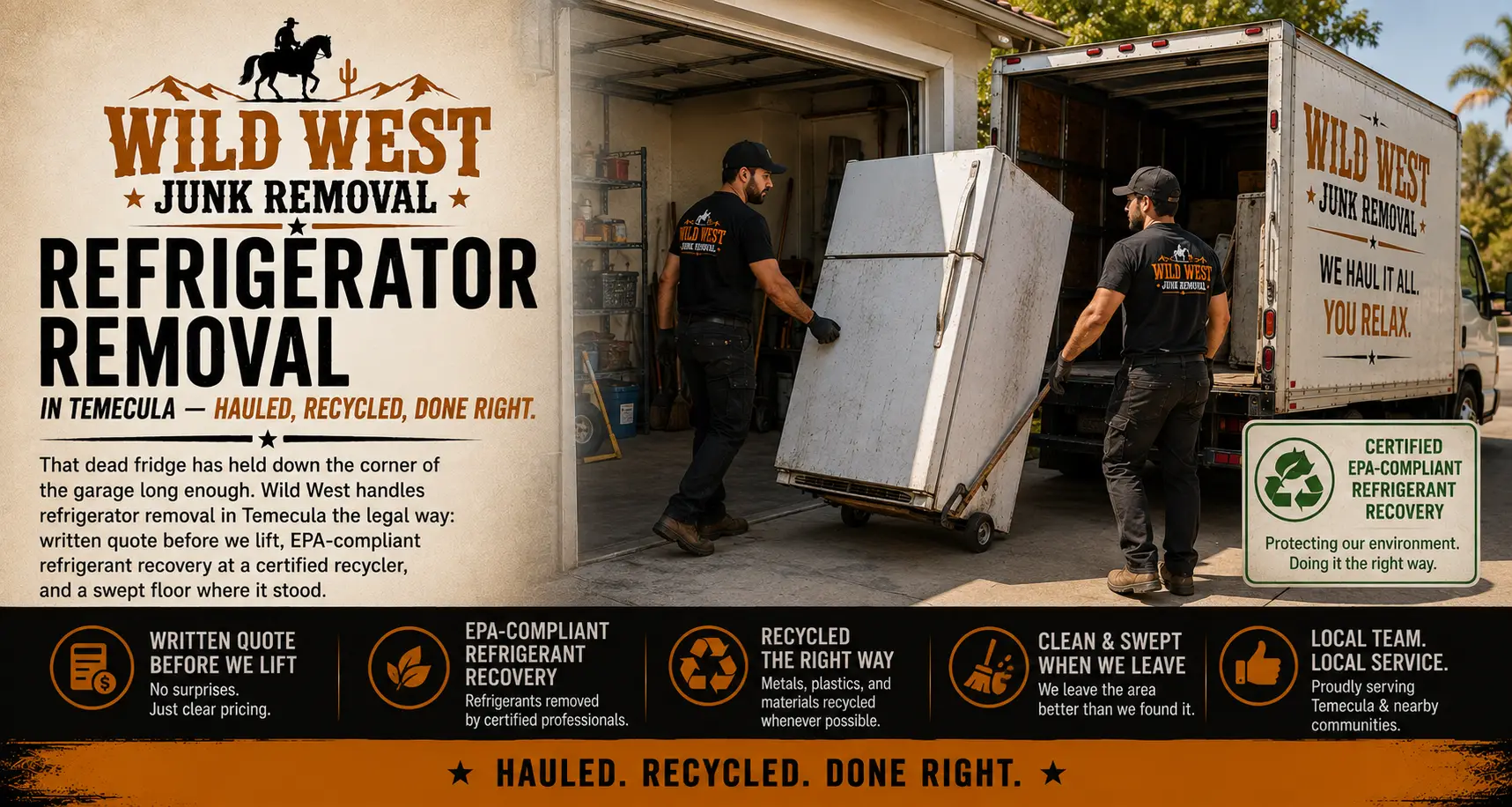
That dead fridge has held down the corner of the garage long enough. Wild West handles refrigerator removal in Temecula the legal way: written quote before we lift, EPA-compliant refrigerant recovery at a certified recycler, and a swept floor where it stood.
Licensed & Insured · EPA Section 608 Compliant Disposal · Family-Owned Since 2021 · Same-Day Often Available
Refrigerator Removal Temecula
A Fridge Isn't Just a Heavy Box
Most people size up appliance removal in Temecula as a muscle problem. Get two strong backs, wrestle the thing to the curb, done. That assumption quietly costs folks around here money every year, because a refrigerator is not furniture. It is a sealed pressure system carrying regulated refrigerant, a compressor full of oil that has been absorbing that refrigerant for a decade, foam insulation blown with ozone-depleting agents, and in the older units, mercury. Every one of those has to come out at a certified facility before the steel and copper are legally allowed near a scrap yard.
Under EPA 40 CFR Part 82, Subpart F — Section 608 of the Clean Air Act — the last person in the disposal chain has to verify the refrigerant was recovered before the unit gets scrapped. That obligation rides along with the appliance. It does not stop at the tailgate of whoever hauled it. Hire the wrong guy off a marketplace listing and the exposure follows you, not him.
California stacks a second layer on top through the DTSC Certified Appliance Recycler (CAR) Program. A facility has to hold CAR certification, document removal of every Material Requiring Special Handling, and file annual reports with the state. No CAR status means no legal path to process a refrigerator in California. Period.
Every fridge removal in Temecula we run ends at a recycler clearing both bars: federal Section 608 and California DTSC. That is not a badge on a website. It is the only legal route, and it is the whole difference between a real appliance removal service and someone who plans to figure out the disposal part after your money clears.
Riverside County Environmental Health lands in the same place. Major appliances hold materials that have to be pulled before anything is crushed, baled, or shredded, and scrap yards that accept unprocessed units carry their own regulatory exposure. That is exactly why legitimate recyclers only take fridges a certified appliance recycler has already handled. The chain of compliance starts with the truck sitting in your driveway.
Who's Behind the Truck
Weston Molitor, Founder
Wild West is not a franchise call center routing your address to whichever contractor bid lowest this week. It is a Temecula family business, and the founder still answers the phone.
Weston Molitor
Founder · Wild West Junk Removal · Temecula, CA
Weston started Wild West in 2021 out of Temecula with one truck and a simple rule: the number you hear on-site is the number you pay. Five years and a few thousand hauls later, that rule has not moved, and neither has the crew's habit of sweeping the floor before they roll out.
Appliances are where that discipline actually shows. A fridge is the easiest item on a junk truck to cheat on, because nobody follows the truck to the recycler. Weston built the disposal side of this business around DTSC-certified appliance recyclers specifically so there is a paper trail behind every unit that leaves a Temecula driveway on his trailer.
Call or text him a photo at (951) 837-8072 and you will usually get a ballpark back the same day.

"We go the extra mile. Not just hauling out your junk, but sweeping the floors underneath. You'll have a clean, ready space the same day we leave."
Weston Molitor, Founder, Wild West Junk Removal
The Process
How Appliance Removal in Temecula Works
Five steps from "it's been there three years" to a clean floor and a receipt. You point. We lift, haul, and carry every legal obligation that comes attached to it.
Empty and Prep the Unit
Pull all the food, shelves, and crisper drawers. Unplug it a few hours ahead. Disconnect the ice-maker line and keep a towel close, because there is always residual water in it. Defrost anything standing in the freezer.
Text a Photo for a Ballpark
Send a photo of the appliance and where it sits to (951) 837-8072. Show the path to the door, flag the tight spots, and say whether stairs are involved. You get a price range back before you commit to anything. No deposit.
Lock Your Window
Book same-day or pick a slot Monday through Saturday, 7AM to 7PM. The crew calls about fifteen minutes out. Clear the driveway and the lane from the appliance to the exit, and move the cars so the truck has room to back in.
Written Quote On-Site
Before anybody lifts a thing, the crew sizes up the load and hands you a firm written price. Labor, fuel, certified disposal, and any stair carry are all in that number before you approve it. Nothing gets tacked on once it is on the truck.
Load, Sweep, Recycle
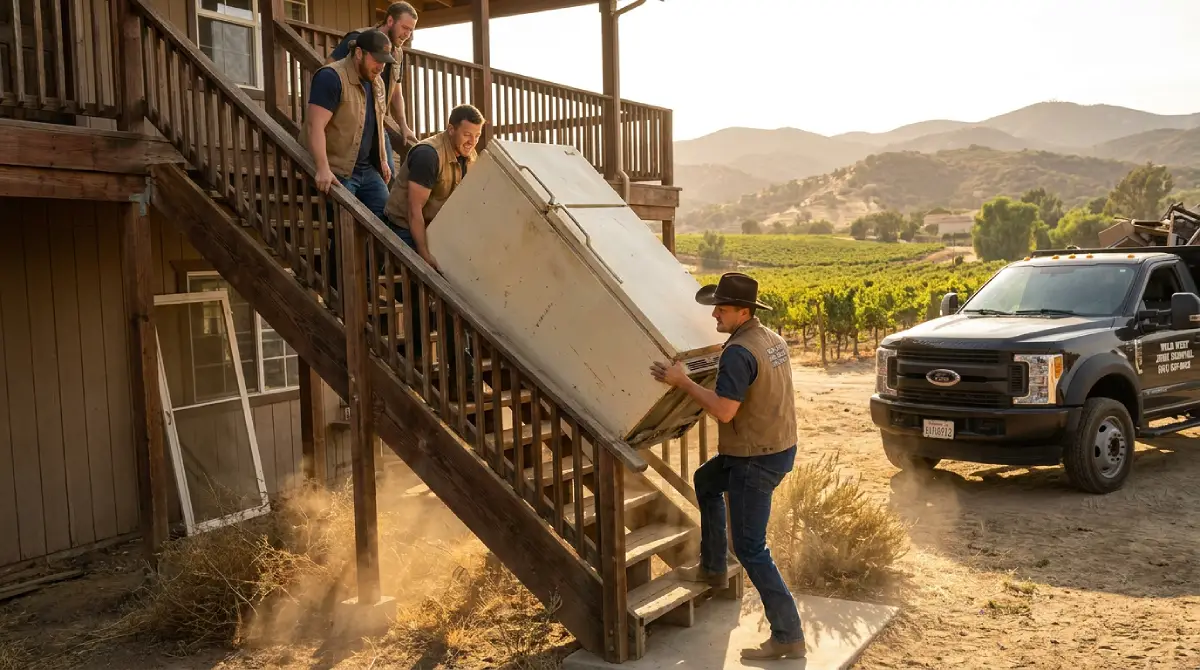
The crew takes the stairs, the hallways, the second-floor laundry rooms, then sweeps the spot where it stood. The unit heads to a DTSC-certified recycler. Refrigerant recovered, floor clean, done.
Appliance Removal Temecula
Every Appliance. Every Size.
Wild West covers the full range of appliance hauling in Temecula and across the Valley. Stack a multi-appliance load into a single trip for the best rate. Volume pricing rewards a full truck, not a busy schedule.
Refrigerator Removal
Top-freezer, bottom-freezer, side-by-side, French door, counter-depth, built-in. Every layout. Pre-1994 units still running R-12 get routed to recyclers certified for ozone-depleting recovery. Same written quote, whatever the vintage.
Chest and Upright Freezers
A standalone freezer carries the same Section 608 disposal rules as a full fridge. The deep freeze that quit two summers ago and became a garage shelf is one of the most common fridge removal Temecula calls we run all year.
Wine Coolers and Mini-Fridges
Under-counter wine fridges, beverage centers, and dorm-style mini-fridges all hold refrigerant and need certified handling. Utility rebate programs generally skip units this small. We take them anyway.
Washers and Dryers
Bundle the laundry pair with a fridge haul and you almost always come out ahead of running two trips. Disconnect from the water and power lines before the crew rolls up and we handle it from the wall out.
Ranges, Ovens, and Dishwashers
Gas lines have to be capped before a range goes. We haul, we do not disconnect gas. Tell us it is a gas appliance when you call and we will point you toward who caps it first if that is not handled yet.
Window and Portable AC Units
Window and portable air conditioners fall under the same Section 608 rules as refrigerators, for the same reason: sealed refrigerant. The scrap value in the metal can offset part of the disposal, so mention them when you describe the load.
Commercial Refrigeration
Reach-ins, bar coolers, prep tables, and walk-in components out of restaurant and retail moves around Old Town and the Promenade. Commercial appliance hauling in Temecula is quoted case by case. Have the unit dimensions and the refrigerant type off the data plate ready when you call.
Multi-Appliance Loads
A fridge with a washer, dryer, range, and an old window AC in one load beats four separate trips nearly every time. Volume pricing rewards a full truck. List the whole pile when you call and the estimate reflects it.
Before the Crew Arrives
Empty the fridge all the way: food, shelves, drawers, ice. Defrost standing water. Disconnect the ice-maker line and keep a towel ready. If it is still running, unplug it a few hours out so the compressor pressure normalizes. None of this takes more than ten minutes, but skipping it adds time at the truck and can move the final number.
Mention the stairs when you call. Carrying an appliance up or down a flight runs $150 on loads up to a half truck load and $300 on loads over a half load. That figure is written into the on-site quote before anything moves, never added afterward.
Who We Help
Who Calls Wild West — and Why They Call Back
Homeowners and Sellers
Swapping in a new fridge, or clearing the house before close of escrow. This is the bread-and-butter call: one appliance, usually the garage, a few years overdue. Temecula listing agents send sellers our way because an appliance graveyard in the garage tanks buyer first impressions fast.
Renters and Apartment Tenants
Move-out clauses in a lot of Temecula and Murrieta complexes bill leftover-appliance fees per piece, and those numbers add up against a deposit fast. One Wild West haul covering everything usually beats eating the charge. We work gated lots, elevator buildings, and third-floor walk-ups.
Property Managers and Landlords
Between tenants, a dead fridge is a vacant day you cannot list around. We clear it fast so the unit gets cleaned, photographed, and back on the market. Managers across Murrieta and French Valley keep this number on file for exactly that reason.
Businesses Relocating
Breakroom fridges, commercial freezers, and under-counter units out of an office or restaurant move. Commercial appliance hauling runs the same as residential: written quote on-site, volume pricing, certified disposal on every unit.
Estate Cleanouts
Estates tend to have appliances scattered across the main house, the garage, and a shed out back that nobody has opened in years. We pull the whole load in one trip and steer anything still running toward a donation partner before it heads to the recycler.
Moving Day Cleanouts
Book us for the back half of moving day, after the movers grab the keepers. The crew loads whatever is left, the fridge the buyers did not want and the rusted patio set, while you walk the final inspection.
Read Before You Book
What's Actually Inside Your Old Fridge
Every refrigerator built since the 1950s holds at least one regulated material, and most hold several. That is the reason California and federal law treat refrigerator removal and appliance removal differently from a standard trash pickup.
CFC Refrigerant (R-12)
Anything built before 1994. Ozone-depleting under the Montreal Protocol. Recovery by Section 608-certified technicians is federally required before the shell can be scrapped.
HCFC Refrigerant (R-22)
Mid-1990s through the early 2000s. Still ozone-depleting, still regulated. We pull these out of Temecula garages constantly, usually the unit that became "temporary storage" back when the kids were in grade school.
HFC Refrigerant (R-134a)
The modern standard. Not ozone-depleting, but a greenhouse gas roughly 1,430 times as potent as carbon dioxide. Section 608 recovery still applies under 40 CFR Part 82, Subpart F.
Compressor Oil
The compressor runs on mineral or synthetic oil that soaks up refrigerant over the years. It is a hazardous material in its own right and has to be drained and managed separately before the metal moves anywhere.
Foam Insulation
Units built before roughly 2005 used HCFC-141b as the foam blowing agent. Shred that foam and it off-gasses. Certified recyclers contain it before anything gets crushed.
Mercury Switches
Pre-2000 models often hide a mercury tilt switch in the door-light circuit. The California DTSC CAR Program requires documentation and proper disposal of every mercury component.
PCB Capacitors
Old motor-start capacitors can contain polychlorinated biphenyls. Any pre-1980 unit gets treated as if it does and goes to a certified recycler. No shortcuts on those.
Recoverable Metals
The steel, copper, and aluminum carry real scrap value, but only after every hazard above comes out first. That sequence is exactly why an unlicensed fridge haul is a liability, not a bargain.
| Your Option | Works For | The Catch |
|---|---|---|
| City curbside trash | Nothing with refrigerant | Refrigerators, freezers, wine coolers, and window AC units are excluded outright. The truck will leave it at the curb. |
| Haul it yourself to a county facility | A working truck, a helper, and a free Saturday | Unit must be fully emptied and defrosted, and you are handling the load-out, the straps, and the doorway on your own. |
| Utility recycling pickup | Working full-size units only | Program rules change year to year, size minimums apply, and mini-fridges and dead units generally do not qualify. |
| Retailer haul-away on delivery | Like-for-like swap on delivery day | Only the one unit being replaced, only on the delivery window, and the old garage fridge never counts. |
| Marketplace hauler | Nothing you want your name attached to | No certified disposal chain, no paper trail, and Section 608 liability follows whoever hired the truck. |
| Wild West Junk Removal | Any appliance, any condition, any floor | Written quote on-site before loading, DTSC-certified recycler on the back end, floor swept before we leave. |
Why Proper Disposal Pays
The Real Cost of Cutting Corners
When refrigerator removal starts feeling pricey, dumping it somewhere else starts looking tempting. The math flips the second you see what California actually charges for that.
$10,000
Maximum fine per illegal dumping incident, California Penal Code 374.3
A refrigerator dropped on a roadside easement, an empty lot, or somebody else's property is a misdemeanor in California, and courts can attach fines up to $10,000 per incident, with jail time on the table for repeat offenders. Riverside County code enforcement has leaned harder into appliance dumping lately, and cameras are now routine near the repeat fly-dump spots along the Temecula and Menifee corridors. One Wild West haul costs a sliver of one enforcement fine. Call us first.
The Riverside County Illegal Dumping Task Force works off public tips and keeps reporting tools live year-round. Refrigerators and freezers sit near the top of the reported-items list for an obvious reason: they are big, identifiable, and almost always left near a road with a clean line of sight to a camera. A single legitimate haul runs less than what a property owner pays to deal with an abandoned appliance somebody left on their land.
Before You Book
Fridge Removal Prep Checklist
Ten minutes of prep the night before keeps the on-site quote sitting right where the estimate landed. Run the list.
Empty it completely. Food, condiments, shelves, crisper drawers, all out before the crew arrives.
Unplug several hours early so compressor pressure settles and the door seals let go easier on the carry-out.
Disconnect and flush the ice-maker supply line. Towel nearby, because there is residual water in that line every single time.
Defrost standing water in the freezer. Riverside County facilities reject units with liquid still inside.
Clear a three-foot lane from the appliance to the front door. Rugs, boxes, and furniture out of the way.
Move the cars out of the driveway so the truck pulls in clean and does not have to block the street.
Say whether stairs are involved. A stair carry is $150 on loads up to a half truck load, $300 over a half load, quoted in writing before loading.
Note the other tight spots: narrow doorways, a 90-degree turn, a low garage header. The crew brings blankets and frame protectors.
Text a photo to (951) 837-8072 first. It tightens the on-site quote and tells the crew which dolly to load.
Decide if anything else rides along: washer, dryer, range, a window AC. Combined loads beat separate trips per piece.
Have someone on-site who can approve the written quote. After that you are free to step away and they will flag you when it is done.
What Neighbors Say
Temecula Reviews — In Their Own Words
Verbatim reviews from verified Google customers of Wild West Junk Removal.
★★★★★
They were amazing! Answered their phone promptly. Came exactly when they said they would be there! Was so gracious and nice! They had everything loaded quickly and the areas around very tidy. The price was good, all in all, the nicest experience ever. If you need things removed, I definitely recommend Wild West.
★★★★★
I had an amazing experience with Nick and his crew- Wild West Junk Removal from start to finish, the team was professional, punctual, and incredibly efficient. They arrived right on time, were friendly and respectful, and made the entire junk removal process quick and stress-free. They handled everything with care and left the area spotless. Pricing was fair and transparent, with no surprises. I highly recommend them to anyone looking for reliable and hassle-free service — I'll definitely be using them again in the future!
★★★★★
Wild West Junk Removal is the real deal! They showed up on time, worked fast, and were super professional. The crew was friendly, respectful, and went above and beyond to make sure everything was cleaned up perfectly. I couldn't believe how quickly they got the job done. Fair prices, great service I highly recommend them to anyone needing junk gone fast. Will definitely be using them again!
★★★★★
Best junk removal ever! Fast affordable and friendly choose Wild West for your next haul pardner!! Heeeee!! Haw!!!
Common Questions
Refrigerator Removal Temecula — FAQ
Pricing is based on volume, meaning how much room your load takes up in the truck, not a per-item menu. Text a photo to (951) 837-8072 for a same-day ballpark, then the crew hands you a firm written number on arrival before anyone lifts a thing. That figure covers labor, fuel, and certified disposal, and there is no separate refrigerant fee added afterward.
No. California bars refrigerators from regular trash because they hold regulated refrigerant, so curbside crews in Temecula and Murrieta will not take one. Leaving it on a public easement or vacant lot is illegal dumping under California Penal Code 374.3, with fines that can reach $10,000 per incident, and the Riverside County Illegal Dumping Task Force follows up on appliance reports near roadways.
Yes. Every unit goes to a California DTSC Certified Appliance Recycler, where refrigerant is recovered by EPA Section 608 certified technicians under 40 CFR Part 82, Subpart F. Compressor oil is drained, mercury switches are pulled from older units, and foam insulation is contained. Nothing is vented and nothing is dumped.
Refrigerators of every layout including top-freezer, bottom-freezer, side-by-side, and French door, plus chest and upright freezers, wine coolers, mini-fridges, washers, dryers, dishwashers, ranges, wall ovens, and window AC units. Restaurant reach-ins and bar coolers are handled case by case. Text a photo and we send back a same-day ballpark.
Yes. Hazardous material falls outside what a standard hauler is permitted to transport, so wet paint, solvents, motor oil, pesticides, pool chemicals, asbestos, and propane tanks have to go through Riverside County household hazardous waste collection instead. Refrigerators are a separate case and are accepted: the refrigerant is recovered under EPA Section 608 rather than landfilled. If something in the pile is questionable, text a photo to (951) 837-8072 before the truck is scheduled and you will get a straight answer.
Yes. Riverside County waste facilities will not accept an appliance that still has contents, so food, shelves, drawers, and ice must come out. Unplugging the unit about twenty-four hours ahead gives it time to defrost fully, which keeps meltwater off your floor during the carry-out. Disconnect and drain the ice maker line and defrost any standing water in the freezer. It takes about ten minutes and keeps the recycler from rejecting the load.
Often, depending on truck space that day. Wild West runs Monday through Saturday, 7AM to 7PM. Call or text (951) 837-8072 before noon on a weekday and a morning call usually turns into same-day or next-morning service across Temecula and Murrieta. Outlying areas such as Aguanga, Anza, or Fallbrook depend on where the route already runs that day.
Yes. Packed garages, second-floor laundry rooms, tight Old Town hallways, gated complexes, and elevator buildings are all standard work, and the crew brings appliance dollies, straps, and moving blankets. Carrying an appliance up or down stairs runs $150 on loads up to a half truck load and $300 on loads over a half load, written into the on-site quote before anything moves. Flag stairs, a tight 90-degree turn, or a low garage header on the first call so the crew brings the right gear and finishes in one trip.
It goes to a certified recycler, not a landfill. Refrigerant is recovered by Section 608 technicians, compressor oil is drained, and mercury switches in pre-2000 units are removed under the California DTSC Certified Appliance Recycler Program. Foam insulation is contained. Only after every regulated material is out does the steel, copper, and aluminum shell get recycled as scrap.
If it runs and is under roughly 15 years old, mention it when you book. We route working appliances to local donation partners when they will take them, and a donated unit is charged at the haul rate only, not haul plus disposal. Donation centers set their own standards, so it is not guaranteed, but it is always worth asking before a good fridge heads to the scrap line.
Yes. A unit that no longer runs still holds recoverable steel, aluminum, copper, and plastic, and it still holds refrigerant that has to be pulled before anything is crushed. Broken fridges are handled exactly like working ones: refrigerant recovered under EPA Section 608, compressor oil drained, then the shell goes to a scrap processor. Whether the compressor works makes no difference to the price or the pickup.
Yes, and it is almost always the better deal per piece. A fridge plus a washer, dryer, range, or window AC unit in one load beats separate trips because volume pricing rewards a full truck. Describe everything that needs to go when you call and the estimate reflects the combined load.
Yes. Breakroom fridges, commercial reach-ins, bar coolers, and under-counter units from offices, restaurants, and retail moves around Old Town and the Promenade are all regular work. Commercial appliance hauling runs the same way as residential: a written quote on-site, volume pricing, and certified disposal on every unit.
Someone needs to be on-site to approve the written quote before the crew starts loading. After that you are free to step away and they will let you know when the space is swept and the truck is loaded. For vacant rentals and estate properties, lockbox and gate-code arrangements work fine as long as the quote is approved by phone first.
Temecula and Murrieta are the core service area, with regular runs through Menifee, Wildomar, Winchester, French Valley, Lake Elsinore, and Canyon Lake. De Luz, Rainbow, and Fallbrook are covered depending on the day's route. Wild West is based at 41713 Niblick Rd in Temecula, so most Valley addresses are a short run rather than a trip in from out of the area.
Call or text (951) 837-8072 with a photo of the appliance and where it sits in the house. You get a price range back before committing to anything, and no deposit is taken. Same-day often works if the truck still has room; otherwise pick a window Monday through Saturday, 7AM to 7PM. The crew calls about fifteen minutes out, and the written quote is confirmed on-site before a single item is loaded.
Yes. Wild West is a licensed and insured family-owned business founded in Temecula in 2021 by Weston Molitor. That matters more on appliance work than on a couch haul, because refrigerant disposal liability under Section 608 follows the person who hired the hauler. Ask any appliance removal service where the unit goes after pickup, and only take a named certified recycler for an answer.
Ready to Haul That Fridge?
Text a photo to (951) 837-8072 and get a ballpark in minutes. Written quote on-site before we lift a thing. Same-day often available across Temecula and Murrieta.
Sources & References