
Green Waste · Branches · Palm Fronds · Temecula & Southwest Riverside County
Yard Waste Removal in Temecula
Yard waste removal in Temecula starts at $195 for a quarter load, about 3 cubic yards of branches, brush, palm fronds or clippings, loaded by our two-person crew and taken to green-waste recycling instead of the landfill. A full 12-yard trailer is $595. Text a photo to (951) 837-8072 and you get a firm price before we roll out, with same-day slots most days, Monday through Saturday.
Family-owned in Temecula since 2021 · Licensed & insured · 5,000+ loads since 2021
Wild West Junk Removal · 41713 Niblick Rd, Temecula, CA 92591 · (951) 837-8072 · Mon to Sat: 7AM-7PM · Sun: Closed · Family-owned and operated by Weston Molitor since 2021
Yard Waste Removal Cost
How Much Does Yard Waste Removal Cost in Temecula?
Yard waste removal in Temecula costs $195 for a quarter load, $350 for a half load, $495 for three-quarters and $595 for a full 12-yard trailer. Loading, the drive and green-waste disposal are inside that number.
I price green waste the same way I price everything else: by how much of the trailer your pile fills. Not per bag, not per branch, and not by the hour. Green waste has no item surcharge of its own, so the starting price is the $195 minimum. The catch with yard waste is that it's mostly air. A pile of oleander cuttings that looks like an afternoon of work can take up more room than a couch, so a photo with something in the frame for scale tells me more than a description ever will.
Quarter Load
About 3 cubic yards
$195
About 1½ full-size pickup beds · minimum pickup
Half Load
About 6 cubic yards
$350
About 3 full-size pickup beds
Three-Quarter Load
About 9 cubic yards
$495
About 4 to 5 full-size pickup beds
Full Load
12 cubic yards
$595
About 5 to 6 full-size pickup beds
Lowest price per yard
Every load includes a two-person crew, loading by hand, cutting long limbs down to fit the trailer, raking and sweeping the spot where the pile sat, fuel, and the disposal fee. No per-bag charge, no dump fee added later, and no deposit.
What Add-Ons Can Change the Price?
Five things can, and you hear about each one before we load anything.
- Heavy material
- Sod, dirt, rock and wet root balls can move the price, because the landfill bills us by the ton and a trailer of dirt weighs several times what the same space of brush does. If your pile is mostly heavy material, I say so on site and give you the number then.
- Stairs
- $150 on loads under 7 cubic yards, $300 on loads of 7 cubic yards or more. The $300 replaces the $150. No stair charge with an elevator.
- Appliances
- $30 each for a fridge, freezer, or AC unit that rides in the same load, for refrigerant recovery.
- Mattresses
- $15 per mattress. Box springs carry no fee but count toward the load volume.
- Extra loading time
- A full load includes one hour of loading. Past that, $75 per hour per crew member.
A full load is 12 cubic yards in our 12ft × 8ft × 4ft dump trailer, loaded by a two-person crew.
Here's how the number works. Text a photo and you get a load size and a firm price before we roll out. On site we confirm what the photo showed: if it comes in smaller, you pay the smaller price; if the pile grew, we re-quote before anything goes on the trailer. Nothing is added after loading starts. No deposit.
The full ladder and every surcharge are on the junk removal prices page. Prices current as of October 2026.
What We Haul
What Yard Waste Will You Haul?
Anything that grew in your yard and is already on the ground: branches, brush, palm fronds, hedge cuttings, leaves, dead shrubs and sod. We load it loose, so there's nothing to bag or bundle first.
Most of what we haul in Temecula comes off three kinds of properties. The master-planned streets in Redhawk, Harveston, Vail Ranch and Paloma del Sol, where mature palms and ficus drop a steady load. The bigger lots out toward Wine Country off De Portola and Rancho California Road, where a single pruning day fills a trailer. And the older parts of Murrieta off Jefferson and Kalmia, where forty-year-old shrubs finally get pulled. The material changes from one to the next. The job doesn't.
Do You Haul Tree Branches and Limbs?
Yes: pruning piles, storm limbs, eucalyptus and pepper tree limbs, and trunk sections two of us can lift. Long limbs get cut down on site so they fit the trailer.
Do You Take Palm Fronds and Palm Skirts?
Yes, and it's one of our most common single loads. Fan palm skirts and Mexican fan and queen palm fronds are spiny and far too big for the green cart.
Do You Take Brush and Hedge Cuttings?
Yes: oleander, bougainvillea, juniper, rosemary, ivy and whatever the hedge trimmer took off. Thorny stuff is fine; we wear the gloves.
Do You Take Leaves, Needles and Grass Clippings?
Yes, loose or bagged. Paper or plastic bags both ride; we empty nothing at your curb.
Do You Haul Sod and Old Landscaping?
Yes: sod from a lawn tear-out, dead turf, dead shrubs with root balls, and moderate amounts of soil or river rock. Heavy loads get priced for weight, and you hear that first.
Do You Clean Up After a Windstorm?
Yes. After a Santa Ana the pile is rarely just green waste. Limbs, fence pickets, a shredded patio umbrella and a neighbor's trash can all go in one load.
Can Old Planters and Patio Junk Ride Along?
Yes, at no extra charge. Cracked pots, a rusted fire pit or a dead patio set go in the same load and get sorted at the trailer.
Do You Take Railroad Ties and Landscape Timbers?
Yes, but they're treated wood, not green waste. We keep them out of the organics and take them to a landfill approved for treated wood.
Do You Take Bamboo, Cactus and Agave?
Yes. They're awkward and the spines go through gloves, but they load like any other green waste. Send a photo, because a dead agave takes more room than people think.
What Won't You Haul With a Yard Waste Load?
We won't take garden chemicals, standing trees, or stumps still in the ground. Half-used pesticide and herbicide jugs, pool chemicals, fertilizer with weed killer in it and gas cans with fuel in them are household hazardous waste, and none of it can ride in the load at any price.
Riverside County runs free household hazardous waste drop-offs for residents. Pesticides, pool chemicals and fuel go there, in their original containers, not in your trash cart and not in our trailer.
- Trees still standing. We don't take down standing trees; that's work for a qualified, licensed tree contractor. In Temecula, a tree covered by the city's Protected Tree Ordinance can't be cut or removed without a city permit, so check before anyone starts. Once the tree crew is done, we haul what they leave.
- Stumps in the ground. We don't dig or grind stumps. A stump that's already out of the ground loads like any heavy piece, and after a stump grinder has been through, we can haul the grindings.
- Brush that still has to be cut. Clearing a lot or a hillside for a fire notice is our weed abatement service in Temecula, where the crew cuts and hauls in one visit.
How It Works
How Does a Yard Waste Pickup Work?
You text a photo, we text back a firm price, you pick a time, and our two-person crew loads, rakes and hauls the pile in one visit, usually the same day or the next.
What Do You Text Us First?
Two or three wide photos of the pile with something in the frame for scale, the address, and where the pile sits: backyard, side yard, slope or curb. Gate codes help too. Text (951) 837-8072.
When Do You Get the Price?
Before we roll out. You get the load size and a firm price from the photo, and on site we confirm it before anything moves.
What Does the Crew Do on Site?
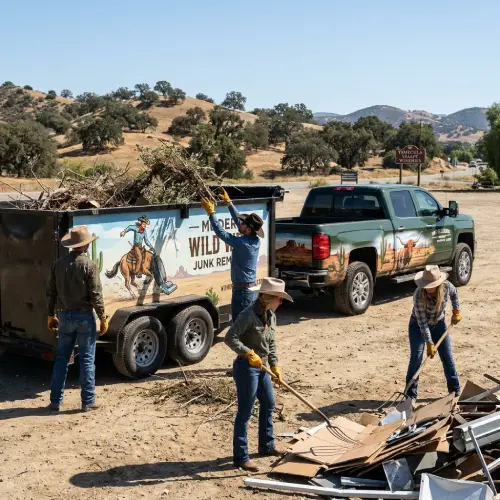
We cut fallen limbs into trailer-length sections, load heavy wood on the bottom and brush on top so nothing sticks out past the trailer, then rake and sweep where the pile sat. You don't have to drag anything to the curb.
Where Does the Load Go When We Leave?
Green waste goes to green-waste recycling. Anything else in the load gets sorted out first. The details are in the next sections.
Most of the work on a yard job is the carry, not the cutting. A three-foot side yard between a stucco wall and a block fence is normal in Temecula tracts, and it's where most of a crew's time goes. If the pile is spread across the backyard, say so. If there's a gate code or an HOA gate guard, send it with the photos so the crew isn't parked outside waiting.
Two things save time on your end. Point out drip lines, sprinkler heads and landscape lights near the pile before we start, since a buried drip line is easy to snag with a rake. And if a landscaper is doing the cutting, ask them to leave the pile near the gate or driveway instead of scattered across the lot. Same volume, faster load.
What Changes the Price
What Makes Yard Waste Removal Cost More?
Volume first, then weight, stairs and loading time. In Temecula the volume of loose brush is what surprises people, and dirt or sod is what moves the price past the bracket.
Why Does a Brush Pile Take More Room Than It Looks?
Because branches lock together and trap air. A pile that's four feet high in the yard can fill more trailer than its weight suggests, and palm fronds are the worst for it. We pack the load as tight as we can by hand, but the price follows the space the load takes up in the trailer, which is why I ask for wide photos instead of a description.
Do Sod, Dirt and Rock Cost More to Haul?
Yes, when they're most of the load. The landfill charges us by the ton, and a trailer of sod and soil from a lawn tear-out in Harveston weighs far more than a trailer of hedge cuttings. A few root balls mixed into a brush pile don't change anything. A pile that's mostly dirt does, and you hear that number before we load.
Do Slopes, Side Yards or Stairs Cost Extra?
A long carry across a flat yard is free. Stairs aren't: $150 on loads under 7 cubic yards and $300 on loads of 7 cubic yards or more. That applies when the pile sits up or down a set of steps, which is common on the hillside lots in Redhawk and Crowne Hill. A walkable slope with no steps isn't a stair charge.
When Does Extra Loading Time Apply?
Only on a full load that takes more than the hour it includes, at $75 per hour per crew member. That's rare on a pile that's already cut and stacked. It comes up when we're raking leaves and clippings scattered over a big lot, and it goes in your quote before we start.
Is It Cheaper to Stack the Pile Before We Come?
A little, and mostly in time. One pile near the gate loads faster than five piles around the yard, and limbs stacked in one direction pack tighter than a tangle. Don't bag loose brush to make it neater. Bags add volume and we just empty them.
When You Don't Need Us
When Don't You Need Us for Yard Waste?
When it fits in your green cart over a week or two, you don't need us. Temecula's green organics cart comes with your CR&R service at no extra charge, and that's the cheaper move for a normal week of trimmings.
I tell people this on the phone all the time. Since SB 1383 took effect in Temecula, the green cart takes yard trimmings and food scraps, and CR&R empties it on your regular collection day. If your pile is a few hedge trimmings and a bag of leaves, cut it to fit and feed it in over two or three pickups. Fronds, sod and treated wood are where people get tagged, and the rules on those are in our guide to what goes in the Temecula green waste bin.
- ✓A week of trimmings. Use the green cart. It's already paid for.
- ✓The Christmas tree. CR&R picks up stripped trees at the curb for a few weeks after December 26. Dates and the flocked-tree rule are in our guide to Christmas tree disposal in Temecula.
- ✓You have a pickup and a free Saturday. Clean branches and brush can go to a green-waste recycler such as Agriscape on Borel Road in Murrieta or B.P. John Recycling on Matthews Road in Romoland, and Lamb Canyon Landfill in Beaumont takes green waste at a county rate. Call ahead, because what each one accepts, especially palm fronds, leaves and mixed loads, and what it charges a landscaper can change. If you can load it yourself, it costs less than we do.
- ✓Leaves on a big lot. Shredded leaves make good mulch under trees and shrubs. Not everything has to leave the property.
- ✓You can wait for the right month. A pile cut in March doesn't have to sit until June. Our Temecula yard waste calendar shows which weeks book easily and which ones fill up.
Where we do make sense: a pile bigger than a few cart loads, palm skirts and fronds the cart won't take, storm limbs you want gone today, or yard waste mixed with junk that the cart was never meant for. And if the City of Temecula sent you a weed abatement notice, you need clearing, not only hauling. The city's weed abatement program inspects in late winter and early spring and mails notices with a deadline, and our weed abatement crew handles the cutting and the haul together.
Where It Goes
Where Does Your Green Waste Go After Pickup?
Clean green waste goes to green-waste recycling, where it's ground into mulch and compost instead of being buried as trash. Palm fronds, treated wood and any junk in the load get sorted out first and go where each one is accepted.
California made this the rule, not a nice extra. Under SB 1383, the state set a target of 75% less organic waste going to landfills by 2025, because yard trimmings and food rotting in a landfill give off methane. CalRecycle counts organics like yard trimmings, food, paper and cardboard as about half of what Californians dump. Branches off your slope are exactly what that law is about.
Yard trimmings are organic waste under the law. That's why we keep green waste separate from junk at the trailer.
The difference that matters is between a green-waste processor and a landfill. A landfill or transfer station takes trash. A processor only takes clean material it can grind into mulch, and a load with fronds, dirt or junk mixed in can be turned away or charged as trash. That's why the sorting happens at the trailer, before anything leaves your yard.
What Happens to Palm Fronds and Treated Wood?
They're kept out of the clean green waste and go somewhere different. Palm fronds, bamboo and cactus wrap around grinders, so a lot of green-waste processors won't take them, and they go to a facility that has confirmed it accepts them, which is often the landfill. Railroad ties and pressure-treated landscape timbers are treated wood waste under DTSC rules. They can't be burned or mixed with other wood, and they go only to a landfill authorized to take them. The state Water Board's list of treated-wood landfills includes Lamb Canyon, Badlands and El Sobrante here in Riverside County.
What Happens to the Junk Mixed Into a Yard Load?
It gets sorted out at the trailer. Metal like an old fire pit or patio frame goes to scrap. A patio set or planters still in good shape go to the charities and recyclers on our list of donation and recycling partners in Temecula. What's left goes to the landfill.
Service Area
Do You Haul Yard Waste in Murrieta and Menifee?
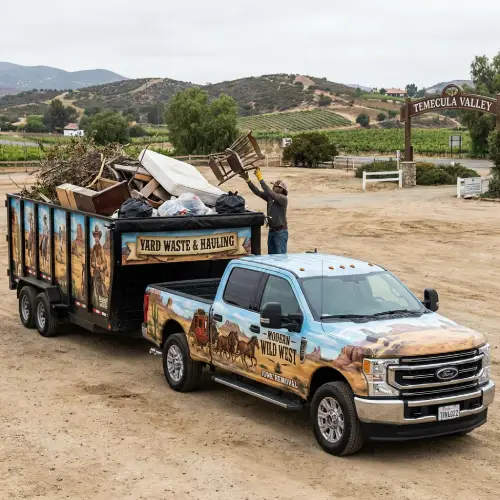
Yes. We haul yard waste in Temecula, Murrieta, Menifee, Wildomar, Winchester, French Valley, Lake Elsinore, Canyon Lake and Hemet at the same prices, and we also run out to De Luz, Rainbow and Fallbrook.
We're based on Niblick Road in Temecula, which puts most Murrieta addresses fifteen minutes out. There's no travel charge for crossing Winchester Road. What changes from city to city is the kind of pile. Murrieta's newer tracts off Clinton Keith tend to be lawn tear-outs and storm debris. Murrieta's older streets off Jefferson and Kalmia lean toward mature-landscape jobs: forty-year-old shrubs, big eucalyptus and pepper limbs, and decades of ivy. Each city has its own page with local details: Temecula junk removal, junk removal in Murrieta and Menifee junk removal.
Who Shows Up
Who Shows Up to Clear the Yard?
A two-person Wild West crew out of Temecula: family-owned since 2021, licensed and insured, with 5,000+ loads hauled. The person who quotes you is part of the crew that loads it.
Who Is Weston Molitor?
Founder · Wild West Junk Removal · Temecula, CAI started Wild West in 2021 with one dump trailer, and I still answer the phone. Yard waste is a big part of what we do, because it's the job people put off longest. The cutting gets done on a Saturday and the pile sits behind the shed until it's dry, brittle and a fire risk.
We don't subcontract green waste to anybody. My crew shows up when we said we would, the price you agreed to is the price you pay, and we leave the spot raked and swept.
"The cutting isn't the job. Getting it out of the yard is the job. Send me a wide photo of the pile and I'll tell you the load size and the price before we ever pull up."

Why Do Homeowners Call Us Instead of Making Four Dump Runs?
Because a strapped pickup bed holds about two cubic yards of loose brush, and one mature oleander hedge is more than that. Four trips to the county landfill, four waits at the scale and a bed full of thorns is a lost weekend. One visit from us usually fits inside the hour of loading a full load includes.
- ✓Same-day slots most days. Call or text early in the day, Monday through Saturday.
- ✓Firm price first. Load size and any add-ons confirmed before we lift anything.
- ✓Raked and swept. We leave the spot cleaner than the pile did.
What Do Customers Say About Our Yard Cleanups?
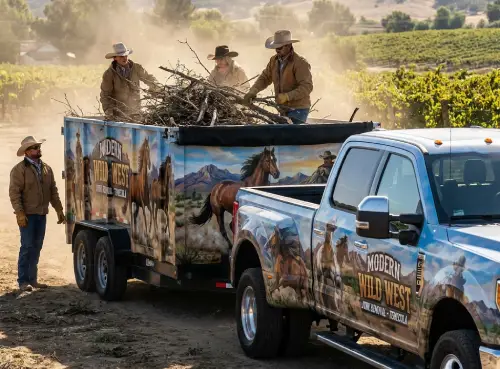
They say we showed up fast, cleared the yard and left it clean. Here are three Google reviews from customers who had yard debris hauled, copied exactly as they were posted.
★★★★★
Wild West Junk Removal did a wonderful job getting 2.14 tons of yard & construction waste off my property, including the demolition of a construction grade dog house. They communicated clearly, were super professional & got everything done fast. They left the space where the trash was clean of all debris and made our lives much easier. If you are looking for an honest and reputable company, they are the place to go to.
★★★★★
Wild West junk removal came to our house same day as called and cleared all the debris and junk we had cluttering up the front of our house. I would definitely use them again 100%
★★★★★
The Wild West crew showed up promptly and cleared my yard of some junk that’s been sitting there way too long. Highly recommended!!!
FAQ
What Else Do People Ask About Yard Waste Pickup?
No. Leave it loose in one pile if you can. We load branches, brush and fronds by hand and cut long limbs to fit the trailer. Leaves and clippings can be loose or bagged. Bagging brush only adds volume.
Usually, yes. We have same-day slots most days, Monday through Saturday from 7AM to 7PM. Call or text early in the day with a photo. The days right after a Santa Ana windstorm fill up fastest, so call the morning after, not the weekend after.
Yes, and that's a common call. Plenty of tree crews and gardeners cut and leave. Text a photo once they're done, or tell us the day they finish and we'll book around it. Ask them to leave the pile near the gate or driveway and it loads faster.
No. It's the same $195 to $595 load ladder as everything else we haul, priced by how much of the trailer it fills. The exception is heavy material: a load that's mostly sod, dirt or rock can cost more because the landfill bills by weight.
Yes. Wet clippings and a pile that's been composting behind the shed for a year both load fine. Wet material is heavier and messier, so it can take longer to load, but we still price it by volume unless it's mostly soil.
Yes. Landscapers use us to clear a job so their crew stays on billable work, and managers use us for rentals and common areas between tenants. If you manage several properties, our page on junk removal for property managers, Realtors and landlords covers how we work with you.
Yes, if the shed is already down. If it's still standing, that's outdoor structure removal in Temecula, where we take it apart and haul it. The yard waste can ride along in the same trailer, priced as one load.
Measure the length, width and height in feet, multiply them, and divide by 27. A pile 6 feet long, 4 feet wide and 3 feet high is 72 cubic feet, or about 2⅔ cubic yards, which is a quarter load. Brush settles when it's loaded, so a photo still gives you a more accurate price.
Not every tree. Temecula's Protected Tree Ordinance requires a city permit before a protected tree is cut, removed or relocated, and the city can designate a tree as protected regardless of its species or size. Check with the City of Temecula before the tree crew starts. We don't take down standing trees, but we haul everything once the cutting is done.
Yes. Ice plant, English ivy, pampas grass and fountain grass come out of Temecula yards all the time. They're heavy when wet and the roots hold dirt, so shake off what you can.
Keep Reading
What Should You Read Next About Yard Waste?
Start with the green-bin guide if you're trying to avoid a haul, the calendar if you're planning one, and the Christmas tree guide in December.
Guides
- GuideTemecula Yard Waste CalendarWhat piles up in each season, and the weeks that book easily or fill up.
- GuideWhat Goes in the Temecula Green Waste BinFronds, cactus, sod, treated wood and food scraps: what CR&R takes and what gets tagged.
- GuideChristmas Tree Disposal in TemeculaCR&R's curbside window, the flocked-tree rule, and options after it closes.
Related Wild West services
- ServiceWeed Abatement in TemeculaNotice to Abate clearing: cut, loaded and hauled in one visit.
- ServiceOutdoor Structure RemovalSheds, pergolas, gazebos and hot tubs taken down and hauled.
- ServiceDeck and Fence RemovalOld decks, fence runs and playsets torn out and cleared.
- ServiceConstruction Debris RemovalHardscape, concrete and remodel debris from a landscape rebuild.
- ServiceHorse Manure RemovalScheduled manure hauling for horse properties.
- ServiceDumpster RentalA 40-yard roll-off for a long landscape project you load at your own pace.
- AudienceProperty Manager Junk RemovalRentals, listings and common areas for managers, Realtors and landlords.
- PricingJunk Removal PricesThe four-bracket ladder and every surcharge.
- Where It GoesDonation and Recycling PartnersThe charities and recyclers we actually drive to.
At a Glance
| Provider | Wild West Junk Removal, family-owned since 2021 |
|---|---|
| Owner | Weston Molitor |
| Address | 41713 Niblick Rd, Temecula, CA 92591 |
| Phone | (951) 837-8072, call or text |
| Hours | Mon to Sat: 7AM-7PM · Sun: Closed |
| Starting price | $195 quarter load; green waste carries no item surcharge |
| Load ladder | $195 quarter · $350 half · $495 three-quarter · $595 full 12-yard trailer |
| Stairs | +$150 on loads under 7 cubic yards; +$300 on loads of 7 cubic yards or more; none with an elevator |
| Other add-ons | Heavy material can move the price · appliances $30 each · mattresses $15 each · $75/hr per crew member past the included hour |
| Booking | Text a photo for a firm price; same-day slots most days; no deposit |
| Not accepted | Garden chemicals, pool chemicals, fuel and other household hazardous waste; standing trees; stumps in the ground |
| Service area | Temecula, Murrieta, Menifee, Wildomar, Winchester, French Valley, Lake Elsinore, Canyon Lake, Hemet; also De Luz, Rainbow, Fallbrook |
Ready to Get the Pile Out of the Yard?
Text a wide photo of the pile and the address. You'll get a load size and a firm price back, and most days we can come out the same day.
Mon to Sat: 7AM-7PM · Sun: Closed
Wild West Junk Removal · 41713 Niblick Rd, Temecula, CA 92591 · (951) 837-8072 · service@wildwestjunkremoval.com
Sources & References
- calrecycle.ca.govCalRecycle: SB 1383 Organic Waste ReductionThe 75% landfill-organics target for 2025, and why yard trimmings count.
- temeculaca.govCity of Temecula: SB 1383 ImplementationGreen organics cart and food-scrap pail through CR&R.
- temeculaca.govCity of Temecula: Weed AbatementInspection timing, notices and what happens after a missed deadline.
- dtsc.ca.govDTSC: Treated Wood WasteHandling and disposal rules for railroad ties and pressure-treated timbers.
- waterboards.ca.govState Water Board: Landfills Authorized for Treated Wood WasteIncludes Lamb Canyon, Badlands and El Sobrante in Riverside County.
- ecode360.comTemecula Municipal Code Chapter 8.48: Protected Tree OrdinanceThe city permit required before a protected tree is cut, removed or relocated.
- rcwaste.rivco.govRiverside County: Household Hazardous WasteFree drop-offs for residents' pesticides, pool chemicals and fuel.
Written by Weston Molitor, owner of Wild West Junk Removal. Last reviewed and updated October 15, 2026 · Prices verified against the Wild West rate card the same day.
Prices: $195 quarter load, $350 half, $495 three-quarter, $595 full 12-yard trailer. Stairs $150 under 7 cubic yards, $300 at 7 or more. Current as of October 2026; see the price page for every surcharge.