
Home › Temecula Junk Removal › Where Your Junk Goes
Where Your Junk Actually Goes
Every junk removal company in Temecula says it donates and recycles. Almost none of them will tell you where. This page names the three charities we deliver to, the five recyclers we use, what we can't donate no matter how much you'd like us to, and what still ends up at the landfill.
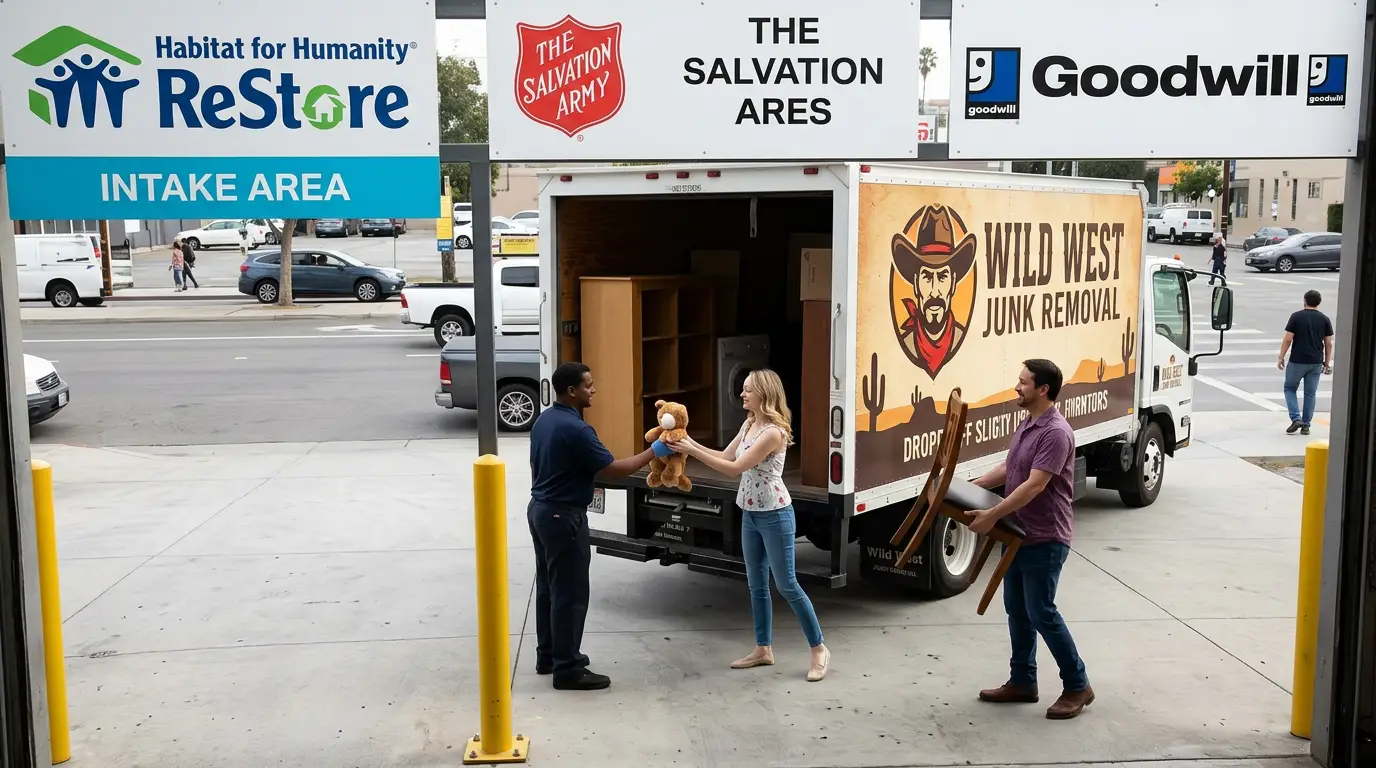
How We Sort A Load — On The Truck, Not At The Yard
The sorting decision gets made in your driveway. When my crew loads a job, usable furniture and household goods go on first and get strapped upright so they arrive at the donation dock in the same condition they left your house. Metal, cardboard, and electronics get their own zones on the truck. Anything headed for the landfill goes on last, because it's the first thing off.
That order matters more than it sounds. A company that piles everything together and "sorts later" doesn't sort later. A dresser that rode under a water heater for forty minutes isn't donatable when it comes off, and at that point the path of least resistance is the transfer station. Sorting on the truck costs us about ten minutes per job. It's the whole difference between a donation program that exists and one that's a sentence on a website.
Walk-through and tag
Before we lift anything we look at each piece and call it: donate, recycle, or dispose. If you want something donated that we'd normally call disposal, tell us — we'll try, but the charity makes the final call at the dock.
Load in reverse order
Donations first and protected, recyclables grouped, landfill material last. Mattresses ride flat with nothing on top so they qualify for the state mattress recycling program instead of the landfill.
Three stops, not one
A typical full load makes a donation drop, a recycler drop, and a landfill drop. Smaller jobs get staged with other loads so a single armchair still makes it to Habitat instead of riding to the dump because it was alone.
The Charities We Deliver To
We work with three organizations in and around the Temecula Valley. Each one takes a different slice of what comes off the truck, and each has its own rules about condition. We deliver to their docks during their intake hours; we don't leave items outside after hours, because that's dumping, not donating.
Habitat for Humanity ReStore
Our first stop for anything you'd find in a home improvement store: intact cabinets, doors, windows, sinks, light fixtures, working appliances, tile and lumber left over from a remodel, and solid furniture. ReStore sales fund Habitat home builds, and a good kitchen tear-out can be a real contribution. This is where most of our construction and remodel debris goes when it's still usable.
The Salvation Army
Our main outlet for household furniture: sofas, dining sets, dressers, bed frames, bookcases, and working appliances. The Salvation Army's family stores fund their local rehabilitation programs. They are strict about upholstery condition and structural soundness, which is why our crew checks frames and cushions in the driveway rather than finding out at the dock. Most of what we haul from estate cleanouts and moving-day jobs that is donatable ends up here.
Goodwill
Where the smaller goods go: boxed clothing and linens, kitchenware, books, decor, small working electronics, toys, and sporting goods. Goodwill takes mixed household boxes that the furniture-focused charities won't, which makes it the right stop after a garage or storage unit cleanout. Goodwill funds job training and placement programs with store revenue.
The honest number
On a typical residential job, somewhere between a fifth and a third of the load by volume is donatable. Estate cleanouts run higher. Hoarding cleanouts, water-damaged garages, and anything with rodent evidence run close to zero. We won't pad that figure to make the page sound better.
What We Can't Donate — Even If You Ask
Customers want to see things reused, and so do we. But the charities have liability rules and resale standards, and some categories are closed regardless of how nice the item looks. Here is what gets a "no" at every dock we use.
The Recyclers We Use
Everything that's not donatable but is made of something recoverable goes to a recycler, not a transfer station. We use five, each for a different material stream. Recycling metal and electronics is also cheaper for us than landfilling by weight, so this isn't charity on our end. It's just the correct way to run the business.
JVA Mobile Scrap Metal Recycling
Scrap steel, aluminum, copper, and brass: bed frames, patio furniture, water heaters, exercise equipment, fencing, grills, and the metal skeletons of anything we've had to break down. Metal is the easiest stream to divert and the one most haulers still landfill because sorting it takes effort.
Electronic Recycling Center
Our e-waste outlet: TVs, monitors, computers, printers, and small electronics. In California most of these are universal waste and can't legally go in a landfill. If you're wondering what counts, read What Is E-Waste? or the electronic waste service page.
CRV Recycling Solutions
California Redemption Value containers: the bags of bottles and cans that come out of garages, rentals, and commercial cleanouts. They get redeemed rather than landfilled.
Sunset Recycling Center
Mixed recyclables from residential and commercial loads: cardboard, paper, plastics, and container material sorted by type on the truck.
Recycle Strong
Additional capacity for mixed recyclable material, and our backup outlet when a primary recycler is closed or at capacity so a sorted load doesn't get landfilled for scheduling reasons.
Two streams don't appear on that list because the state handles them. Mattresses and box springs go through the California mattress recycling program run by the Mattress Recycling Council, and refrigerant-bearing appliances go to a facility that recovers the refrigerant before the metal is scrapped, as federal law requires.
What Still Goes To The Landfill
Some of your junk ends up at the county landfill. Anyone who tells you otherwise is describing a company that doesn't exist. What goes there from our truck: damaged upholstered furniture, broken particleboard, carpet and pad, general construction debris that can't be separated, contaminated or infested items, and mixed household trash. We take those loads to a county-permitted facility, we keep the weight tickets, and we don't dump in the hills off De Luz Road. That last one shouldn't need saying, but in this business it does.
Donation Receipts And Tax Deductions
This is the question we get asked most on this topic, and the answer is one most haulers dodge. When a junk removal company drops your furniture at a donation center, the receipt is issued to the company that made the drop. In most cases that means you can't claim the deduction, because the charity's records show us, not you, as the donor.
If the deduction matters to you, the cleanest approach is to donate the good pieces yourself first — Habitat, Salvation Army, and Goodwill all offer scheduled pickup for larger furniture — and then have us haul what's left. The IRS explains how donated household goods are valued in Publication 561, and non-cash donations over $500 in a year need Form 8283 with your return. Talk to your tax preparer for your own situation; we're haulers, not accountants.
If you'd rather we handle everything and just want confirmation that the items were donated, we'll text you a photo of the drop-off and the charity's intake slip when we receive one. It isn't a tax document, but it does answer the question of where your things went.
Weston Molitor
Founder & Owner, Wild West Junk Removal
"I started naming our charities and recyclers on this page because I got tired of the phrase 'eco-friendly junk removal.' Everybody says it. Ask them which dock they drove to last Tuesday and you'll get a blank look."
"Here's the thing customers don't expect: donating is harder than dumping. The stores have hours, they have standards, they turn things away. Half the skill in this job is knowing what the Salvation Army will take before you load it, so you're not driving a rejected sofa across town for nothing."
"And if you've got a couch that's in great shape and you want the tax receipt, call the charity for a pickup before you call me. I'll tell you that on the phone. I'd rather you get the deduction than we get the haul."

Common Questions
Three: Habitat for Humanity ReStore for building materials, fixtures, and solid furniture; The Salvation Army for household furniture and working appliances; and Goodwill for boxed clothing, housewares, books, and small electronics. We deliver to their docks during intake hours.
Usually not. The charity issues the receipt to whoever makes the drop, which is us. If you want the deduction, donate the good pieces yourself or schedule a charity pickup first, then have us haul the rest. We can send you a photo of the drop-off for your own records, but it is not a tax document.
No, because no charity in the Temecula Valley accepts used mattresses. Clean mattresses and box springs go to California's mattress recycling program, which recovers the steel, foam, and fiber. Infested mattresses are wrapped and landfilled.
Working appliances with intact seals go to Habitat ReStore or The Salvation Army. Non-working refrigerators, freezers, and air conditioners go to a facility that recovers the refrigerant first, as federal law requires, then scraps the metal. Washers, dryers, and ranges go straight to scrap metal recycling.
It depends entirely on the job. A furnished estate cleanout might see half the volume donated or recycled. A water-damaged garage or a hoarding cleanout might see almost none. Across all jobs, roughly a fifth to a third of residential volume is donatable, with metal and electronics recycled on top of that.
Yes. Point it out during the walk-through and we'll load it for donation and try. The charity makes the final call at the dock, and if they refuse it we recycle or dispose of it and let you know.
Resale standards. Donation centers sell what they take, and stained or torn upholstery does not sell, so they refuse it at intake. A rejected sofa still has to be hauled somewhere, and that somewhere is the landfill.
We don't haul household hazardous waste at all. Riverside County runs free household hazardous waste collection for residents; paint, solvents, pesticides, pool chemicals, and propane cylinders should go there. See our what we take and don't take page for the full list.
Sources
Related reading: what we take and what we cannot take · furniture removal · what is e-waste · junk removal pricing. Reviewed and updated September 4, 2026 by Weston Molitor, founder of Wild West Junk Removal, Temecula, California.