
Fire, Flood & Water Damage Debris Cleanouts · Temecula, Murrieta, Menifee
Fire, Flood & Water Damage Cleanouts in Temecula Ruined Contents Hauled Out Fast
Soaked carpet, swollen furniture, smoke-ruined boxes, torn-out drywall, and everything else a loss leaves behind, loaded and gone in one trip. Same-week and often same-day. Priced by trailer volume from $195, written estimate before we lift anything, and we wait for your adjuster's okay if you need us to.
Family-owned in Temecula since 2021 · Two-person crew · 12-yard dump trailer · Mon–Sat 7AM–7PM · Licensed and insured
Wild West Junk Removal · 41713 Niblick Rd, Temecula, CA 92591 · (951) 837-8072 · Mon to Sat 7AM–7PM · Sun closed
Fire & Water Damage Cleanout Cost
What a Damage Cleanout Costs in Temecula
Same four brackets as every other job we run. You pay for how much of the trailer the ruined material fills, and the number includes the crew, the carry, the fuel, and the dump fee. Wet stuff weighs three times what it did dry, but I don't charge by weight, so a soaked couch costs the same as a dry one. What changes on these jobs is loading time, and I'll tell you up front when that applies.
Quarter Load
3 cubic yards
$195
Minimum pickup
One room of wet carpet and pad
Half Load
6 cubic yards
$350
Flooded garage or a water-heater failure
Three-Quarter Load
9 cubic yards
$495
Slab leak across two or three rooms
Full Load
12 cubic yards
$595
Kitchen fire contents or a whole-floor tear-out
Inside every price: two-person crew, all the carrying, sheeting and bagging of wet or sooty material, the haul, the dump fee, and a sweep of the floor we emptied. A full load includes one hour of loading. Written estimate on site before anything moves. No deposit.
What can change the price
- Extra loading time
- $75 per hour per crew member past the hour that's included with a full load. Bagging soaked insulation or sorting fire-damaged contents room by room takes longer than tossing dry junk, and this is where it shows up. I'll estimate the hours on the walk-through, not after.
- Stairs
- $150 on loads under 7 cubic yards, $300 on loads of 7 cubic yards or more, when we're carrying down a flight. No charge if the building has an elevator. Wet carpet from an upstairs bedroom is the classic case.
- Appliances
- $30 each for anything with refrigerant: a fridge, freezer, or window AC that went through the water or the fire. Water heaters, washers, and dryers ride at the regular volume rate.
- Mattresses
- $15 per mattress, any size. Box springs carry no fee but count toward the load volume. A flooded mattress can't be donated or recycled, so it goes to disposal, and this covers the handling.
- Multiple trips
- A house fire's contents rarely fit in one 12-yard trailer. Each trip is quoted as its own load, and we run them back to back so the property isn't sitting open.
Full ladder and every surcharge on the Wild West pricing page. Prices current as of October 2026.
What We Haul
The Part of a Loss We Actually Handle
I want to be straight about what this page is. We are the hauler. We're not the water-extraction crew, the mold remediator, or the fire restoration company. Those trades dry the house and clean what can be saved. We come for what can't be saved and get it off the property so the rebuild can start. A lot of Temecula homeowners have never needed both and don't know where one job ends and the other begins, so here it is.
Wet carpet, pad, and tack strip
The most common water-damage load we run. Pulled, rolled, wrapped, and out, or already pulled by the mitigation crew and stacked in the garage waiting on somebody. Our carpet removal page covers the tear-out itself.
Furniture and mattresses
Couches that sat in water, particleboard dressers that swelled and split, mattresses from a burst pipe upstairs. None of it is donatable once it's been wet or smoked. We bag the worst of it so it doesn't drip through the house on the way out.
Drywall, insulation, and baseboard
The flood cuts and ceiling drop the restoration crew leaves in piles. Wet insulation gets contractor-bagged before it moves. Drywall is stacked flat so it doesn't crumble into the flower beds on the carry.
Smoke and soot-damaged contents
Boxes, clothing, books, rugs, and anything porous from a house or garage fire that the adjuster has already photographed and released. We sort out what you're keeping first, then load the rest.
Ruined appliances and electronics
Water heaters that caused the flood, fridges that died in the outage, TVs and computers from a fire. Refrigerant appliances carry the $30 handling fee; electronics get routed as e-waste, not landfill.
Storm and flood debris
Mud-caked patio furniture, a collapsed fence, sandbags, the pile of yard and garage contents a creek overflow or a broken irrigation main left behind. Yard material can ride with the rest or go as yard waste on the same trip.
What we don't do, and who does
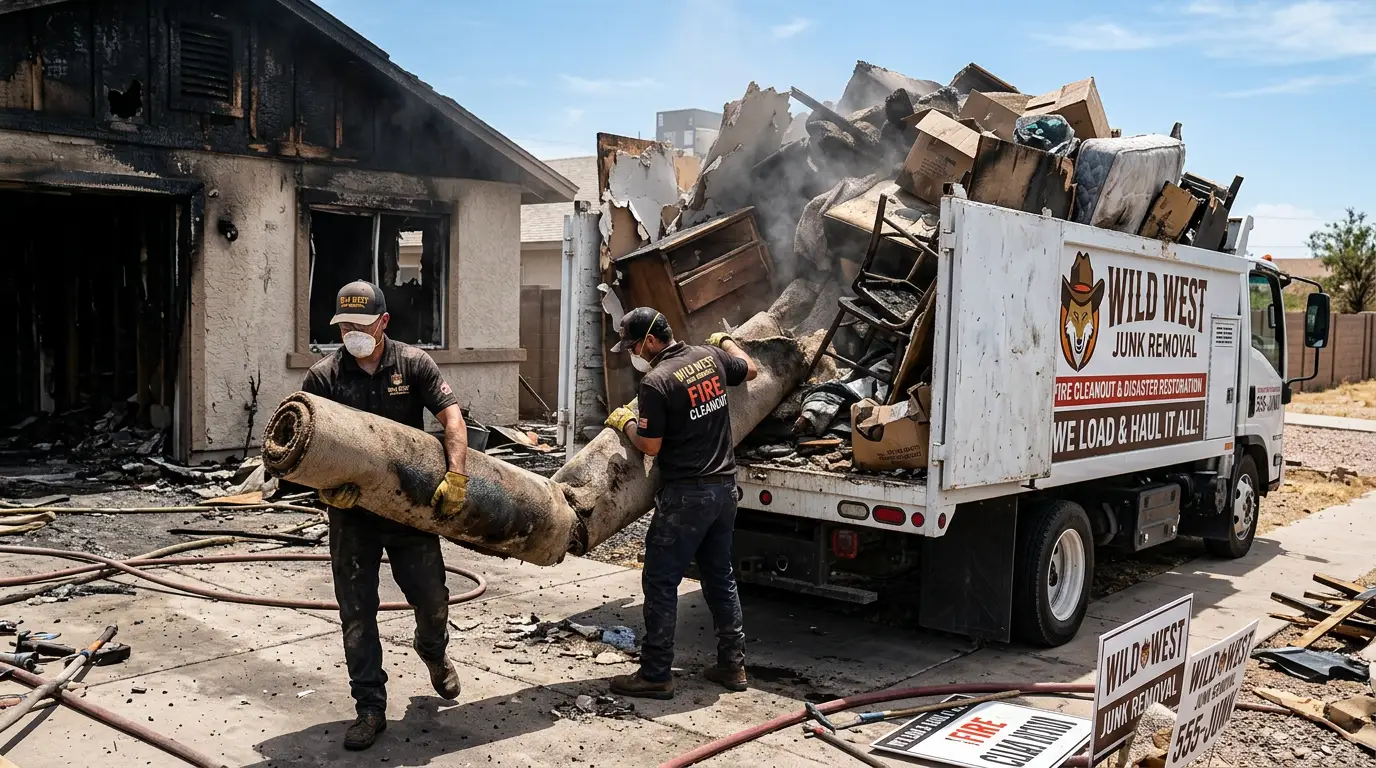
We don't pump standing water, run dehumidifiers, spray antimicrobials, or test for mold. If there's water on the floor when you call, you need a mitigation company first, and I'll tell you that on the phone rather than take your money to haul a couch out of a room that's still wet. We don't do asbestos abatement, and we won't disturb drywall or flooring in a pre-1980 house until somebody has checked it. And in a declared wildfire disaster, the household hazardous waste and ash removal is a state program run through CalRecycle and DTSC, not a private hauler. Where we fit is everything after that: the contents, the tear-out debris, the cleanup that gets you to a clean slab or a dry subfloor.
If the job turns into a full gut, the same crew does demolition cleanup and hauls the construction debris from the rebuild. One phone number for the whole thing.
When to Call
The Order Things Happen In After a Loss
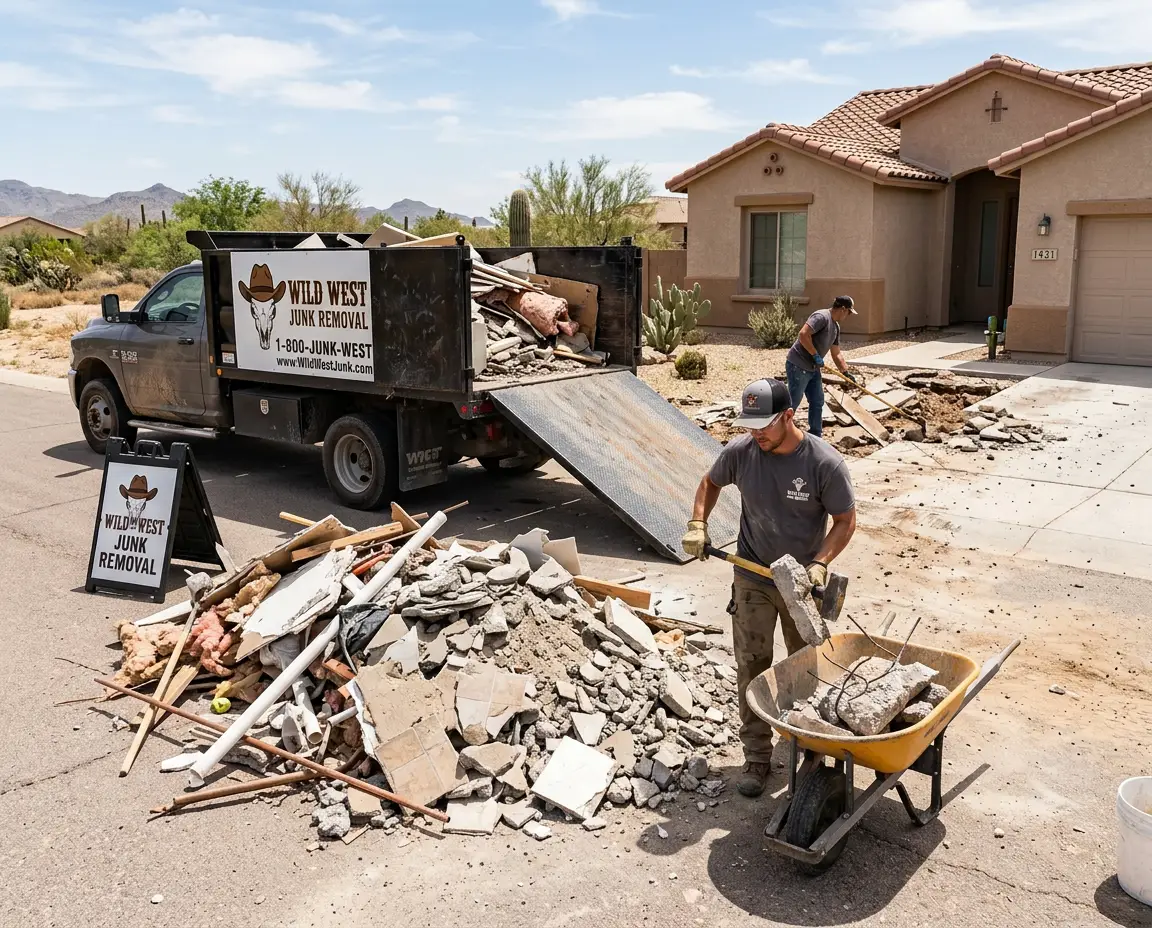
People call me the morning after a flood and want it all gone by noon. I get it. But calling the hauler first can cost you money with your insurance company and with the mitigation crew. Here's the sequence that works, and where we land in it.
Stop the source and make it safe
Shut the water main, kill the breaker to a flooded room, don't go into a fire-damaged structure until the fire department releases it. Nothing we do matters until the house has stopped getting worse.
Call your insurance company and photograph everything
Before one item leaves. Wide shots of each room, close-ups of the damage, the water line on the wall. Your adjuster may want to see the damaged items in place; the NAIC's post-disaster claims guidance says as much. Hauling before that sign-off can leave you arguing about what was there.
Get the mitigation crew in
For water: extraction, fans, dehumidifiers, and the flood cuts, ideally inside 48 hours. For fire: the restoration contractor's assessment of what's salvageable. They'll usually pile what's coming out in the garage or driveway.
Now call us
Once the adjuster has released the contents and the mitigation crew has separated the keepers from the losses, we load it all in one trip. Text me photos of the pile and I'll give you a bracket before we roll. Most of these are on the road the same day or next morning.
Rebuild with a clean site
Flooring installer, drywall crew, cabinet guys. Nobody works well around a pile of wet carpet. If the rebuild generates its own debris, same crew, same number.
The 48-hour thing is real. The EPA's mold guide puts the window to dry water-damaged material at 24 to 48 hours before mold starts. That's a deadline for the drying, not for the hauling. Get the fans running first. The wet stuff can sit in the garage a day while the adjuster looks at it; the wet subfloor can't.
Water & Flood Damage
Where the Water Comes From Around Here
Temecula doesn't flood the way the Gulf Coast floods. Most of our water-damage calls come from inside the house, not outside it, and they come from the same handful of causes over and over.
Slab leaks. The tract homes built in the '90s and early 2000s across Paloma del Sol, Redhawk, Vail Ranch, and half of Murrieta have copper running under the slab. When a line pinholes, the water comes up through the foundation and the first sign is warm spots on the floor or carpet that never quite dries. By the time it's found, the carpet and pad in two or three rooms are done. Our wet carpet guide gets into why slab-leak carpet almost never gets saved.
Water heaters and washing machines. A 50-gallon tank in the garage lets go, or a braided supply hose splits behind the washer, and everything on the garage floor or in the laundry room gets it. Boxes, shelving, the stuff you were storing for the kids. These are usually quarter and half loads, and they're the jobs where somebody calls at 8 a.m. and we're loading by 11.
Winter roof leaks. When the atmospheric-river storms come through in January and February, the ceiling drywall that's been quietly soaking up a tile-roof leak gives out. That's a ceiling on the floor, wet insulation everywhere, and a bedroom's worth of furniture that got rained on indoors.
Actual flooding. It happens. Murrieta Creek has gone over its banks into Old Town before, and low lots along the creek and in the Wine Country washes get water inside during a big enough storm. That water is contaminated by definition, and the CDC and EPA's disaster mold cleanup guide says anything porous it touched gets thrown out, not cleaned. Mattresses, upholstery, carpet, drywall, books, stuffed animals. That's a big load and a fast one.
Clean water, gray water, black water
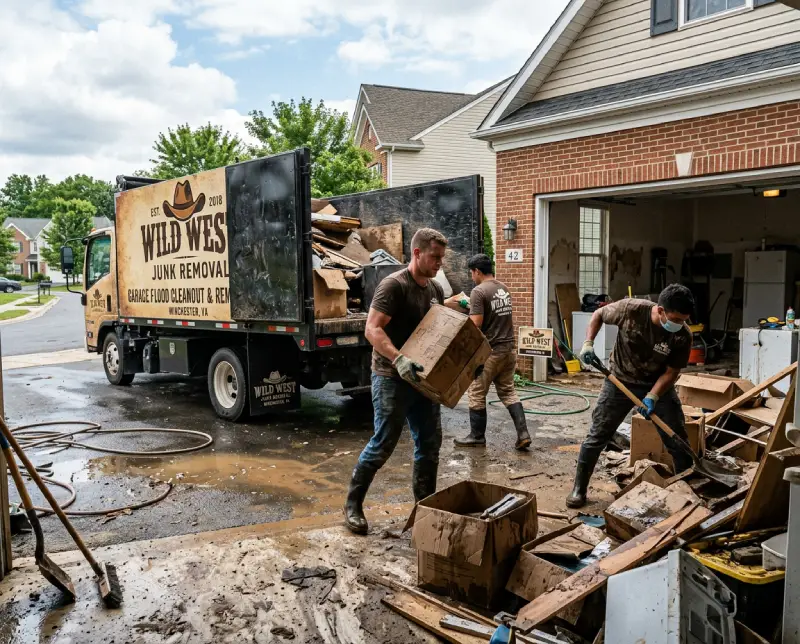
The restoration industry sorts water damage into three categories, and it changes how we handle the load. Clean water from a supply line is just wet. Gray water from a washing machine or dishwasher overflow has soap and food in it. Black water, meaning sewage backups, toilet overflows with solids, or anything that came in from outside, is a health hazard, and the crew gloves up, masks up, and bags everything before it moves through the house. Tell me which one you've got when you book so we show up with the right gear. If you don't know, I'll ask where the water came from and figure it out from there.
| Material | Clean water, dried in 48 hrs | Wet more than 48 hrs | Sewage or floodwater |
|---|---|---|---|
| Carpet face fiber | Often saved | Hauled | Hauled |
| Carpet pad | Usually replaced | Hauled | Hauled |
| Drywall and insulation | Depends on saturation | Hauled | Hauled |
| Upholstered furniture, mattresses | Sometimes cleaned | Hauled | Hauled |
| Solid wood furniture | Saved | Depends | Cleaned if it can be |
| Particleboard and laminate furniture | Watch for swelling | Hauled | Hauled |
| Books, paper, cardboard boxes | Some saved | Hauled | Hauled |
| Tile, sealed concrete, metal | Cleaned | Cleaned | Disinfected and kept |
Fire & Smoke Damage
After the Fire Department Leaves
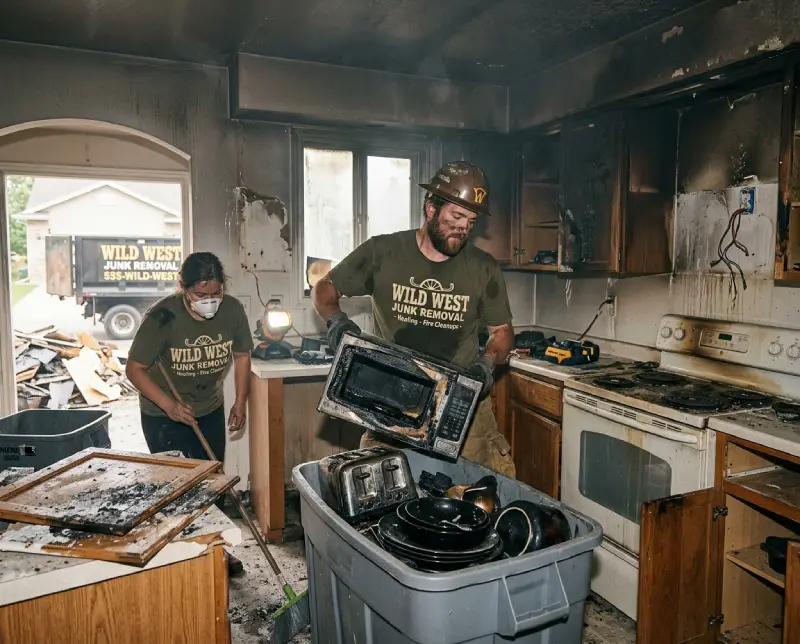
A kitchen fire that never got past the range hood can still ruin the contents of half the house. Smoke goes everywhere the air goes. What we haul from a fire is usually less about the burned stuff and more about the boxes, clothes, and furniture that smell like it and can't be cleaned back.
Kitchen and garage fires are the ones we see. A grease fire on the stove, a charging battery in the garage, a space heater too close to the bed. The fire department knocks it down, the house is standing, and the homeowner is looking at a room of charred cabinets and a house full of soot. The restoration contractor decides what gets cleaned. We take the rest: the cabinets, the melted appliances, the contents that were written off, and the drywall and insulation the contractor pulled to get at the smoke damage in the walls.
Wildfire. If a fire in the hills takes a house in De Luz, Rainbow, or the east side of Temecula and the county declares a disaster, the first two phases of cleanup are government-run. DTSC removes the household hazardous waste, then CalRecycle's contractors clear the ash and foundation. Property owners who opt out can hire their own licensed debris contractor under the county's rules, but that's a different scope than we run. Where we do fit on wildfire is the house that survived: smoke-ruined contents, the ash-covered patio furniture, the fence that burned along the back line. We've done that work and we'll be honest about the line.
Asbestos and lead. Fire debris from any house built before 1980 can contain asbestos in the drywall joint compound, floor tile, or acoustic ceiling, and the South Coast AQMD's asbestos rules apply to renovation and demolition work. We don't pull drywall or flooring in an older house without a survey, and we won't load material a survey has flagged. Your restoration contractor will already know this. If you're doing it yourself, ask before you swing a hammer.
Smoke-damaged doesn't always mean ruined. Hard-surface items, sealed containers, metal, glass, and a lot of solid wood can be cleaned by a restoration company that knows how. Soft goods, mattresses, open food, cosmetics, and particleboard almost never can. Let the contractor and your adjuster make that call before we load, and keep anything sentimental in a separate pile until you've decided. We won't load a pile you haven't pointed at.
Who Shows Up
Weston Molitor Runs These Jobs
Weston Molitor
Owner and founder, Wild West Junk Removal · Hauling in the Temecula Valley since 2021I started Wild West in 2021 with one trailer and the idea that people should get a straight price and a crew that shows up when it said it would. Damage cleanouts are where that matters most, because the person calling has usually had a bad week already. I answer the phone myself, I look at the photos myself, and on most of these jobs I'm one of the two people carrying the carpet.
What I've learned running these: get the adjuster's okay before we load, bag the wet insulation before it moves, and never mix the keep pile with the go pile. We've hauled out of flooded garages in Winchester, slab-leak tear-outs in Redhawk, and a kitchen fire in Harveston where the family had been sleeping at a hotel for two weeks waiting on somebody to clear the house. Nobody should wait two weeks for that.
"If the room's still wet, I'll tell you to call a mitigation company before you call me. I'd rather lose the job than haul your couch out of a house that's going to grow mold anyway."

How It Works
From Your Photos to an Empty Room in Four Steps
There's no app and no call center. You text me, I answer.
Text photos of the pile
Two or three shots of what's going, plus one of the path out. Tell me where the water came from or what burned. I'll text back a bracket, usually inside the hour during business hours.
We confirm the adjuster's okay
If insurance is involved, I'll ask whether the adjuster has seen the items or released them. If they haven't, we'll schedule for after they have. If you're paying out of pocket, we skip this and go.
Walk-through and written price
Crew arrives in the window we agreed on, walks it with you, confirms the keep pile and the go pile, and hands you a written price. Then we load. Wet material gets bagged or wrapped first; sooty material gets sheeted so it doesn't smear the walls on the way out.
Sweep, photos, gone
We sweep the space we emptied and take photos of the loaded trailer if you want them for your claim file. Recyclable metal and e-waste get pulled at the yard; the rest goes to the county landfill. Card, cash, or check when we're done.
Insurance
Working With Your Claim Instead of Against It
I'm not an adjuster and I won't pretend to know your policy. But I've hauled enough of these to know what makes the claim go smoothly and what makes it go sideways, and most of it is about timing and paperwork.
Debris removal is usually covered
Most homeowner policies carry a debris-removal provision for a covered loss. Ask your adjuster whether our invoice can be submitted under it. We write the invoice with the address, the date, the volume hauled, and a description of what it was, which is what they usually want.
Don't haul before the inspection
If the adjuster hasn't seen the ruined contents, wait. Once it's at the landfill, you're relying on photos to prove what was there. We'd rather come Thursday after the visit than Tuesday before it.
Keep a list as we load
Big-ticket items especially: the sectional, the king mattress, the fridge, the TV. Snap a photo of each as it goes on the trailer. The crew will slow down for it if you ask; it takes five minutes and can be worth a lot on the contents claim.
Mitigation and hauling are separate line items
The water-extraction company bills for drying. We bill for hauling. Some restoration outfits sub the hauling out and mark it up; you're allowed to hire that piece yourself, and it's often cheaper if you do.
Renters
The landlord's policy covers the building. Yours covers your stuff, if you have one. Either way, the contents in your unit are yours to release, and the tear-out debris is the property manager's. We can invoice each side separately on the same trip.
Paying out of pocket
No claim, no waiting. A lot of small water jobs come in under the deductible anyway. Text the photos, get the bracket, and we'll usually have it gone the same day.
What Can't Ride
Things a Fire or Flood Leaves Behind That We Can't Load
A garage fire or a flooded storage room tends to surface every can and bottle you forgot you owned. Some of it is hazardous waste by law, and it can't go in a dump trailer at any price. Here's what to pull aside, and where it goes instead.
Paint, solvents, and pool chemicals
Scorched paint cans, swollen cans of thinner, chlorine tabs that got wet. All household hazardous waste. Riverside County takes it free at the county HHW collection sites, including the permanent facility in Lake Elsinore.
Propane and gas cylinders
BBQ tanks, camp canisters, a fire extinguisher that went off. Even empty, they don't ride. County HHW takes propane; the exchange cage at the hardware store takes an intact BBQ tank.
Batteries, especially lithium
A charred e-bike or power-tool battery is the single most dangerous thing in a fire cleanout, and a soaked one isn't much better. Tape the terminals, set it outside on concrete, and take it to HHW. We won't load it.
Fuel, oil, and antifreeze
Gas cans, the mower, the outboard. Drained and dry, the equipment rides. The liquid goes to HHW or an auto-parts store that takes used oil.
Ash from a structure fire
Ash and burned debris from a house that partly or fully burned can carry asbestos and heavy metals. It's not junk; it's regulated debris with its own disposal path. We haul contents and tear-out material, not ash.
Sewage-soaked material, bagged
This one we do take, but only bagged. Black-water carpet, pad, and drywall go into contractor bags before they leave the room. If the mitigation crew already bagged it, great. If not, we bag it and it shows up as loading time.
Not sure whether something rides? Text a photo. I'd rather answer a question than turn a crew around at the curb.
Service Area & Special Situations
Where We Run Damage Cleanouts
Based in Temecula, working the whole southwest corner of Riverside County plus the north San Diego County backcountry. Same price everywhere in the list; nothing added for the drive.
Not listed? Call or text (951) 837-8072 and ask. City-level detail is on the Temecula junk removal, Murrieta junk removal, and Menifee junk removal pages.
Upstairs water damage
A bathroom overflow on the second floor of a Harveston or Morgan Hill two-story means wet carpet coming down the stairs and, usually, ceiling drywall from the room below. Stair charge applies on the carry; the ceiling material rides at volume.
HOA and gated communities
We'll get on the gate list and park where the HOA wants. If the community limits truck hours, tell me when you book and we'll work inside them.
Rentals and turnovers
A tenant's washer flooded the unit, or a fire in one apartment smoked the ones next to it. We work with property managers on turnover cleanouts all the time and can split the invoice between tenant contents and building debris.
Storage units and garages
Roof leak at the facility, or the garage water heater let go across the Christmas decorations. Same crew, same brackets. We'll pull anything salvageable to the side before it goes.
Commercial and restaurant losses
A grease fire in a Murrieta strip-mall kitchen or a broken sprinkler head over a stockroom. We run commercial cleanouts before opening or after close so you're not losing a business day.
What we don't do
Water extraction, structural drying, mold remediation, asbestos abatement, smoke cleaning of salvageable items, and wildfire ash removal. We'll point you to who does.
Checklist
Before the Crew Arrives
None of this is required. All of it makes the job faster, and on a damage cleanout faster means cheaper.
- ✓Get the adjuster's release in writing. A text or email saying "you can dispose of the damaged contents" is enough. Screenshot it.
- ✓Separate keep from go. Two piles, or tape on the floor. Anything sentimental in a third spot you haven't decided on yet. We don't touch that one.
- ✓Pull the hazardous stuff. Paint, propane, batteries, fuel, pool chemicals. Set them outside on concrete, away from the pile, and plan an HHW trip.
- ✓Turn on the fans if the mitigation crew left them. We work around equipment. Don't shut it down for us.
- ✓Clear a path. Gate unlocked, cars out of the driveway, the dog inside. Wet carpet drips; the shorter the walk, the less it drips on.
- ✓Tell us about the water. Clean, gray, or black. It changes what we bring and how we bag.
- ✓Photograph the pile before we load. One wide shot. It's your inventory for the claim.
Loading it yourself? A dumpster rental can make sense on a multi-day gut where debris comes out over a week. For a one-day contents cleanout, the crew is usually cheaper once you count the rental days, the tonnage, and your own back.
Page reviewed by Weston Molitor · Updated October 14, 2026
Reviews
What Neighbors Say
Real Google reviews from real jobs. The first one was a garage flood.
We have used Wild West Junk Removal twice now and both experiences have been FIVE stars! The second time was after a flood and we had to make room in our garage immediately. I was worried about it being so last second, but these guys were here and loading in no time. They really bailed us out! I have recommended them to friends and family and will do so again in the future. They are super professional in their appearance, in their communication, and most importantly, in the work they do.
Nick from Wild West Junk removal came out and took care of a trash overflow! They showed up within 2 hours of us calling and got the job done quickly and efficiently. Not to mention they were extremely friendly. I would highly recommend Wild West for any of your junk removal needs!
Wild West Junk Removal did a wonderful job getting 2.14 tons of yard & construction waste off my property, including the demolition of a construction grade dog house. They communicated clearly, were super professional & got everything done fast. They left the space where the trash was clean of all debris and made our lives much easier. If you are looking for an honest and reputable company, they are the place to go to.
Wild West Junk Removal did an amazing job at my mother’s house. They were fast, professional, and took care of everything with care. I really appreciated their hard work and how smoothly it all went. Highly recommend them!
Read all our Google reviews · Post your own Google review · More on our Yelp page. Reviews shown are excerpts.
Frequently Asked Questions
Fire, Flood & Water Damage Cleanout FAQ
The questions people ask on the phone, answered the way I answer them.
Water damage debris removal in Temecula starts at $195 with Wild West Junk Removal. We price by how much of the trailer the ruined material fills, not by weight or by the hour: $195 for a quarter load, $350 for a half, $495 for three-quarters, and $595 for a full 12-cubic-yard load. One room of wet carpet and pad is usually a quarter load. A flooded garage or a water-heater failure runs a quarter to a half. A slab leak that took the carpet out of two or three rooms lands at a half to three-quarters. The crew, the carrying, bagging of wet material, the haul, and the dump fee are inside the number. You get a written price on site before we load, and if it comes in under the estimate, you pay the smaller number.
Fire damage cleanouts use the same $195 to $595 volume brackets, but they run bigger. A kitchen fire's ruined cabinets and contents usually fill three-quarters to a full trailer. A garage fire is a full load and sometimes two. Whole-house contents after a structure fire is a multi-trip job that I quote per load after seeing the property. Extra sorting time past the hour included with a full load is $75 per hour per crew member, and fire jobs are where that comes up, because the family is deciding item by item what's salvageable. I'll estimate the hours on the walk-through so there's no surprise.
Usually, yes, if the material is ready to go. We run Monday through Saturday, 7 to 7, and a quarter or half load texted to me in the morning is typically loaded by afternoon. The catch is that "ready to go" matters. If the room is still wet, a mitigation company needs to get in first. If there's an insurance claim, the adjuster may need to see the damaged contents before they leave. When those two boxes are checked, we move fast. Ben B. in Winchester called us last-minute after a garage flood and we were loading within hours.
Restoration first, almost every time. The mitigation crew extracts the water, sets fans and dehumidifiers, and does the flood cuts in the drywall. The EPA's guidance is that water-damaged material needs to be drying within 24 to 48 hours to head off mold, and that's their job, not ours. Once they've pulled what can't be saved and piled it, and once your adjuster has released it, we come haul it. Calling us first just means the wet stuff gets moved while the house keeps getting worse.
Often, under the debris-removal provision most policies carry for a covered loss, but I'm a hauler, not an adjuster, so ask yours. What I can tell you is what they usually want from us: an invoice with the property address, the date, the volume hauled, and a plain description of what it was. We write it that way by default. Keep your own photos of the pile before we load and of the big-ticket items as they go on the trailer. Don't haul anything before the adjuster has inspected it unless they've told you in writing that you can.
Yes. Once a mattress or upholstered piece has been soaked, it can't be donated or recycled, so it goes to disposal. Mattresses are $15 each, and box springs carry no fee; couches ride at the regular volume rate. We bag or wrap the worst of it before it moves so it isn't dripping through the house. If the water was sewage or came in from outside, everything porous it touched gets bagged as a rule.
It's how the restoration trade sorts what the water was carrying. Clean water is from a supply line or a water heater; it's just wet. Gray water comes from a washing machine, dishwasher, or tub overflow and carries soap, food, and bacteria. Black water is sewage, a toilet overflow with solids, or floodwater from outside, and it's a health hazard. For us it changes the gear and the handling: black-water material gets gloved, masked, and bagged before it leaves the room, and it adds loading time. Tell me which you've got when you book. If you're not sure, tell me where the water came from and I'll sort it out.
Yes, and it's a big share of what comes out after a leak. The flood cuts, the ceiling that came down, the pink or blown-in insulation behind it. Wet insulation gets contractor-bagged before it moves because it's heavy and it sheds; drywall gets stacked flat. Two things I'll ask first: was the house built before 1980, and has anyone checked the joint compound or ceiling texture for asbestos? If the answer is "old house, nobody checked," we don't load it until somebody does.
Not the ash. When a wildfire destroys a home and the county declares a disaster, the household hazardous waste and the ash-and-foundation removal are run through a state program: DTSC handles the hazardous phase, then CalRecycle's contractors clear the lot. That debris can carry asbestos and heavy metals and has its own disposal path. What we do handle after a wildfire is the house that survived: smoke-damaged contents, ash-covered patio furniture, a fence line that burned, the garage that got smoked out. We've done that work in the hills east of Temecula and we're clear about where our part ends.
Some can. Hard surfaces, sealed containers, metal, glass, and a lot of solid wood clean up well when a restoration company does it. Soft goods are the problem: mattresses, upholstery, open food, cosmetics, and particleboard soak up smoke and rarely come back. Your restoration contractor and your adjuster should make that call item by item before we load, and we'd rather come after that sort than before it. Keep anything sentimental in its own pile until you've decided. We won't load a pile you haven't pointed at.
Anything that's household hazardous waste by law: paint and solvents, pool chemicals, propane and gas cylinders, fuel and oil, and batteries, especially lithium batteries from e-bikes and power tools, which are the most dangerous thing in a fire cleanout. Also structure-fire ash. Riverside County takes household hazardous waste free at its collection sites, including the permanent facility in Lake Elsinore. Pull that material aside before we arrive and plan an HHW trip; we'll take everything else.
No. We don't pump water, set fans, run dehumidifiers, spray antimicrobials, or test for or remove mold. That's the mitigation and restoration trade, and it needs to happen before we show up. We haul what they and your adjuster have decided can't be saved. If you call and the room is still wet, I'll tell you to call a mitigation company first.
Shut the cold-water valve on top of the tank and kill the gas or the breaker, then get everything off the floor that you can. What usually goes: soaked cardboard boxes and their contents, particleboard shelving, rugs, and the tank itself once the plumber has swapped it. The tank rides at the regular volume rate, no appliance fee, because there's no refrigerant. Most of these are a quarter to half load and we can often have it gone the same day. Run fans on the floor and the bottom of the drywall while you wait; garage slabs dry fast, but the drywall doesn't.
The EPA's homeowner guidance puts it at 24 to 48 hours for water-damaged material that isn't dried. That's why the drying has to come before the hauling. The wet carpet and drywall can sit in the garage for a day while the adjuster looks at it, because it's already a loss; the wet subfloor and the wall cavities can't, because they're what you're trying to save. Get the fans and dehumidifiers running first, then call us.
Yes, regularly. A tenant's washer floods the unit, or a fire in one apartment smokes the neighbors, and the manager needs the unit cleared before the restoration crew can rebuild. We can split the invoice between tenant contents and building debris on the same trip, and we'll work with whatever release process your management company uses. It's the same crew that does our tenant turnover cleanouts.
Water-damaged and smoke-damaged material that's soft, porous, or contaminated goes to the Riverside County landfill system, because it can't be recycled or donated once it's been wet or smoked. Metal shelving, appliance carcasses, and copper from a tear-out get pulled for scrap. Ruined TVs, computers, and other electronics are routed as e-waste under California's rules, not landfilled. Hazardous material never rides with us and goes to county HHW. If you want a disposal receipt for your claim file, ask when you book and I'll get one.
At a Glance
| Provider | Wild West Junk Removal, family-owned in Temecula since 2021 |
|---|---|
| Owner | Weston Molitor |
| Address | 41713 Niblick Rd, Temecula, CA 92591 |
| Phone | (951) 837-8072 — call or text |
| Hours | Mon to Sat: 7AM–7PM · Sun: Closed |
| Starting price | $195 quarter load; $350, $495, $595 for half, three-quarter, and full loads |
| We haul | Wet carpet and pad, ruined furniture and mattresses, drywall and insulation tear-out, smoke-damaged contents, dead appliances and electronics, storm and flood debris |
| We don't do | Water extraction, drying, mold remediation, asbestos abatement, wildfire ash removal, hazardous waste |
| Typical job | 1–3 hours for a single-room or garage loss; half a day to two days for a fire |
| Same-day | Usually, once the material is released and the space is dry enough to work in |
| Insurance | Itemized invoice for the debris-removal provision; we wait for adjuster release on request |
Ready to Get It Out of the House?
Text photos of the pile to (951) 837-8072 and tell me what happened. You'll have a bracket back fast, and most days a crew that afternoon.
Mon to Sat: 7AM–7PM · Sun: Closed
Sources
- epa.govEPA — A Brief Guide to Mold, Moisture, and Your HomeThe 24-to-48-hour drying window for water-damaged materials, and which materials can be cleaned versus replaced.
- epa.govCDC / EPA / FEMA — Homeowner's and Renter's Guide to Mold Cleanup After DisastersPorous items exposed to floodwater or sewage should be discarded; protective gear and cleanup sequence after a flood.
- calrecycle.ca.govCalRecycle — Disaster Debris Recovery OperationsThe two-phase state program for wildfire debris: DTSC household hazardous waste removal, then CalRecycle ash and debris removal.
- naic.orgNAIC — What Should I Do After a Wildfire?Documenting damage, home inventories, and the adjuster's inspection before disposing of damaged items.
- rcwaste.orgRiverside County Waste Resources — Household Hazardous WasteFree county drop-off for paint, propane, batteries, fuel, and pool chemicals that can't ride in a junk load.
- aqmd.govSouth Coast AQMD — Asbestos Demolition and RenovationSurvey and notification requirements before disturbing building materials that may contain asbestos.
Related Wild West Services
- Service AreaTemecula Junk Removal
- Service AreaMurrieta Junk Removal
- Service AreaMenifee Junk Removal
- ServiceCarpet Removal
- ServiceDemolition Cleanup
- ServiceConstruction Debris Removal
- ServiceFurniture Removal
- ServiceMattress Removal
- ServiceTenant Turnover Cleanout
- GuideWet Carpet: Dry It or Remove It
- GuideWhere Your Junk Actually Goes
- PricingJunk Removal Prices
Prices shown are the Wild West Junk Removal volume ladder as of October 2026: $195 quarter load, $350 half, $495 three-quarter, $595 full 12-yard trailer, plus stair, appliance, mattress, and extra-loading-time surcharges as listed above. Every job gets a written estimate on site before work begins. This page describes hauling and cleanup; it is not restoration, insurance, or legal advice.