

Removing old carpet is a task that often surprises people. The removal itself is easy enough. But the disposal side of things means more decisions than expected. Carpet is heavy, awkward to transport, and not necessarily welcome at the curb. Your options, along with the effort or money required for each, can vary quite a bit depending on where you live and how much material you are dealing with.
The good news is that there are a few well-established paths forward. Some homeowners manage everything themselves with a rented truck and a trip to the landfill. Others call a junk removal company, like Wild West Junk Removal, and hand the whole job off. And in some areas, carpet recycling programs give you a disposal path that keeps the material out of the waste stream entirely. Each strategy has its trade-offs in terms of cost, convenience, and environmental results.
This guide breaks down those options so you can figure out which one fits your situation. Whether you’re clearing out a single room or tackling a whole-house renovation, the right choice can depend on a handful of factors—and by the end you’ll have a clear enough picture to make that call with confidence.
 What Actually Happens to Old Carpet After Removal
Most old carpet ends up in a landfill. Around 73% of carpet pulled from homes and businesses goes straight to landfill, and less than 10% ever makes it to a recycling facility.
Carpet is harder to recycle than expected—it’s usually made from multiple materials bonded together—synthetic fibers, latex backing, and adhesives—and the separation of the materials takes equipment that most standard recycling centers don’t have. So even when carpet gets dropped off at a general recycling facility, there’s a chance it still ends up buried.
There are dedicated carpet recycling programs out there. Some manufacturers and retailers operate take-back initiatives, while a few facilities specialize in breaking down carpet into raw materials for new products. The catch is that access to these programs depends heavily on where you live.
It’s worth asking yourself if it matters where your carpet ends up. Some care where their carpet ends up, while others just want it gone. Neither is wrong. But knowing that the default outcome is usually a landfill gives you a better picture of what your disposal choice actually means.
The way you remove and dispose of carpet directly shapes where it goes next. Not all removal services dispose of carpets the same way, which can affect your booking.
Breaking Down the Real Costs of Carpet Disposal
The cost to remove old carpet is not a single fixed number, and that’s worth learning about before getting any quotes. HomeAdvisor puts the national average around $280. But HomeGuide shows a range of $150 to $350 per load for junk removal services. Where you land in that range can depend on how much carpet you have, where you live, and what type of service you use.
Volume is the biggest factor, so it helps to have a rough estimate of your carpet’s weight. Carpet runs about 4 to 5 pounds per square yard. A 200-square-foot room works out to roughly 22 square yards, which puts you between 88 and 110 pounds of material to haul away. CLICK HERE to see Wild West Junk Removal’s Price Chart.
That weight matters most if you go through a recycling program. The Carpet America Recovery Effort, known as CARE, charges between $0.05 and $0.25 per pound at participating drop-off sites. For that same 200-square-foot room, you’re looking at roughly $5 to $27 in disposal fees if you manage the haul yourself.

One thing to watch: not all services charge by weight. Some go by load size, some by square footage, and some bundle labor into a flat rate. A quote that sounds low might not include the haul, and a higher quote might cover everything from start to finish—it’s worth asking what the price includes before you commit.
Location can add another layer. Urban areas with higher dump fees tend to cost more, and rural areas can sometimes cost more too if the nearest facility is far away. Two or three quotes give you a much clearer picture of what’s fair in your area.
Junk Removal Services vs. DIY Haul-Away
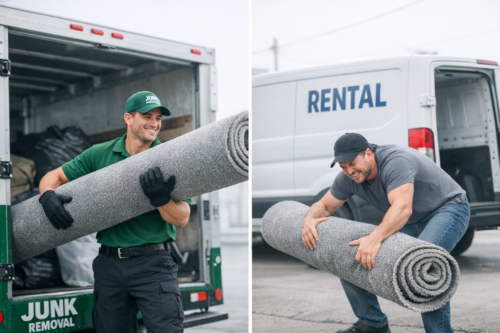
Junk removal services, like Wild West Junk Removal, manage the heavy side of things. A crew will roll up the carpet, carry it out, load it onto their truck, and drive it away. Some services start as low as $77, and they run 20-30% cheaper than traditional carpet removal businesses.
DIY haulaway puts that work on you. You need to rent a truck, cut and roll the carpet yourself, find an accepted drop-off location, and physically load everything. That is a time commitment, and it gets harder if you have a large space or a damaged back.
Which Option Fits Your Situation?
Consider if you have convenient access to a pickup truck or cargo van. If you don’t, the rental cost alone can close the price difference between DIY and hiring a service. Factor in your time too—a few hours on a Saturday may or may not be worth the savings to you.
Physical ability matters here. Old carpet is heavy and awkward to move, and that’s also the case on stairs or through tight hallways. If lifting is not easy for you, a junk removal service is the more helpful path.
DIY makes the most sense for those who already have a truck, live close to a dump or transfer station, and are comfortable with the labor. Junk removal services are a better fit for those who want the job done without coordinating those moving parts themselves.
Your time, body, and resources determine which path is right.
 Recycling Programs and Donation Options Worth Knowing
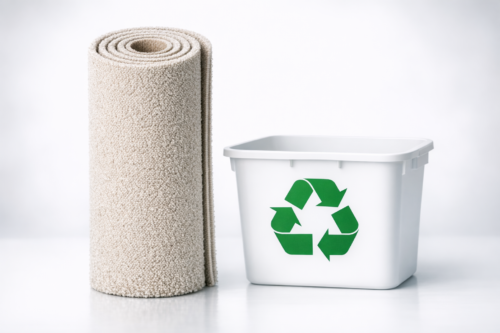
Most carpet ends up in a landfill. But it doesn’t have to. If your carpet is in basic usable shape, you have options to keep it out of the trash.
The Carpet America Recovery Effort, known as CARE, runs a network of certified drop-off locations across the country. These sites accept old carpet for recycling and charge only a small fee per pound. Nylon, polyester, and polypropylene carpets are the most commonly accepted materials. Wool and carpet with heavy backing or padding sometimes get turned away, so it’s worth a quick call before you haul anything over.
Some carpet manufacturers also run take-back programs with new purchases. If you’re replacing carpet and buying from a bigger brand, ask the retailer if removal and recycling are part of the deal—it’s not universal. But it comes up more than you’d think to check.
Local municipality programs often go unnoticed. Some areas include carpet in bulk pickup schedules or hazardous material drop-off events. A quick search on your city’s waste management page can tell you what’s available in your area.
Donation works too. But only when the carpet is legitimately usable. Habitat for Humanity ReStores accept carpet in excellent condition and put it back into homes in need—it has to be clean, free of damage, and ideally still in full pieces or large sections.
| Option | Best For | Condition Needed |
|---|---|---|
| CARE drop-off sites | Synthetic carpet recycling | Any condition |
| Manufacturer take-back | New carpet replacements | Any condition |
| Municipality pickup | Bulk or scheduled disposal | Any condition |
| Habitat ReStore donation | Reusable, clean carpet | Good condition only |
Picking the Right Removal Path for Your Situation
There is no universally correct answer here. The best choice is the one that fits your situation—your schedule, your budget, and how much effort you want to put in. Someone clearing a single bedroom has very different needs than gutting a multi-room rental property, and that’s fine.
Once you pick a direction and take that first step, most people find the whole process far less stressful than they expected. The carpet that has been sitting there for weeks tends to disappear faster once a plan is in motion. Please choose your strategy, make the call or schedule the pickup, and complete the task—you’ll likely wonder why you waited.
References
- (2024). “Durable Goods: Product-Specific Data.” U.S. Environmental Protection Agency (EPA). https://www.epa.gov/facts-and-figures-about-materials-waste-and-recycling/durable-goods-product-specific-data
- “Carpet America Recovery Effort (CARE).” carpetrecovery.org. https://carpetrecovery.org/
- “Carpet Weight Calculator.” Riddle Waste Services. https://www.riddlewasteservices.com/dumpster-size-calculators/carpet-weight-calculator/
- (2024). “CARE End of Year Newsletter—June 2024. “Carpet America Recovery Effort (CARE). https://carpetrecovery.org/wp-content/uploads/2024/06/CARE_EOY_Newsletter_JUNE_2024_WEB.pdf
- (2024). “UK Gate Fees Report 2024–25.” WRAP. https://www.wrap.ngo/resources/report/uk-gate-fees-report-2024-25
- “Truck Rentals.” The Home Depot. https://www.homedepot.com/c/truck-rentals
- “Recycling Locator.” Recycle Now. https://www.recyclenow.com/recycling-locator
- “California Carpet Recycling Services.” Carpet America Recovery Effort (CARE). https://carpetrecovery.org/california/ca-service/
- “Managing and Reducing Wastes: A Guide for Commercial Buildings.” U.S. Environmental Protection Agency (EPA). https://www.epa.gov/smm/managing-and-reducing-wastes-guide-commercial-buildings
- “Removing Shoreline Rental Carpet.” RPM Eclipse. https://www.rpmeclipse.com/removing-shoreline-rental-carpet-661
