
Home › Homeless Encampment Cleanup › Cleanup Strategies
Field Guide
Homeless Camp Cleanup: A Compliant, Humane Playbook for Temecula
What California law actually requires in 2026, the six-step sequence crews follow on site, and how a property owner clears an encampment without inheriting a nuisance case.
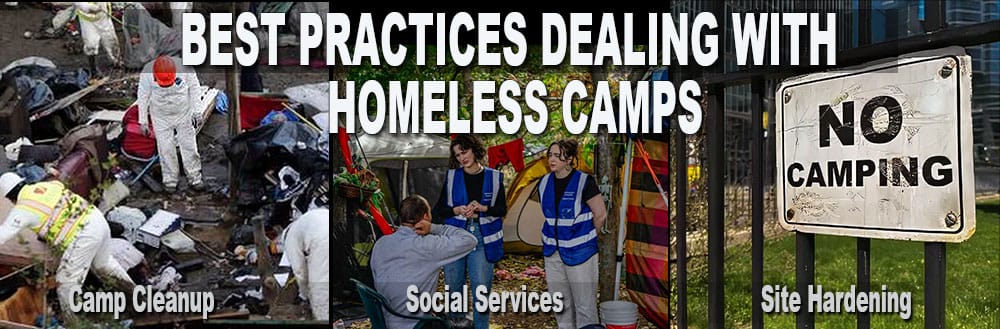
The short version
- Outreach and a posted notice come first. The state model sets the floor at 48 hours, and the notice has to name the date, the services available, and how belongings get recovered.
- Photograph everything before anyone touches anything. Photos, an inventory, and disposal receipts are what protect you if the removal is challenged later.
- Belongings that are not a hazard are tagged and stored for at least 60 days, not 30.
- Sharps, human waste, and contaminated bedding are regulated waste. That is the part that needs an insured crew, not a truck and a couple of volunteers.
- Harden the site the same week you clear it. Fencing, light, and brush removal are the difference between a cleanup and a recurring expense.
What the law actually requires in 2026
Three things changed the ground rules in the last two years, and a lot of the advice still circulating online predates all of them.
Grants Pass removed the shelter-availability bar
In June 2024 the U.S. Supreme Court decided City of Grants Pass v. Johnson, holding that enforcing generally applicable camping rules on public property is not cruel and unusual punishment under the Eighth Amendment. That overturned the practical standard most California cities had been operating under, which treated enforcement as off-limits unless shelter beds were available. Cities now have far more latitude. That is a change in what they may do, not a change in what they should do, and the procedural obligations below did not go away.
Executive Order N-1-24 pushed the state's own approach outward
A month after Grants Pass, the Governor signed Executive Order N-1-24, directing state agencies to prioritize clearing encampments on state property while providing reasonable advance notice and partnering with shelter and service providers. It also encouraged local governments to adopt the same posture and directed the California Interagency Council on Homelessness to publish implementation guidance.
The May 2025 model ordinance is the practical checklist
On May 12, 2025 the Governor released a statewide model ordinance for cities and counties, backed by $3.3 billion in Proposition 1 funding. It is a template, not binding law, but it is the clearest statement of what the state considers defensible, and it is what most Southwest Riverside County jurisdictions are measuring themselves against. Its core requirements:
- Offer shelter and services first. Officials must make every reasonable effort to identify and offer shelter at an emergency shelter, navigation center, or other appropriate housing, plus supportive services, before enforcement.
- Post a notice to vacate at least 48 hours ahead, in a prominent location at the site. It must state the anticipated date and time of the action, what shelter and services are immediately available, and how unattended belongings will be handled, stored, recovered, and by what deadline.
- Re-notice if you slip. If the work does not begin within two days of the date on the notice, a new notice goes up and the 48-hour clock restarts.
- Store non-hazardous belongings for not less than 60 days, tagged and collected. This covers items of apparent value of $50 or more and items of apparent personal value including eyeglasses, working wheelchairs, walkers, crutches, other medical equipment, habitable tents, personal papers, backpacks, and operational bicycles, scooters, and strollers.
- Exigent circumstances are the only shortcut. Where an imminent threat to life, safety, health, or infrastructure requires less than 48 hours, give as much notice as reasonably possible and post storage-and-recovery information at the site as soon as possible afterward.
What does not get stored
The model ordinance is explicit that health and safety hazards are not collected: toxic sharps such as needles, scissors, and knives; chemicals including bleach, paint, and oils; bedding and clothing soiled by human waste or bodily fluids; moldy or mildewed items; anything infested by rodents or insects; and combustibles, propane tanks, and unidentified liquids. Bulky items such as mattresses and sheds, perishable food, contraband, and plain trash are also excluded. Where belongings are co-mingled with needles or human waste, the whole pile may be discarded.
Correcting a figure you may have seen
A 30-day storage window circulates widely in encampment cleanup guidance, including in an earlier version of this page. The state model ordinance says not less than 60 days. Some jurisdictions also impose their own limits on the hours cleanups may occur or on operating during extreme weather. Those are local rules, not statewide ones. Confirm your own city's ordinance before you set a schedule.
The six-step cleanup sequence
This is the order the work actually happens in. Skipping a step does not save time; it moves the cost to the back end, usually as a claim.
-
Outreach and advance notice
Before any enforcement, attempt contact with the people living at the site and offer shelter referrals, behavioral health support, and social services. Log every attempt, including the ones that fail.
Then post written notice at the site. Even where a private property owner has clear authority to clear a camp, a notification window and a coordinated outreach handoff reduce harm, reduce confrontation on the day of the work, and give you a defensible record.
-
Documentation and record-keeping
Photograph or video the entire site before anyone touches anything: tents, structures, personal items, debris, and the general condition of the ground. Wide shots plus detail shots.
Inventory any personal items collected and record where they are stored and how they can be claimed. Keep a running log of outreach attempts, notices posted, dates and times of the work, crew present, and disposal manifests. This file is what protects the owner or the city if the removal is challenged later, and it is the single item most often skipped.
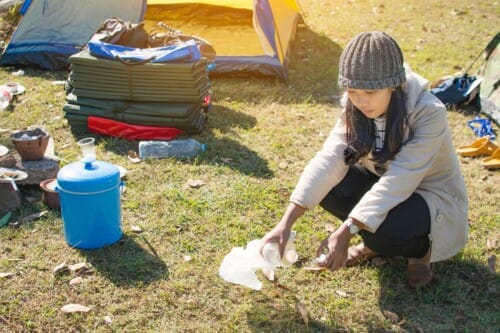
Document the site in its original condition before removal begins. Photos taken after the fact are worth very little. -
Professional removal and compliant disposal
This is where an insured crew matters. Wild West homeless encampment cleanup handles human waste, sharps, biohazards, contaminated bedding and clothing, odor treatment, waste sorting, and disposal at the correct facility rather than the nearest one.
Regulated medical waste follows its own handling and disposal track. The CDC's guidance on regulated medical waste is the baseline; California's hazardous waste and environmental health rules layer on top of it. Where the site sits near a waterway, storm drain, or a fire-prone slope, remediation of soil and runoff belongs in the same scope of work rather than a follow-up visit.
-
Restore and harden the site
A cleared site with nothing changed about it is an available site. Close or block the access point with fencing, gates, or barriers. Improve lighting and sight lines in alleys, trails, riverbeds, and other low-visibility zones. Remove the overgrown brush and debris piles that create concealment.
Then put the location on a walk-through schedule for the first ninety days. Partnering with a local nonprofit or service agency to keep eyes on formerly cleared zones costs far less than a second full cleanout. Property managers running multiple sites across Temecula, Murrieta, and Menifee usually fold this into an existing rounds schedule.
-
Integrated social services
Cleanup does not solve homelessness, and no honest vendor will tell you it does. Durable results come from pairing the removal with mental health support, substance-use treatment, emergency shelter, transitional housing, and job placement. The federal 19 Strategies for Communities to Address Encampments guidance is the most useful synthesis of what has worked elsewhere, and it maps cleanly onto the enforcement-plus-support posture California has adopted.
-
Transparent public communication
Tell residents, tenants, and neighboring businesses what is happening and when. Publish a hotline or reporting path, the social-service contacts, and a complaint route through code enforcement. Close the loop afterward with a short completion and disposal summary.
Communities that hear nothing assume the worst about both the encampment and the response. A two-paragraph notice ahead of the work prevents most of it.
Phase-by-phase framework
A one-page version to hand to a crew lead, a board, or a city contact.
| Phase | Key actions | Why it matters |
|---|---|---|
| Assessment and outreach | Locate and scope the encampment, make contact, offer shelter and services, log every outreach attempt | Reduces harm, provides real alternatives, and builds the record that enforcement was a last step |
| Notice and documentation | Post notice to vacate at least 48 hours ahead; photograph and video the site; record items and conditions | Legal protection, transparency, and evidence of the site's condition before removal |
| Removal and disposal | Insured crew handles waste, biohazards, sharps, and debris; disposal and sanitation documented | Health and environmental compliance, and no liability transferred to the property owner |
| Property storage | Tag and store non-hazardous belongings not less than 60 days; post recovery instructions | Meets the state model standard and closes off the most common source of claims |
| Restoration and hardening | Secure access points, sanitize, install lighting and barriers, clear concealment | Prevents re-encampment and repeat dumping at the same spot |
| Follow-up and communication | Scheduled walk-throughs, ongoing outreach contacts, status updates to residents and stakeholders | Catches recurrence early and keeps community cooperation intact |
If the camp is on your property
This is the situation most property owners and managers in Temecula are actually in, and it works differently from a camp on a public right-of-way.
Temecula Municipal Code Chapter 9.70 makes camping unlawful on public and private property alike, and the city council has found that encampments on private property carry the same health, safety, and welfare concerns as those on public land and constitute a public nuisance. The city manager is authorized to promulgate regulations for city cleanup and removal of encampments on private property and for recovery of all associated costs and expenses.
Separately, the nuisance provisions in Chapter 8.12 let the city serve the owner a written notice to abate, with a minimum of seven calendar days to correct the condition, delivered by registered or certified mail. Ignoring that notice does not make the problem go away; it converts a cleanup bill into a cleanup bill plus enforcement costs and a lien risk.
The practical read
If you own the parcel, you are better off scheduling the work yourself, on your timeline, with your documentation, than waiting for the city to do it and invoice you. You keep control of the notice period, the outreach handoff, and the disposal record.
The same crew and the same documentation approach cover the adjacent situations that tend to arrive together: tenant turnover cleanouts, foreclosure cleanouts, hoarding situations, and brush and yard waste removal for the site-hardening step.
Common questions
California's state model ordinance sets the floor at 48 hours. A notice to vacate gets posted in a prominent spot at the site, and it has to state the date and time of the enforcement action, what shelter and services are available right now, and how anyone can recover stored belongings. If the work does not begin within two days of the date on that notice, a fresh notice goes up and the 48 hours starts over. Cities can require longer, so read your local ordinance before you post anything.
Not less than 60 days under the state model ordinance. That covers items of apparent value of $50 or more and items of apparent personal value: eyeglasses, working wheelchairs, walkers, crutches, other medical equipment, ID and legal papers, photographs, backpacks, and operational bicycles, scooters, and strollers. Health and safety hazards are not stored, and neither are bulky items like mattresses, perishable food, or plain trash and debris.
Yes. Temecula Municipal Code Chapter 9.70 finds that encampments on private property carry the same health, safety, and welfare concerns as those on public property and declares them a public nuisance, with the city authorized to remove them and recover its costs. Under the nuisance provisions in Chapter 8.12, the city can also serve the owner a written notice to abate that gives a minimum of seven calendar days to correct the condition. Most owners are better off clearing the site themselves before the city does it and bills them.
Tents, structures, bedding, furniture, and general debris, plus the material most crews will not touch: human waste, used needles and other sharps, bedding and clothing soiled by infectious material, propane tanks and fuel containers, and mold or rodent infested items. Everything gets sorted, contained, and routed to the correct facility so the disposal side stays compliant. Wild West Junk Removal is licensed and insured and has worked the Temecula Valley since 2021.
Cleanup is only half the job. Close the access point with fencing, gates, or barriers, put light on the area, cut back the brush and overgrowth that made the spot attractive in the first place, and walk the site on a schedule for the first few months. Sites that get cleared and then ignored are usually reoccupied within weeks.
This page is general information about cleanup practice and publicly available California guidance. It is not legal advice. Confirm your local ordinance and, where enforcement is contemplated, your city attorney's current direction.
Sources
- gov.ca.govModel Ordinance: Addressing Encampments with Urgency and DignityOffice of the Governor, May 12, 2025. Source for the 48-hour notice floor, the 60-day storage minimum, and the excluded-items list.
- supremecourt.govCity of Grants Pass v. JohnsonU.S. Supreme Court, June 28, 2024.
- usich.gov19 Strategies for Communities to Address Encampments Humanely and EffectivelyU.S. Interagency Council on Homelessness, May 2024.
- cdc.govRegulated Medical WasteCenters for Disease Control and Prevention.
- ecode360.comTemecula Municipal Code Ch. 9.70Prohibition against certain conduct on public property and property open to the public.
Reviewed and updated August 2026. Legal requirements change; verify current local ordinance before acting.
Encampment on your property in the Temecula Valley?
Licensed, insured crews. Sharps, biohazards, and structures handled. Full photo and disposal documentation with every job.
Wild West Junk Removal · 41713 Niblick Rd, Temecula, CA 92591 · (951) 837-8072
Open Monday through Saturday, 7am to 7pm. Closed Sunday.