
Home › Junk Removal Tips › Illegal Dumping
Property Owners · Landlords · Commercial Sites
What To Do About Illegal Dumping on Your Property
Somebody backed a truck up to your land and left. I have been cleaning up after those people in Temecula and Murrieta since 2021. Here is what the law actually puts on you, who to call, and how to get it hauled off without making it worse.
Family-owned · Licensed & insured · Same-day slots most days · Mon–Sat 7AM–7PM
Whose problem it is
You Did Not Put It There. It Is Still Yours.
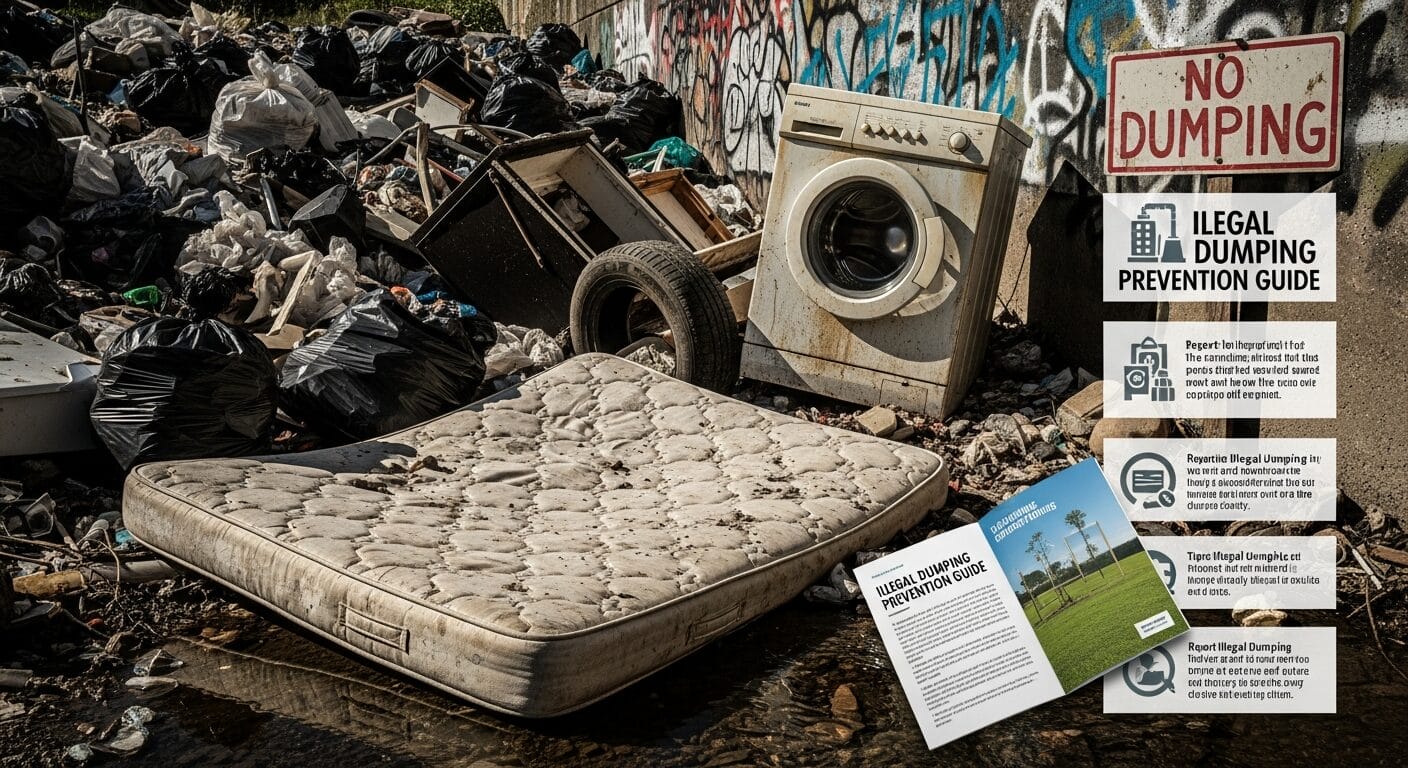
The first thing most people say to me on the phone is some version of "it's not even my trash." I believe you. The county does not care.
In California, cleanup responsibility follows the land. If nobody can prove who dumped it, the parcel owner is the one code enforcement writes to, and the one who pays to abate it. CalRecycle's own abatement guidance says exactly that: unless the responsible party is identified and held accountable, the cost lands on the owner.
The reason agencies push so hard is that a pile is never just a pile. The EPA connects illegal dumping to soil and groundwater contamination, rats, mosquitoes, fire load, and lower property values for the whole street. I have pulled apart enough of these to tell you the fire part is not theoretical. Out in De Luz and Wine Country, a stack of dry pallets and a couch against a brushy fence line is a problem in August.
There is one carve-out in the statute worth knowing. Penal Code 374.3 does not tell a private owner what to do with his own land until the material becomes a public health hazard, a public nuisance, or a fire hazard as determined by the health department or fire agency. In this valley, a debris pile crosses that line faster than people expect, especially in fire season.

The pile grows if you leave it
I can tell you from experience: a dump site that sits for a week is a dump site that gets a second load. The first truck tells every other truck that nobody is watching. Document it first, then get it gone, but do not let "documenting" turn into two months of looking at it.
Day one
The First Six Steps, In Order
Do these before you move a single item. Once the pile is disturbed, your odds of identifying the dumper and getting your money back drop fast.
-
Look from a distance. Touch nothing.
Moving debris destroys evidence and can put you into whatever is buried in it. I have found drums, unlabeled buckets, needles, and old floor tile that was probably asbestos in piles that looked like plain household junk from the driveway. Walk around it before you walk into it.
-
Photograph everything with timestamps on
Wide shots from several angles to show scale and where it sits on the property, then close-ups of individual items. Make sure your phone is saving date and time in the photo data. Back the originals up off the phone the same day. Insurance adjusters and small claims judges both want the originals, not a screenshot.
-
Look for anything with a name on it
Envelopes, utility bills, prescription bottles, contractor receipts, Amazon boxes, business cards, equipment tags. Photograph them right where they sit and leave them there for the officer. You would be surprised how many Riverside County cases get solved off one piece of mail.
-
Check for hazardous material before anything moves
Drums, unlabeled containers, paint, solvents, batteries, TVs and monitors, sharps, tires, and demolition debris that could contain asbestos. If any of that is in the pile, stop and call environmental health before you book anyone, including me.
-
File your reports and write down every case number
A police report plus a code enforcement report. Write down the date, the case number, and the name of whoever took it. That paper trail is what insurance claims, cost recovery, and grant programs are built on, and it is almost impossible to rebuild later.
-
Book a licensed, insured hauler
For anything past a couple of bags, hire a company that carries liability coverage, quotes in writing, and can tell you where the load went. Text me photos of the pile at (951) 837-8072 and I will price it the same day.
Reporting
Who To Call, By Jurisdiction
The number one reason reports go nowhere is that they get filed with the wrong agency. Southwest Riverside County has city limits and unincorporated pockets sitting right next to each other, and half the people who call me are not sure which one they are in.
Inside Temecula
Temecula Code Enforcement, (951) 694-6444, handles violations inside city limits. Use the city's "Am I in Temecula?" tool first. De Luz, Wine Country, Morgan Hill, and French Valley are county, not city. Temecula does not take anonymous complaints, so have your contact info ready.
Inside Murrieta
Murrieta Code Enforcement takes reports inside Murrieta city limits. Riverside County Environmental Health also accepts household trash and garbage complaints for both Murrieta and Temecula.
Unincorporated County
Riverside County Code Enforcement runs a 24-hour complaint line at (951) 955-2004. If it was dumped on a county road, the Department of Waste Resources IMPACT program takes reports at 1-800-870-6600 or through the RivCoMobile app.
File the police report too
Code enforcement deals with the nuisance. The police report is what creates the criminal case number your insurance carrier will ask for and a small claims judge will want to see. If there is anything in the pile that identifies the dumper, say so on the call. That is what moves a report from a log entry to an actual investigation.
A plate number is worth more than a hundred photos of the trash
Riverside County Ordinance 840 declares any vehicle used to illegally dump waste a nuisance, subject to seizure and a 30-day impound, and no criminal conviction is required first. If you have a plate, lead with it.
Safety
What Turns a Cleanup Into a Regulated Job
Most dumped loads are ordinary junk and my crew has it on the trailer in an hour. Some are not, and the difference decides whether this is a quick haul or a permitted abatement with a different kind of contractor.
Drums & unlabeled containers
Do not open, tilt, or move one. Solvents, fuel, and pool chemicals all turn up in dump piles. Photograph and report.
Asbestos debris
Pre-1980 demolition material, old floor tile, pipe wrap, popcorn ceiling. That needs a certified abatement contractor, not a junk hauler.
Medical & sharps
Needles and biohazard bags need specialized handling. Do not bag them yourself.
Paint, oil & batteries
Household hazardous waste. It cannot ride in a standard load and gets routed to a county HHW facility.
Tires
Tracked separately under state law and priced separately. Dumping them doubles the offender's fine.
Electronics & refrigerant
TVs, monitors, and anything with a compressor are restricted from the landfill and go on their own stream. More on that in our e-waste guide.
If you are not sure, treat it as hazardous
Call Riverside County Environmental Health before you schedule any removal. A hauler who will take unidentified drums off your property without asking a single question is not doing you a favor. Improper disposal traces back to the address it came from, and that address is yours.
Removal
Your Three Cleanup Options
Once the documentation is done and you have ruled out hazardous material, it comes down to who moves it and where it ends up.
1. Haul it yourself
Fine for a small, clean load and a truck you do not mind scratching. Budget for transfer station tipping fees, separate charges for mattresses, tires, and appliances, and the fact that you cannot legally leave any of it at a curb or in a dumpster you do not own. If you re-dump somebody else's trash, you are now the offender. If it is more than a truck bed but you want to do the labor, a dumpster rental is the middle option.
2. County or grant-funded programs
Riverside County's IMPACT crews handle dumping on county roads, not private parcels. For farm and ranch land there is a real avenue: CalRecycle's Farm and Ranch Solid Waste Cleanup and Abatement Grant Program, which Riverside County Code Enforcement has drawn from for years. Ask before you clean up. Work that is already done generally cannot be reimbursed.
3. A licensed removal company
The right call for mixed loads, anything heavy, tenant-occupied or customer-facing sites, and any situation where you might go after costs later. We price by volume. The smallest load runs $195 and our full junk removal pricing is published, not made up on your driveway. We load it, sweep the spot, and can tell you where the material went. Reusable items go to our donation partners and recyclable material gets sorted out; our where-your-junk-goes page lists who we work with.
- ✓
Proof of general liability and workers' comp, shown on request
- ✓
Written price covering labor, equipment, and disposal in one number
- ✓
Disposal at a permitted facility, documented for your file
- ✓
An itemized invoice you can attach to an insurance or small claims filing
Keep the invoice
If the dumper is ever identified, a court can order them to pay your removal costs under Penal Code 374.3. A paid, itemized invoice from a licensed hauler is the document that establishes the number. I have had customers come back a year later for a copy.
Commercial
Commercial Lots, Rentals, and Vacant Parcels
Income property gets dumped on for the same reason it gets tenants: predictable access and nobody around after six.
Back alleys, unlit rear parking, dumpster enclosures without a gate, and vacant pads between tenants are the four spots behind almost every commercial call I take. For a property manager the cost is rarely just my invoice. It is the code enforcement notice, the tenant complaint, and the turnover date that slips. If that is your situation, I wrote a separate guide on illegal dumping for property managers that goes deeper on liability and the commercial-quantity threshold.
Related work we handle across the valley: commercial junk removal, tenant turnover cleanouts, construction debris removal, and homeless encampment cleanup.
Document before your tenant does
If a tenant reports the pile before you do, the record starts with a complaint against your property. Filing first puts you on record as the reporting party, not the responsible one.
Prevention
Stopping the Second Load
Sites that get dumped on once usually get dumped on again. What changes that is making the property look watched and hard to back a truck into. Here is what I have seen actually work on repeat customers' lots.
Visible cameras
Remote-access cameras pointed at every vehicle approach. The deterrent comes from being obvious. The plate capture comes from the angle. You want both.
Motion lighting
Bright, motion-triggered light at the approach points. Dumping is a two-minute job done in the dark. Light takes away the two minutes.
Physical barriers
Boulders, bollards, cable, or fencing that keeps a truck from backing to the drop point. If they cannot reverse to it, they will not carry it by hand.
Clear it fast
The strongest single signal. A parcel cleaned within days reads as maintained. One that sits reads as abandoned and invites the next load.
Signage
Post the Penal Code 374.3 penalties and say the site is under video surveillance. It costs almost nothing and moves the opportunists to somebody else's lot.
Cut the weeds
Tall weeds and overgrowth say nobody is home. Regular weed abatement and yard waste removal on a vacant parcel do more for dumping than most people expect.
Weston Molitor
Founder · Wild West Junk Removal · Temecula, CAI started Wild West in Temecula in 2021 and I am still on the truck. Illegal dumping calls are some of the most frustrating jobs we do, not because of the work, but because the customer is paying to clean up a stranger's mess. The best thing I can do for you is make sure you have the paperwork to get that money back if the dumper ever turns up.
"Take the photos before you call me. I will still come out. But I cannot get your evidence back once it is on my trailer."

Questions
Illegal Dumping FAQ
The questions Temecula and Murrieta property owners ask me most after finding a pile.
In California, usually yes. Cleanup responsibility follows the land, not the person who made the mess. If the dumper is never identified, you are the one code enforcement contacts, and you are the one expected to pay for abatement.
It is not the end of the story. Penal Code 374.3 lets a court order a convicted dumper to remove the waste or pay what it cost to remove it, and you can go after the same money in civil court. Both routes depend on knowing who did it, which is why I tell people to document before they clean.
Do not confront them. From your vehicle or a safe distance, get the license plate, the make and color of the truck, a description of the people, what is coming off the tailgate, and the time. Call law enforcement while they are still there.
The plate is the prize. Riverside County Ordinance 840 declares a vehicle used for illegal dumping a nuisance and allows it to be seized and impounded for 30 days, and no criminal conviction is required first.
It depends on which side of the city line you sit on. Inside Temecula city limits, report to Temecula Code Enforcement at (951) 694-6444. The city's "Am I in Temecula?" tool settles jurisdiction, and Temecula does not take anonymous complaints. Inside Murrieta, report to Murrieta Code Enforcement.
For unincorporated areas like De Luz, Wine Country, or French Valley, call Riverside County Code Enforcement at (951) 955-2004, which is a 24-hour line. Dumping on a county road goes to the Department of Waste Resources IMPACT program at 1-800-870-6600 or the RivCoMobile app. File a police report as well any time the pile contains something with a name on it.
You can try, and there are two ways. In a criminal case, Penal Code 374.3 lets the court order the convicted dumper to remove the waste or pay removal costs on top of the fine. Separately, you can file a civil claim for trespass and property damage.
Small claims court is the practical route for most residential cleanups because you do not need a lawyer. Either way, your case is only as good as your paperwork: a police report number, timestamped photos, and an itemized invoice from a licensed hauler.
Under Penal Code 374.3, ordinary dumping carries a mandatory fine of $250 to $1,000 on a first conviction, $500 to $1,500 on a second, and $750 to $3,000 on a third or later. If the load includes used tires, the fine doubles.
Commercial quantities are a misdemeanor with up to six months in county jail and mandatory fines of $1,000 to $3,000 first, $3,000 to $6,000 second, and $6,000 to $10,000 for a third or later conviction. If the dumper runs a business with more than ten full-time employees, the ceiling goes to $20,000.
Yes. CalRecycle runs the Farm and Ranch Solid Waste Cleanup and Abatement Grant Program, which funds cleanup of illegally dumped material on farm and ranch land, and Riverside County Code Enforcement has received those funds for years.
The rules are specific, so call County Code Enforcement before you touch anything. Cleaning up first and asking about grant money afterward is the fastest way to disqualify yourself.
Sometimes. Some policies treat it as vandalism and cover it; plenty exclude pollution cleanup or anything they consider gradual. Commercial policies are all over the map depending on the carrier.
Call your agent before anything is moved. Almost every carrier is going to ask for a police report number, dated photos of the pile as you found it, and a written estimate from a licensed removal company.
Ask for proof of general liability insurance and workers' compensation before you agree to anything, and get a written quote with labor, equipment, and disposal in one number instead of a low headline price with fees tacked on at the end.
Then ask the one question that separates real companies from the rest: will you document where the load went? A licensed hauler takes it to a permitted facility and can show you. A cheap bid that ends with your junk dumped on a dirt road two miles away puts the liability right back on you.
Sources
This page is general information about property-owner responsibilities and local reporting channels, written by a junk hauler, not a lawyer. Fine schedules, phone numbers, and program eligibility change. Confirm current details with the agency before you act. Last reviewed September 2026.
Dumped On? We Will Haul It Off.
Family-owned, licensed and insured. Same-day slots most days, so call early. Text photos of the pile and we will price it before we roll.
Wild West Junk Removal
41713 Niblick Rd, Temecula, CA 92591
(951) 837-8072
Mon to Sat: 7AM-7PM · Sun: Closed
Serving Temecula, Murrieta, and Menifee