
Home › Temecula Junk Removal › Environmental Projects for Teens
Classroom Resources · Temecula Valley
Environmental Projects for Teens and Classrooms
Eight hands-on environmental projects that produce a number, an object, or a letter — decomposition tracking, composting, energy audits, impact math, and real-data research — written by the guy who hauls what your students' families throw away, and adaptable to any grade or subject.
Family-owned in Temecula since 2021 · Licensed & insured · Mon–Sat 7 AM – 7 PM
Wild West Junk Removal · 41713 Niblick Rd, Temecula, CA 92591 · (951) 837-8072 · Mon–Sat 7 AM – 7 PM
Start Here
Why Hands-On Beats a Worksheet Every Time
Most of us met "reduce, reuse, recycle" as a poster on a classroom wall. It did not stick, because a poster is not an experience. The projects on this page are built around measuring something, making something, or sending something — and that is the difference.
There is real research behind that. A 2022 meta-analysis in the Journal of Environmental Psychology pooled 169 studies covering 176,000 children and teenagers in 43 countries and found that environmental education reliably improved what students knew, what they cared about, what they intended to do, and — the hard one — what they actually did. The knowledge effect was the biggest, the behavior effect the smallest. The gap between knowing and doing closes when a kid touches the thing, weighs the thing, and reports on the thing.
That is what every project below has in common. Each one ends with a deliverable that did not exist when the student started: a data log, a sheet of paper they made, a kilowatt-hour total, a letter with a real address on it. And because they are built on measurement instead of memorization, they slot into science, math, language arts, civics, art, and history without much rework. Pick one, run it for two weeks, and you will get more engagement than a semester of vocabulary lists.
One thing worth saying up front: I am not a teacher. I run a junk removal crew in Temecula, Murrieta, and Menifee. What I bring to this list is the other end of the pipeline. I see what your students' families throw away, in what volume, and how much of it never needed to hit a landfill at all. Some of that is baked into the projects, and I put my own two cents in a section further down.
The Core List
Eight Environmental Projects for Teens and Classrooms
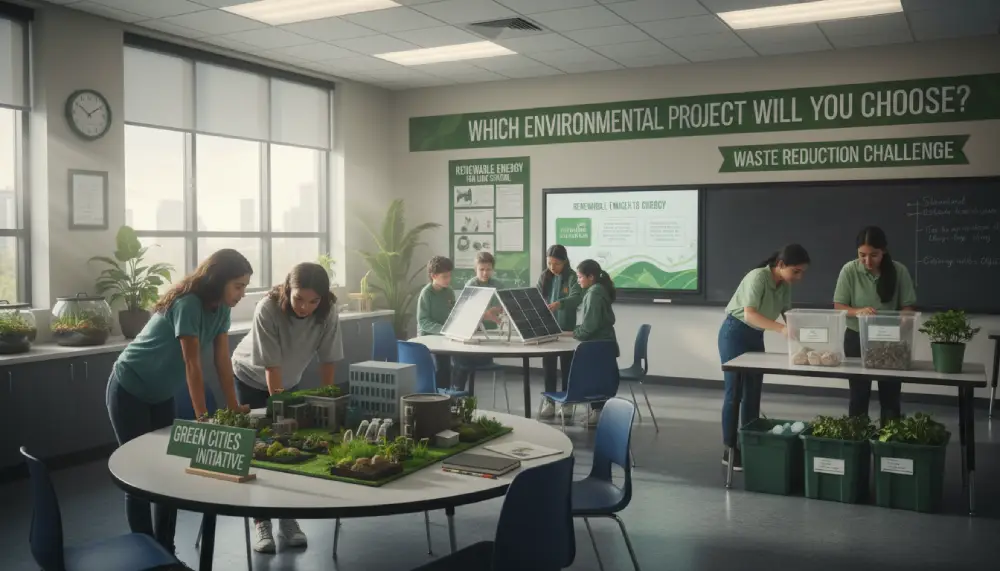
Each project lists the subjects it fits, what students actually do, and how to scale it up or down by grade. Nothing here needs a lab budget. Most of it needs a bucket, a scale, and a spreadsheet.
-
1. Watch Organic vs. Inorganic Material Decompose
Science · Language Arts
Pick a handful of organic samples — apple core, banana peel, leaf litter, a scrap of untreated paper — and a handful of inorganic ones: a plastic film wrapper, a chunk of polystyrene, a bottle cap, a piece of foil. Have every student write a prediction for each (days, weeks, or centuries), then bury or jar them and observe once a week.
The payoff lands around week three, when the apple is unrecognizable and the polystyrene looks exactly like it did on day one. Younger kids sketch what they see. Older students log mass, moisture, and visible change and write a short methods-and-results piece. The EPA's national numbers show that food scraps and yard trimmings together make up about a third of what Americans throw away, which is the whole case for composting in a single statistic.
-
2. Start a Classroom Compost Bin
Science
A five-gallon bucket with holes drilled in the lid works indoors. A pallet bin works outside. Either way the students run it: what goes in, what stays out, browns versus greens, moisture, turning schedule. Keep a shared log so the class can tie conditions to speed. The group that turns weekly will visibly outpace the group that does not, and that is a finding they discovered themselves.
Our weather is an advantage here. The long dry stretches in the Temecula Valley mean the common classroom failure is a bin that dries out, not one that goes anaerobic and stinks. Budget for a spray bottle. The EPA's guidance on preventing wasted food at home gives students a bridge from the classroom bin to their own kitchen.
-
3. Make Recycled Paper
Art · Science
Pull scrap paper out of the recycling bin, tear it, soak it, blend it into pulp, and press sheets over a window screen. One class period plus drying time, and it costs almost nothing. A student who makes one lumpy, ugly sheet understands closed-loop recycling better than a student who watched a video about it.
Push it further by comparing fiber sources — newsprint versus copy paper versus cardboard — and grading the results. Then connect it to the EPA's paper and paperboard data, which shows why paper is the one material stream the U.S. genuinely recycles well.
-
4. Calculate Your Own Environmental Impact
Math · Environmental Science
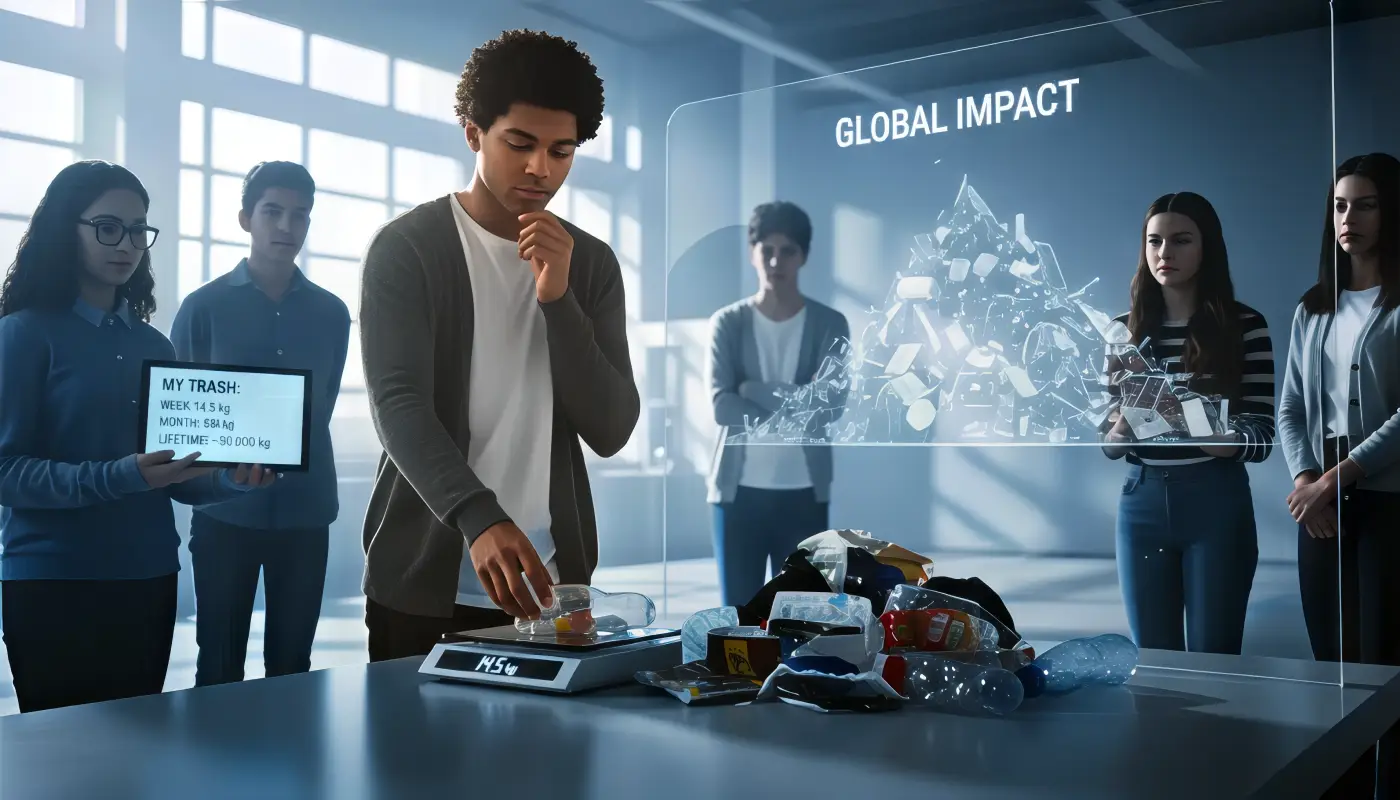
This is the arithmetic project, and it is the one students remember. Each student weighs or estimates their own trash for one week — a bathroom scale and a kitchen bag is enough — then extrapolates to a month, a year, and a lifetime. Scale it outward: their household, the class, the school, the city of Temecula, Riverside County, California.
Then run the what-ifs. How much carbon dioxide does a family avoid by taking transit twice a week? By replacing an eighteen-year-old refrigerator? By cutting meat two days a week? If every student in the room cut their footprint by a third, what does the class save in a year — in a decade? Anchor the math to EPA emissions data by source so the numbers are defensible, not invented.
-
5. Run a Home Energy Audit
Math · Science · Engineering
Students inventory every appliance and fixture at home: what it is, its wattage, and roughly how many hours a day it runs. Watts times hours divided by 1,000 gives kilowatt-hours; multiply by the rate on the family's electric bill and you have dollars. The math suddenly has stakes, and parents tend to get interested.
Younger students can simply rank appliances from hungriest to thinnest. Older students should borrow a plug-in watt meter and measure instead of assuming — the gap between the nameplate rating and real draw is a lesson on its own. For a benchmark, a University of Kent study put real-time energy feedback plus a student "energy delegate" into eight residence halls and cut consumption by 37% over four weeks. Feedback plus peer pressure moves the needle.
-
6. Audit a Local Business
Math · Science · Engineering · Public Speaking
Same method, bigger target. Pick a business that will say yes — a coffee shop, a salon, a small retail unit in Old Town. How many bins do they fill a week, and what is in them? How many hours do the lights, coolers, and HVAC run? Where is the obvious waste?
The version I like best ends with students presenting recommendations to the owner. Small businesses rarely have anyone thinking about this, and a polite teenager with a spreadsheet is disarming. Ground the ask in EPA data on commercial and residential emissions. If the audit turns up a back room full of dead equipment, that is exactly the kind of job my commercial junk removal crew handles, and it turns the recommendation into something the owner can actually do.
-
7. Write Proposals to Companies and Lawmakers
Language Arts · Civics
Individual habits matter, but industrial activity drives most emissions and waste. This project pushes students past their own recycling bin and into the systems around them. Each student researches one company, school board, or city body and writes a formal letter asking for one specific, achievable action: compost the cafeteria food waste, switch to recycled-content packaging, back a local conservation ordinance.
Teach the structure explicitly — know your audience, make one clear ask, explain why it matters to them, propose a next step. The letters that work are short and specific. I have watched one well-argued letter from a kid change how a local shop handles its cardboard, so do not undersell this one.
-
8. Run a Real-Data Research Project
History · Social Studies · Science · Technology
Older students can work with genuine datasets instead of textbook summaries. The NASA-sponsored GLOBE Program maintains a public database of environmental measurements contributed by students around the world, and your class can both query it and add to it. NOAA's paleoclimatology archive holds thousands of datasets built from tree rings, ice cores, corals, and sediment — real climate history, not a graph in a chapter.
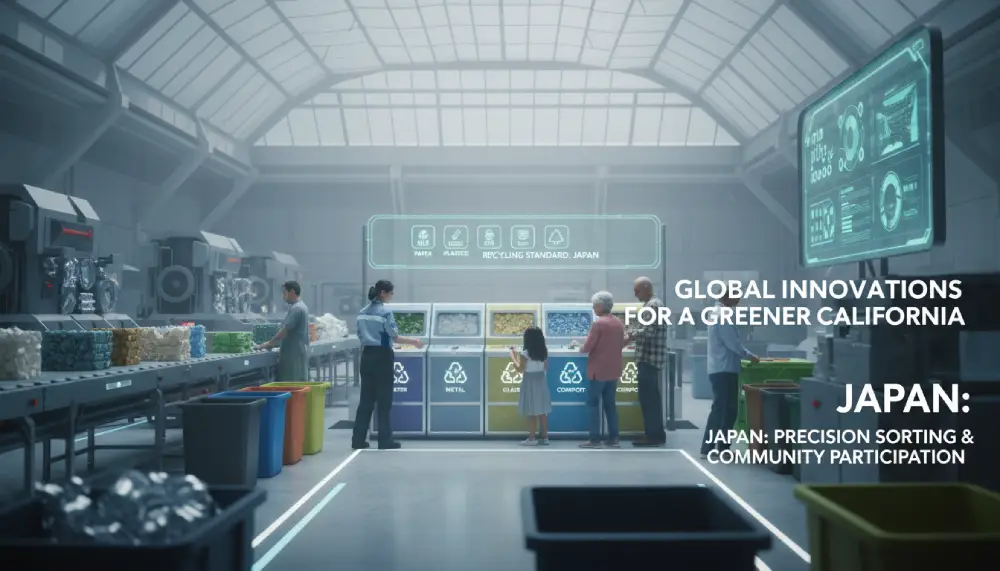
Good prompts: How do different countries handle waste reduction, and what would actually transfer to California? What laws, inventions, or events built the recycling system we have now? Which local organization measures its environmental impact, and how would you verify their claims? Deliverables can be reports or slide decks. The point is the data is real and the conclusion is theirs.
From the Truck
What a Junk Hauler Would Add to Your Lesson Plan
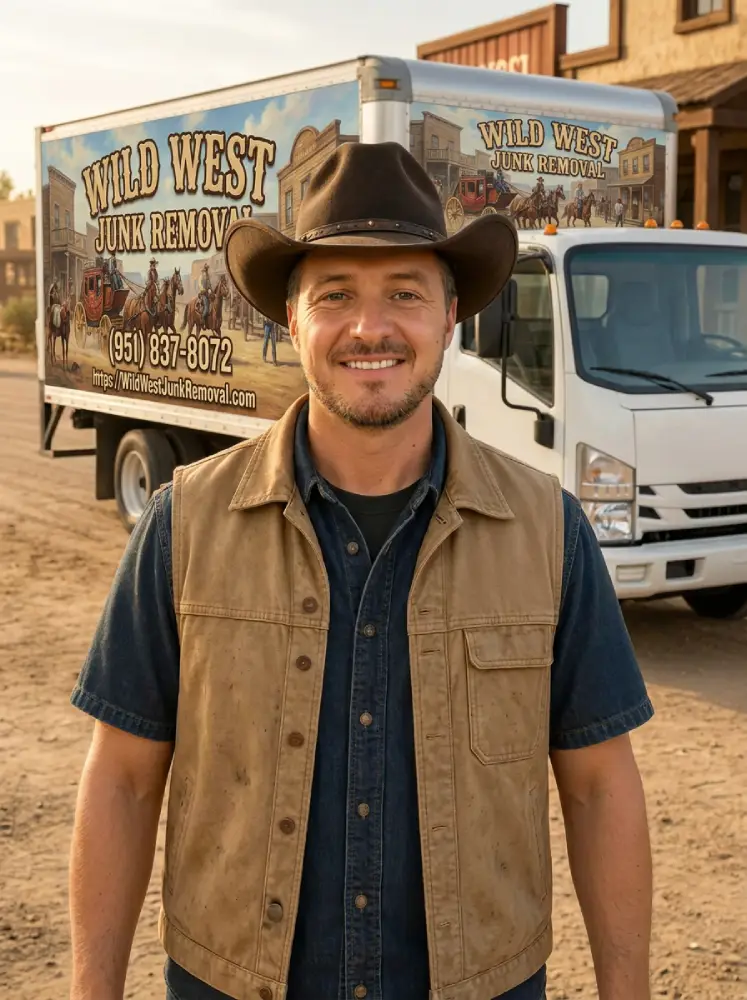
I have been loading other people's discards into a trailer since 2021. If I could put one thing in front of a classroom, it would not be a statistic. It would be the inside of my truck on an average Tuesday.
Weston Molitor
Founder · Wild West Junk Removal · Temecula, CAThe thing that surprises people is how much of a load is not broken. On a typical garage cleanout I am carrying out furniture that works, tools that work, and boxes nobody has opened in nine years. It is not a recycling problem. It is a buying problem, and it happened one small decision at a time.
We sort every load before it goes anywhere. Metal goes to scrap, e-waste goes to a certified processor, and usable furniture gets donated when we can place it. The landfill is the last stop, not the first one. That is the same hierarchy you are teaching — it just has a trailer attached.
"If a teacher wants a field extension for any project on this page, have the students photograph their own garage and count how many items in the frame still work. That number does more than any lecture I could give."
Every project on this list is really the same project: make the invisible visible, then count it.
If you want a real-world extension, the material is already around you. A school year's worth of broken desks, dead monitors, and a storage room nobody has opened since 2019 is a waste audit waiting to happen. Have students inventory and categorize it before anyone hauls it, then work out where each category should go. Our electronic waste page, the what-is-e-waste explainer, and the list of what we take and don't take are useful references for that sort, because they spell out which materials have a legal path and which do not. For where the donated and recycled material actually ends up, see where your junk actually goes.
Safety First
Four Things Students Should Never Handle Directly
Waste audits are excellent teaching tools right up until someone opens the wrong container. If a project involves sorting real material, these four categories are adults-only — or better, professionals-only. This is not liability boilerplate. These are the items that actually hurt people on job sites.
Batteries, especially lithium-ion
Punctured or crushed lithium cells can ignite hours later. Vape pens and cordless tool packs are the usual culprits in residential loads. Students can count and photograph them; an adult collects them for a county household hazardous waste event.
Broken glass and sharps
Anything from a shattered aquarium to a discarded lancet ends up in bins. Sorting by hand is out. If a bag cannot be seen through, a student does not open it.
Paint, solvents, and pool chemicals
Extremely common in Southwest Riverside County garages, and unlabeled containers are the norm. These are household hazardous waste and go to a county facility, never a school dumpster.
Old CRT monitors and televisions
Leaded glass, heavy, and awkward. A dropped CRT is a genuinely bad day. These are e-waste and need a certified handler — not a student and a hand truck. Our TV removal page covers how we handle them.
For anything on this list, Riverside County residents can use the Riverside County Department of Waste Resources household hazardous waste program, and CalRecycle publishes the state rules that govern e-waste and universal waste handling.
Context
Numbers Worth Putting on the Board
Students take a project more seriously when the scale is concrete. These hold up to scrutiny and give any of the eight projects an anchor.
~1/3
Of U.S. trash is food scraps and yard trimmings (EPA)
169
Studies pooled in the 2022 meta-analysis showing environmental education changes behavior
37%
Energy cut in four weeks when students got real-time feedback plus a peer delegate (Kent)
2021
Year we started sorting Temecula Valley loads before they go anywhere
Choose One
Which Project Fits Your Class?
If you only have time for one, use this to pick. Prep time assumes you are starting from nothing. The bottom four rows are the strongest environmental science projects for high school students, because they involve real instruments, real datasets, or a real audience.
| Project | Best subjects | Time needed | Cost | Grade fit |
|---|---|---|---|---|
| Decomposition tracking | Science, language arts | 4–8 weeks, low touch | Near zero | 3rd – 12th |
| Classroom compost | Science | Ongoing, all year | Under $40 | K – 12th |
| Recycled paper | Art, science | One period + drying | Near zero | 2nd – 10th |
| Impact math | Math, env. science | 1–2 weeks | Free | 6th – 12th |
| Home energy audit | Math, science, engineering | 1–2 weeks | $25 watt meter (optional) | 5th – 12th |
| Local business audit | Math, science, speaking | 2–4 weeks | Free | 9th – 12th |
| Proposal letters | Language arts, civics | 1–2 weeks | Free | 2nd – 12th |
| Real-data research | History, science, tech | 3–6 weeks | Free | 8th – 12th |
Before You Start
A Short Prep Checklist
Six things that separate a project that runs itself from one you abandon in week two.
- ✓Decide the deliverable first. A number, an object, or a letter. If you cannot name what the student hands in, the project will drift.
- ✓Get baseline data on day one. Every measurement project needs a "before." Skip it and you have no story to tell at the end.
- ✓Set the observation cadence. Same day, same time, same student roles. Inconsistent logging is the top reason decomposition projects fizzle.
- ✓Pre-clear any outside contact. Business audits and proposal letters need a yes from admin and from the business before students invest.
- ✓Plan where the material goes. Compost, pulp, and audit debris all need an exit. Decide before you generate it, not after. Anything green goes in the yard waste stream, not the trash.
- ✓Book the haul-out early. If a project ends with a storage room emptied, schedule it. Our commercial cleanout calendar fills fastest at semester end.
A note on school dumpsters
The dumpster behind the gym is for ordinary trash. Batteries, paint, CRTs, and fluorescent tubes are not ordinary trash, and a district can be cited for what a well-meaning teacher drops in there. When the audit is over, keep the hazardous categories staged separately and let a licensed hauler or the county program take them.
Reviews
What Temecula Valley Neighbors Say
We are a small local outfit, and word of mouth is most of our business. Here is a sample of what people have posted on Google.
Weston and his team are on it. I run a commercial operation and sometimes we need to bring in some professionals to get rid of some insane types of junk. They respond as fast as any company I have seen, and get the job done 100% of the way with no shortcuts. Good people over at Wild West, recommend highly without any reservation.
Wild West Junk Removal is the real deal! They showed up on time, worked fast, and were super professional. The crew was friendly, respectful, and went above and beyond to make sure everything was cleaned up perfectly. Fair prices, great service — I highly recommend them to anyone needing junk gone fast.
Nick and the crew were on time and very professional. They removed reclining couches, entertainment center, coffee table, end tables from our upstairs loft. They were very careful and cleaned the area afterwards. Great price! I would definitely recommend Wild West junk removal.
This company is amazing! I was in need of junk removal — I called, they came, it was done! They are so professional in every way! Courteous and friendly. What can I say, I will use this company forever!
Questions
Environmental Projects for Teens: FAQ
The questions teachers and parents actually ask, plus a few about what happens when a project ends with a room that needs to be emptied.
Nearly all of them. Decomposition and composting are science; impact calculations and energy audits are math and engineering; proposal letters are language arts and civics; papermaking is art; and research projects work in history, social studies, and technology. That cross-curricular flexibility is why these projects are easy to bolt onto an existing lesson plan instead of carving out new time.
Decomposition tracking. It costs nothing, uses material already in the trash can, runs on about ten minutes a week, and produces a genuinely startling result by week three when the organic samples are gone and the plastic looks brand new. Impact math is a close second and also costs nothing.
Papermaking fits in a single class period plus drying time. Impact math, proposal letters, and home energy audits run one to two weeks. Business audits take two to four weeks because of scheduling. Decomposition needs four to eight weeks of light weekly observation, and a compost bin is best treated as an all-year fixture.
The four with real measurement and a real audience: the home energy audit with a plug-in watt meter, the local business audit that ends in a presentation to the owner, impact calculations checked against EPA emissions data, and research projects built on GLOBE or NOAA datasets. High schoolers disengage from projects that feel simulated, so an outside audience or an authentic dataset matters more than the topic.
Start with something they can weigh, like one week of their own trash on a bathroom scale, then extrapolate outward to household, school, city, and county. For emissions, use published EPA figures by source rather than online calculators with hidden assumptions, and have students state their assumptions in writing. A defensible estimate with visible math is worth more than a precise-looking number from a black box.
Yes. A 2022 meta-analysis of 169 studies found environmental education measurably improved students' knowledge, attitudes, intentions, and behavior. A University of Kent trial that gave students real-time energy feedback and a peer energy delegate cut consumption 37% in four weeks. Closer to home, student proposal letters have gotten local businesses to change how they handle cardboard and food waste. The common factor is that someone outside the classroom received the output.
The NASA-sponsored GLOBE Program hosts a public database of environmental measurements collected by students worldwide, and classes can both query it and contribute to it. NOAA's paleoclimatology archive offers thousands of datasets from tree rings, ice cores, corals, and sediments. The EPA publishes national waste and emissions figures, and CalRecycle covers California-specific diversion data.
With limits. Clean organics, paper, and packaging are fine with gloves. Four categories are off-limits to students entirely: lithium-ion batteries, broken glass and sharps, paint and solvents and pool chemicals, and old CRT monitors and televisions. Students can count and photograph those items, but an adult or a professional should be the one moving them.
The Riverside County Department of Waste Resources runs household hazardous waste collection for paint, solvents, batteries, and pool chemicals, and CalRecycle publishes the state rules covering e-waste and universal waste. None of it belongs in a school dumpster, and none of it belongs in a regular junk load either.
We can, and it is one of our favorite jobs. The usual arrangement is that students inventory and categorize the material first, because that is the lesson, and we handle the removal and sorting afterward, routing metal to scrap, e-waste to a certified processor, and usable items to donation where we can place them. Call or text (951) 837-8072 to talk through timing.
We price by volume, not by the hour. A quarter load is 3 cubic yards at $195, which is our minimum pickup. A half load is 6 cubic yards at $350, three-quarters is 9 cubic yards at $495, and a full 12-cubic-yard load is $595. Labor, loading, sweep-up, and disposal are included, and the price you are quoted at the door is the price you pay.
Yes. We cover Temecula, Murrieta, Menifee, Wildomar, Lake Elsinore, Canyon Lake, Winchester, and French Valley, plus the surrounding Southwest Riverside County communities. We are open Monday through Saturday, 7 AM to 7 PM, and closed Sundays.
Turning a Project Into a Real Cleanout?
Students Sort It. We Haul It.
If a waste audit ends with a storage room, a garage, or a classroom full of material that needs to go, we will sort it, load it, haul it, and sweep up. Family-owned in Temecula since 2021. Written price before anything moves.
Wild West Junk Removal · 41713 Niblick Rd, Temecula, CA 92591 · Mon–Sat 7 AM – 7 PM · service@wildwestjunkremoval.com · Request a quote online
References
Sources & Further Reading
Reviewed and updated September 7, 2026 by Weston Molitor, founder of Wild West Junk Removal, Temecula, California.