
Piano Removal · Temecula, CA
Piano Removal in Temecula, CA: Upright & Grand Piano Hauling Done Right
What a piano actually weighs, why the Saturday DIY move is where the floor damage and the back injuries start, what happens to your piano after we load it, what it costs, and how to get a crew out here today.
By Weston Molitor, Founder · Serving Temecula since 2021 · Updated August 11, 2026

Wild West Junk Removal · 41713 Niblick Rd, Temecula, CA 92591 · (951) 837-8072 · Monday through Saturday, 7am to 7pm · Sunday closed
Reason 1
Why a piano fights back, and why gear beats muscle every time
I've carried more pianos out of Temecula living rooms than I can count, and the call usually opens the same way. It's just a piano, how hard can it be? I get why people think that. But a piano is one of the few things in a house where the weight, the shape, and the finish all work against you in the same second. It's heavy. It's top-loaded, so it lurches the instant you tilt it. And it has to clear a doorway that's almost always narrower than the piano is wide. That's why piano removal is the job folks call me about most often after a weekend attempt has already gone sideways.
The floor is the part nobody sees coming. Even a spinet, which sits on the light end, drops 50 to 80 pounds of point load onto each of its four casters. Old casters get flat spots, and a flat spot squeezes all of that into a patch about the size of a quarter. Hardwood, tile, and the vinyl plank that's in half the newer homes over by Redhawk and Wolf Creek all give up under that the moment somebody drags the piano across a room. A piano that's sat in one spot for twenty years has usually pressed small depressions into a softer floor already. You just won't see them until it moves.
My crew handles upright and grand piano removal across Temecula and the rest of the valley as part of our regular heavy-item work. We roll up with gear matched to the piano type you described on the phone, do all the lifting and any grand disassembly ourselves, and work the tight spots so you don't have to. A single piano in a living room is the same kind of job to us as a full estate cleanout, so it makes no difference whether it goes out alone or with a truckload behind it. Our Temecula service area covers single-item pickups just as readily as big loads, and we run the same crews out to Murrieta and Menifee.
An upright isn't balanced like furniture. The cast iron plate, which is the heavy frame the strings anchor to, sits up in the top of the case. So the top of the piano is far heavier than the bottom. When you tilt an upright to set it on a dolly, that heavy top wants to keep right on going. That's the moment most amateur moves come apart. The piano reaches an angle where you can't control how fast it's tipping, and either it goes over or somebody wrenches their back trying to hold it.
The way that works is a heavy-duty dolly rated well past the piano's weight, straps that spread the load across the cabinet instead of one point, and two people minimum with a third on any stairs. Moving blankets keep the finished case off the door frames. A stair dolly with a nose plate is not optional on any stair run longer than a couple of steps. The Piano Buyer guide to safe piano moving walks through why that gear matters at this weight class. We bring it matched to whatever you describe when you book.
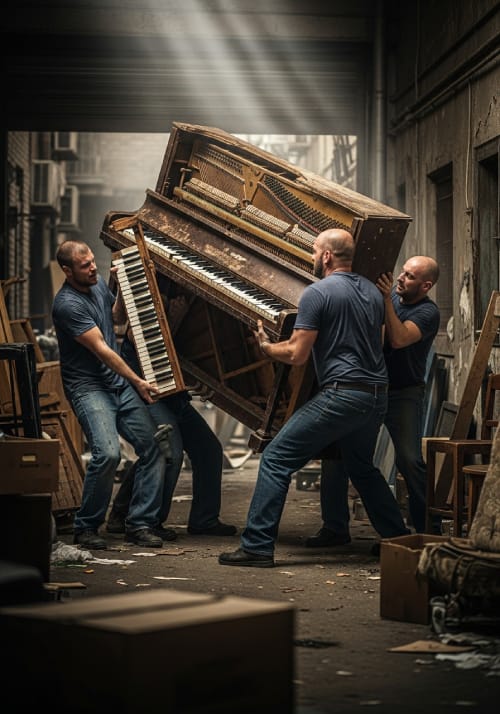
Back injury risk
An upright shifts its weight the second a dolly crosses a threshold. That angle change is where most amateur piano moves send somebody to urgent care. The American Physical Therapy Association keeps piano moving on its list of highest-risk household tasks.
Floor damage
Each caster concentrates 50 to 80 pounds onto a patch the size of a quarter. Dragging without a dolly gouges hardwood, cracks tile grout, and tears vinyl plank. Depressions under old casters are often there before the move starts.
Doorway clearance
Most uprights measure 54 to 58 inches wide. A standard interior door is 32 to 36. The piano has to be tilted onto a dolly and angled through, which takes clear calls between the crew and padding on the frame.
Stair hazard
Taking a piano down stairs without a stair dolly is the most dangerous improvised move in the house. A 400-pound piano building momentum on a staircase can't be stopped by hand once it starts to slide.
Cabinet damage
Piano cabinets are finished wood. Contact with a door frame, wall, or railing at the wrong angle chips it. Blankets and frame protection are what keep it clean all the way out to the truck.
Grand disassembly
A grand won't move whole without a piano board. Legs, pedal lyre, and lid come off in sequence before the body goes down. There's no shortcut around knowing the order.
Reason 2
What every piano type actually weighs
Piano weight ranges wider than people expect even inside one category. A spinet and a studio upright are both just an upright to most folks, but there can be 300 pounds between them. So when somebody calls and says they've got an upright to go, the first thing I ask is which kind. That one answer sets the crew size, the equipment, and whether we're here an hour or three.
The ranges below are the working numbers I plan around, drawn from Piano Buyer's piano weight guide. Older instruments run heavier, especially pre-war uprights with solid cases and heavy plates, and we see plenty of those in the older parts of Temecula and out toward the wine country. If you're not sure what you have, grab a tape measure and tell me the height. Spinets are usually under 40 inches, studio uprights around 45, full uprights 48 to 52. I'll sort it from there.
| Piano type | Typical weight | What it means for removal |
|---|---|---|
| Spinet | 200 to 400 lbs | Lightest upright, under 40 inches tall. Still a dolly job through doorways, never a hand carry. |
| Console | 350 to 450 lbs | Common in homes, 40 to 43 inches tall. Two-person crew minimum. |
| Studio upright | 400 to 500 lbs | Common in schools and studios, 45 to 47 inches. Two-person crew standard. |
| Full upright | 500 to 800 lbs | 48 to 52 inches, older ones near the top of the range. Three-person crew for stairs. |
| Baby grand | 500 to 600 lbs | Legs and lyre off, body onto a piano board. Larger footprint than an upright. |
| Parlor or medium grand | 600 to 800 lbs | Full disassembly, piano board and skid board. Three-person crew minimum. |
| Concert grand | 900 to 1,200 lbs | Rare in homes, seen in estates and churches. On-site look before we quote. |
At 400 to 500 pounds, the studio upright is the piano we see most often in Temecula household and estate cleanouts. Heavy enough that it demands a purpose-rated dolly and proper strapping, light enough that the right gear turns it into a clean single-visit job. We carry dollies rated for this class on every piano call. Full volume detail sits on the Wild West pricing page.
Reason 3
Grand piano removal: piano boards, and why the order matters
A grand can't be tilted onto a standard appliance dolly the way an upright can. The body rests on three legs, two up front near the keys and one at the tail, and the underside has no flat surface to set down on while it's assembled. Moving one whole is only possible with a specialized piano skid board that clamps to the case and rides on floor dollies.
For most homes we take it apart instead. Fold the fallboard over the keys, pull the music desk, prop and remove the lid, take all three legs off in sequence with the body supported at every stage, remove the pedal lyre, lower the body onto a padded piano board sized to the instrument, and roll it out on floor dollies. It sounds technical because it is, and the order is the whole ballgame. Pull the wrong leg first and the body drops. We run the same sequence on every grand and put the room back the way we found it once the piano's on the truck.
Reason 4
Stairs, narrow halls, and the access details that change the whole job
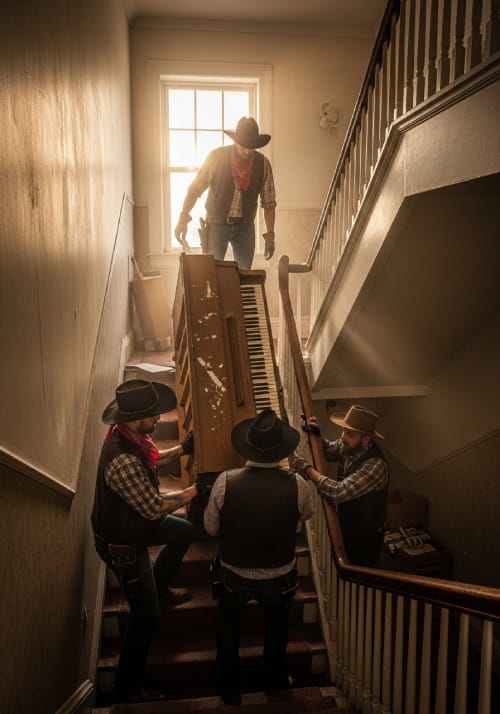
Taking a piano down a flight of stairs without a stair dolly is about the most injury-prone thing you can attempt in a house. A stair dolly holds the piano on a wheeled platform with a pivoting nose that steps down each tread under controlled tension, so the piano never gains momentum. Without one you're relying on muscle to hold 400 to 800 pounds, and past a certain angle on most staircases, muscle doesn't hold it.
Stairs are a crew-size question too. Getting an upright down a flight safely takes three people, one on each side and one below to guide and spot. Two-person stair moves only work on very short runs with a wide staircase and no turn. The two-story tract homes around Paloma del Sol, Harveston, and Morgan Hill nearly always have a 90-degree landing turn, and that's the toughest point on the route.
Straight runs under eight steps. A two-person crew with a stair dolly usually handles these cleanly. Note the stairway width and any handrail in the way when you call.
Long runs or 90-degree landing turns. Three-person crew with a stair dolly. The landing turn often means repositioning the piano mid-staircase with the crew spread across different steps.
Narrow hallways to the door. Most uprights clear a 36-inch hallway on a dolly in the tilted position. Anything tighter, measure it and tell us before we arrive.
Outdoor path to the truck. Steps at the door, a steep driveway, gravel, or uneven walkways all change how we get the piano from the threshold to the trailer. Describe the exterior route on the call.
Elevator-only floors. For a condo or a multi-story building, get the elevator's interior depth. Most residential elevators take an upright on a dolly, but depth is the number that decides it.
36 inches: the practical minimum doorway width for an upright on a dolly
A standard upright runs 54 to 58 inches wide and has to tilt to roughly 45 degrees to pass through a door. Tilted, its front-to-back depth is usually 30 to 34 inches, which makes a 36-inch door the clean-pass minimum without risking the cabinet on the frame. Narrower doors take specific tilting and rotation that add time. Measure your narrowest door before you call. It's the single most useful number for planning the route.
What it costs
Piano removal pricing in Temecula
We price by how much of the truck the job fills, not by the hour. You get the number before we lift anything, and it doesn't move unless the scope does.
Quarter Load
3 cubic yards
$195
Minimum pickup
Spinets Start Here
Half Load
6 cubic yards
$350
Full upright or studio piano
Three-Quarter Load
9 cubic yards
$495
Baby grand, disassembled
Full Load
12 cubic yards
$595
Grand plus bench and other items
Every price includes two-person labor, fuel, all lifting, grand piano disassembly, sorting for donation, and licensed disposal. No deposit to book. A short list of situations carries a surcharge, and every one of them is quoted in writing before work begins.
What can change the price
- Stairs
- $150 on loads up to one-half truck load, $300 on loads over one-half truck load, for carrying items up or down stairs. Tell us the floor level when you call and the figure goes in your written estimate.
- Appliances
- $30 each. Covers refrigerant handling and the separate disposal stream that refrigerators, freezers, and AC units legally require.
- Mattresses
- $15 each, any size.
- Extra loading time
- A full load includes one hour of loading. Past that hour, $75 per hour per crew member.
- What a full load means
- 12 cubic yards in a 12ft x 8ft x 4ft dump trailer, loaded by a two-person crew.
Not sure which bracket your piano falls in? Text a photo of the instrument and the door it has to clear and we'll tell you before we drive out. Full volume detail sits on the Wild West pricing page.
Reason 5
What happens to your piano after we pick it up
If a piano still plays or can be brought back, we look for a donation home before we ever think about disposal. Schools, churches, and community music programs around the Temecula Valley take working uprights a family is clearing out fairly regularly. I flag donation potential right on the scheduling call. If the instrument's been maintained and it plays, we route it for donation instead of the landfill. A piano that ends up in a school music room got a second life, and that beats the alternative every time.
Pianos that can't be saved go to a licensed facility. That's cracked soundboards, broken plates, bad termite or water damage, the ones that spent a decade in a hot garage. The materials inside a piano, steel strings, a cast iron plate, spruce and felt, a hardwood case, don't recycle economically in most municipal streams. The Piano Technicians Guild guidance on old pianos lands in the same place. When a piano can't be donated or sold, responsible disposal is the right path. We don't dump pianos on a back road, and in California that also keeps you clear of the illegal dumping penalties that come with a piano left at the curb too long.
| DIY piano move or self-haul | Wild West piano removal |
|---|---|
| Three to five adults, a borrowed truck, and an appliance dolly rated for a fridge, not a 500-lb piano | Crew arrives with dollies, straps, and piano-specific gear sized to the instrument |
| Casters dragging over hardwood, tile, or vinyl plank with nothing under the wheels | Piano lifts onto a rated dolly, no caster contact with the floor during the move |
| Stair move relies on muscle to stop a 400 to 800-lb piano from running downhill | Stair dolly with a nose plate controls the descent, the crew guides instead of holds |
| Grand moved without disassembly because nobody knows the leg-removal order | Grand disassembly and piano board handled in the correct sequence by a trained crew |
| Unsalvageable piano left at the curb for weeks or dropped at an illegal site | Donation checked first, the rest goes to a licensed facility, never an illegal dump |
Piano types we remove
Every piano and large instrument we handle in Temecula
Single-piano pickups are welcome. It doesn't have to be part of a bigger cleanout. Our full acceptance list is here.
Spinet and console
200 to 450 lbs. Most common in homes built from the 1960s through the 1990s. Two-person crew with a rated dolly. Flag any tight doorways or stairs.
Studio and full upright
400 to 800 lbs. Common in schools, studios, and larger home music rooms. Two-person crew standard, three for stairs or heavy full uprights.
Baby grand and parlor grand
500 to 800 lbs. Legs and lyre off, piano board, floor-dolly transport. Three-person crew minimum. Describe the room and the access path.
Player and antique uprights
Heavier than modern equivalents thanks to older construction and the player mechanism. Give us the approximate height and anything unusual about it.
Church and institutional
Large uprights and grands from churches, schools, and commercial spaces, often the heaviest in the residential range. On-site look recommended.
Piano plus other items
The piano can go with a broader furniture or estate cleanout. Tell us everything so the truck is sized for the whole load.
Who calls us
When Temecula homeowners call us for piano removal
Nobody's played it in ten years
The kids grew up, nobody touches it, and it's holding a corner of the living room hostage. We take it out, donation checked first, disposal if it can't be saved.
An estate cleanout includes a piano
A home being cleared after a passing often has a piano no one in the family can take. Our estate service takes the piano in the same visit as the rest.
Getting a home ready to sell
A piano sitting in a room a buyer needs to picture as an office is worth clearing before listing photos. Pair it with a moving-day cleanout.
The piano is unplayable
Cracked soundboard, warped keys, structural damage, no resale or donation value left. We remove it and route it to a licensed facility so it never sits at the curb.
A downsize needs the space cleared
Moving somewhere the piano won't fit. We grab it before or on moving day so the movers aren't working around it.
A church or school is replacing one
The old piano has to go before the new one lands. We handle institutional pieces and can time the removal to the delivery.
Who does the work
The crew that shows up is my crew
Weston Molitor
Founder and owner, Wild West Junk RemovalI started Wild West Junk Removal here in Temecula in 2021 as a family-owned operation, and heavy-item work has been part of it since day one. Pianos are the item where the gap between the right gear and the wrong gear shows up fastest, so every crew member learns the tilt, the strapping, and the grand disassembly sequence before he touches one.
Tell me the piano type, the floor it's on, and the narrowest door on the way out. Those three answers are what let me put the right crew and the right dolly on the truck the first time.

Before the crew arrives
Piano removal prep checklist
Run through this before you call or before haul day. Each one takes under two minutes and makes the job faster.
Piano type identified. Approximate height and style, so we confirm the right crew and gear before we head out.
Narrowest doorway measured. The tightest door on the path from the piano to the street. Under 36 inches means specific technique and a little more time.
Stairs described. Number of steps, straight or a landing turn, and stairway width. Upstairs pianos need a stair dolly and extra crew lined up ahead.
Path cleared. Furniture, floor lamps, and loose rugs off the route between the piano and the exit. Loose rugs are a real slip hazard under a heavy load.
Exterior path checked. Steps at the door, a steep driveway, gravel, or uneven walkways between the door and truck parking.
Floors you want protected. Mention them so we bring mats and protective material for that run.
Piano condition noted. If it plays and might be donation-eligible, say so. If it has a cracked soundboard or a broken plate, note that so we plan the disposal routing.
Other items in the load. Anything else going in the same trip, so the truck covers the full scope and not just the piano.
What clients say
What Temecula Valley neighbors say about us
Five-star Google reviews from Wild West Junk Removal customers around Temecula, Murrieta, and Menifee.
Weston and his team are on it. I run a commercial operation and sometimes we need to bring in some professionals to get rid of some insane types of junk. They respond as fast as any company I have seen, and get the job done 100% of the way with no shortcuts. Good people over at Wild West, recommend highly without any reservation.
Wild West Junk Removal is the real deal! They showed up on time, worked fast, and were super professional. The crew was friendly, respectful, and went above and beyond to make sure everything was cleaned up perfectly. Fair prices, great service. I highly recommend them to anyone needing junk gone fast.
Nick and the crew were on time and very professional. They removed reclining couches, entertainment center, coffee table, end tables from our upstairs loft. They were very careful and cleaned the area afterwards. Great price! I would definitely recommend Wild West junk removal.
Wild West Junk Removal Service was great. Nick and Jake were friendly, fast, and really efficient. They gave me a fair price and were quick in and out, making the whole process hassle-free. I definitely recommend them.
Read all Google reviews for Wild West Junk Removal · Post your own Google review
How it works
How to book piano removal in Temecula
Call or text with the piano type and access details
Call or text (951) 837-8072 and describe the piano, its type, which floor and room it's in, the narrowest door on the way out, and any stairs. Most piano removals get priced and scheduled in that one call. For concert grands or unusually tight access we may want a quick on-site look before setting the date.
Clear the path before haul day
Move furniture, loose rugs, and obstacles off the route between the piano and the door, and check the exterior path for trip hazards. You don't need to move the piano itself. Just clear the lane we'll use.
Crew arrives with gear matched to the job
We bring the dolly, straps, blankets, and stair equipment for the piano type you described. The written price is confirmed before any work starts. On grands we run the leg and lyre removal, wrap the body, and load in the right order. Uprights go up on a rated dolly, padded, and out through the access path.
Area swept, piano gone, space is yours
Once it's loaded we sweep where it stood, which usually turns up twenty years of dust and the occasional receipt. Same-day slots most days across Temecula and Riverside County, Monday through Saturday, 7am to 7pm. Call early in the day for the best window. Service areas are listed on our Temecula junk removal page.
We remove pianos that are leaving for good, headed to disposal or donation. If you need a piano relocated to another room or a new address where it'll keep being played, that's piano moving, which is work for specialty piano movers who also tune and re-regulate after transport. We handle removal and disposal. If you're not sure yet, settle that first, then call us once you know the piano is leaving your property.
Ready to clear that piano out for good?
We remove every piano type, spinet to grand, from Temecula homes and businesses. Right equipment, trained crew, same-day slots most days. Call for a free estimate.
Frequently asked questions
Piano removal Temecula FAQ
The questions Temecula homeowners ask most before scheduling a piano pickup.
Piano removal in Temecula runs $195 to $595 with Wild West Junk Removal, priced by how much of the truck the job fills rather than by the hour. A spinet or small console usually lands between a quarter and a half load, so $195 to $350. A full upright or studio piano fills about a half load, around $350. A baby grand or grand runs three-quarters to a full load, $495 to $595, because of the leg removal, the disassembly, and the bigger footprint in the trailer. Stairs add $150 on loads up to one-half truck load and $300 on loads over one-half truck load. You get the whole number in writing before we lift anything.
Pianos weigh roughly 200 to 1,200 pounds depending on the type. Spinets run 200 to 400 lbs, consoles 350 to 450, studio uprights 400 to 500, full uprights 500 to 800, baby grands 500 to 600, parlor and medium grands 600 to 800, and concert grands 900 to 1,200. Weight is what sets the crew size and the equipment, and that is why it drives the price. Pre-1970s uprights with solid cases and heavy cast iron plates often sit above the modern range, and there are a lot of those in the older parts of Temecula. If you are not sure what you have, measure the height off the floor and I can place it on the phone.
Yes. Wild West Junk Removal removes baby grands, parlor grands, medium grands, and concert grands throughout Temecula and the surrounding valley. A grand cannot ride a standard appliance dolly, so we take off the lid, the pedal lyre, and all three legs in a set sequence, wrap the body, lower it onto a padded piano board, and roll it out on floor dollies. The sequence matters because pulling the wrong leg first drops the body. Most grand jobs need a three-person crew. Tell me the size of the grand and the room it sits in when you call so the right board and crew go on the truck.
Yes. Upstairs piano removal in Temecula takes a stair dolly and usually a three-person crew, one on each side and one below to guide and spot. What I need from you is the number of steps, whether the staircase runs straight or turns at a landing, and the width of the stairway, because those three answers set the crew and the gear. Stairs add $150 on loads up to one-half truck load and $300 on loads over one-half truck load, and that figure goes in your written estimate before we start. On the two-story tract homes around Paloma del Sol and Harveston, the 90-degree landing turn is almost always the hardest point on the route.
If the piano still plays or can be restored, we look for a donation home before we ever think about disposal. Schools, churches, and community music programs around the Temecula Valley take working uprights fairly often. If the instrument cannot be saved, meaning a cracked soundboard, a broken plate, or serious water or termite damage, it goes to a licensed Riverside County disposal facility. Wild West Junk Removal does not leave pianos at illegal dump sites, which also keeps you clear of California illegal dumping penalties. Describe the condition on the call and we plan the routing before the truck rolls.
Yes. Player pianos and antique uprights are some of the heaviest instruments Wild West Junk Removal handles in Temecula, because the older cases are denser and the player mechanism adds weight on top of that. An early-1900s player piano can run 300 to 400 lbs heavier than a modern upright of the same height. That extra weight usually means a third crew member and a heavier-rated dolly, so give me the approximate height and anything tight about the access when you call and we will size the job correctly the first time.
Yes, we have same-day slots most days. Wild West Junk Removal is open Monday through Saturday, 7am to 7pm, and closed Sunday, and we cover Temecula, Murrieta, Menifee, Wildomar, Lake Elsinore, and the rest of southwest Riverside County. Call early in the day for the best shot at a same-day window. Jobs that need a stair dolly or full grand piano disassembly sometimes move to the next day so the right equipment is confirmed on the truck before we head out.
No. The Wild West Junk Removal crew handles every bit of disassembly a safe removal needs, which on a grand means the lid, the pedal lyre, and the legs. Please do not try to pull piano legs yourself. The order the legs come off is what keeps the body supported at each stage, and getting it wrong is how people end up with a grand on the floor and a hole in it. The only prep I ask for is a clear path from the piano to the exit door, with loose rugs and floor lamps out of the way.
Yes, floor and wall protection is standard on every Wild West Junk Removal piano job in Temecula, and it is most of the reason we bring the gear we do. The piano comes up onto a rated dolly so the casters never drag across your floor, and we pad the cabinet and the door frames on the way out. Old casters develop flat spots that push 50 to 80 pounds of point load into a patch the size of a quarter, which is what gouges hardwood and tears vinyl plank. If you have hardwood, tile, or the vinyl plank that is in most of the newer Redhawk and Wolf Creek homes, point out the run you care about most and we will lay mats along it.
Yes. On a single Temecula visit the piano can go out as part of a furniture clearout, an estate cleanout, a garage cleanout, or a general junk load on the same visit, and it is priced as one load rather than two trips. List everything that is going when you call so the truck is sized for the whole job. A grand eats a big share of a standard load, so mention it first when you walk me through the scope.
Yes. Wild West Junk Removal handles institutional piano removal for churches, schools, studios, and commercial spaces around Temecula, and those instruments are often the largest uprights and grands we see. When an organization is replacing an aging piano, we can time the removal to the delivery of the new one so the room is only empty as long as it needs to be. For the biggest concert grands we usually do a quick on-site look before quoting, since access is the variable that matters most.
Piano removal means the instrument is leaving your property for good, headed to donation or licensed disposal, and that is the service Wild West Junk Removal provides. Piano moving means relocating a piano to another room or a new address where it will keep being played, which is work for specialty piano movers who also tune and re-regulate the instrument after transport. Decide which one you need first. Once you know the piano is leaving, call us and we handle the removal and the disposal end of it.
Wild West Junk Removal removes pianos in Temecula, Murrieta, Menifee, Wildomar, Lake Elsinore, Canyon Lake, Winchester, French Valley, Hemet, Fallbrook, and Rainbow. We are based at 41713 Niblick Rd, Temecula, CA 92591, and the phone is (951) 837-8072 for a call or a text with photos. Single-piano pickups are welcome anywhere in that area. The piano does not have to be part of a larger cleanout for us to come out.
Sources
Piano removal pricing is subject to change without notice, and a written estimate is confirmed before work begins. Piano weights listed are typical ranges and vary by manufacturer, age, and construction, so your instrument may differ from the range for its category. Stair removal and grand piano disassembly require additional crew and equipment confirmed before the appointment. Wild West Junk Removal provides removal and disposal only. Relocating a piano to a new address for continued use is a separate specialty moving service. Donation eligibility is assessed at scheduling and is not guaranteed for every instrument. We do not provide piano tuning, repair, or appraisal.
Last updated August 11, 2026.