
Seasonal Yard Waste · Santa Ana Debris · Palm Fronds · Temecula Valley
Temecula Yard Waste Calendar: When Should You Haul It?
In Temecula, yard waste piles up in two big waves: late spring, when growth from the winter rain gets cut and dries out, and fall, when Santa Ana winds strip palms and drop limbs. Haul spring growth in April and storm debris the morning after the wind; July through September books easiest. The price doesn't change with the season: $195 to $595 a load.
Family-owned in Temecula since 2021 · Licensed & insured · 5,000+ loads since 2021
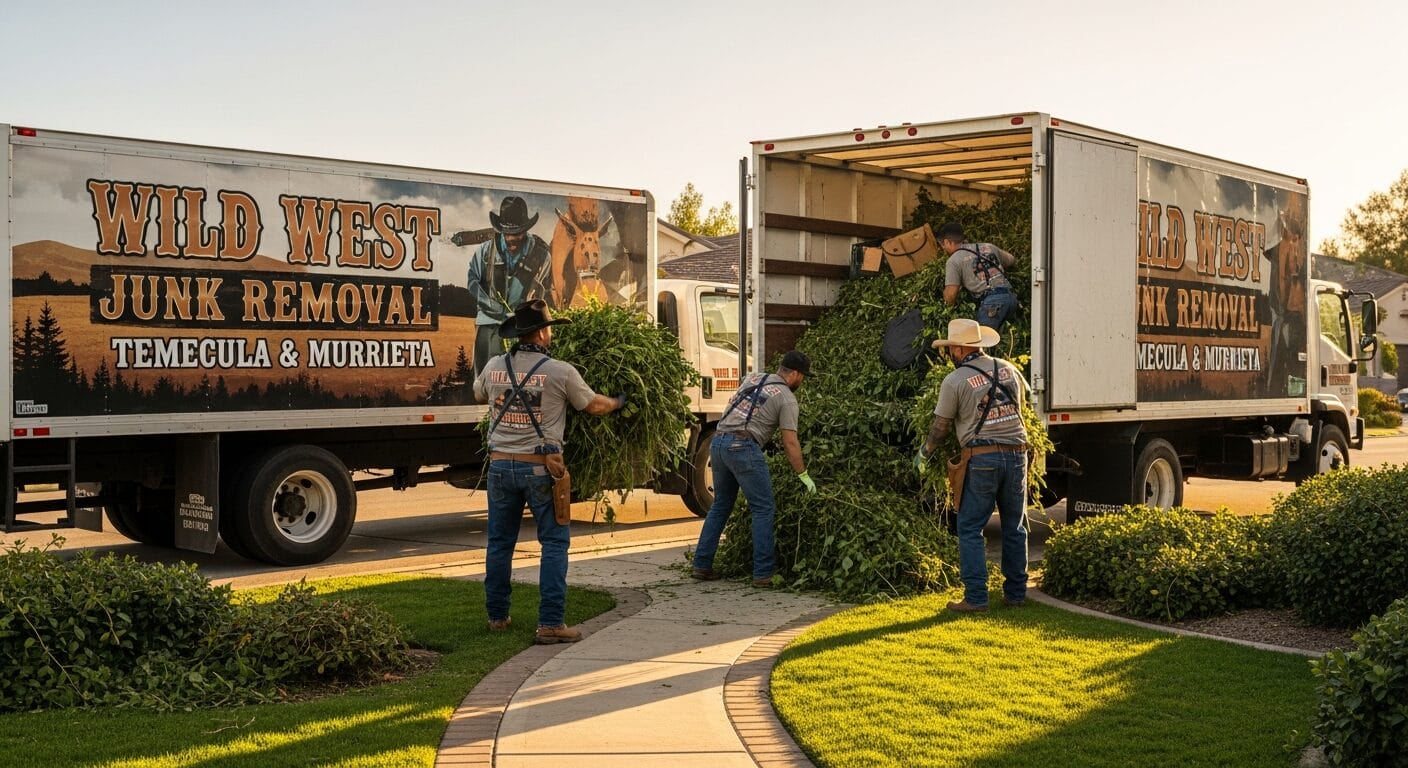
Wild West Junk Removal · 41713 Niblick Rd, Temecula, CA 92591 · (951) 837-8072 · Mon to Sat: 7AM-7PM · Sun: Closed · Family-owned and operated by Weston Molitor since 2021
Why the Calendar Matters
Why Doesn't Yard Waste Arrive a Little at a Time Here?
Because the Temecula Valley runs a boom-and-bust plant cycle. Everything grows at once after winter rain, dries at once in early summer, and comes down in two short bursts: fall wind and January frost.
In a milder climate, yard debris trickles in all year and a curbside cart keeps up. That's not how it works here. Most properties make almost nothing for months, then produce more debris in three weeks than the green cart will take in three months.
Knowing which window you're in is the difference between a haul booked on your schedule and a rush call during the busiest week of the year. It also decides whether a pile in your side yard is just in the way or is fuel.
What Drives the Size of Every Pile?
Four things do. Winter rain sets the size of the spring flush, so a wet December means a huge April. Early-summer heat turns that growth into dry fuel within weeks. Santa Ana winds, strongest from fall into early winter, strip fronds and drop limbs across whole neighborhoods on the same afternoon. And inland cold snaps kill back the subtropical plants that do so well here the rest of the year, which creates a January pruning pile.
Month by Month
What Piles Up in Each Month?
Spring brings weeds and hedge growth, late spring brings cut brush and clearing debris, fall brings palm fronds and wind-blown limbs, and winter brings frost damage and pruning piles. July through September is the quiet stretch.
This is the pattern we see across Temecula, Murrieta and Menifee. Your property will vary with elevation, irrigation and what's planted, but the shape of the year holds.
| Window | What builds up | Why then | When to haul it |
|---|---|---|---|
| January to February | Frost-killed growth, dormant-season prunings | Inland cold snaps kill back tender plants; it's also pruning season for most deciduous trees and roses | Late February, once the freeze risk has passed and the cutting is done |
| March to April | Weeds, annual grasses, fast hedge growth | Rain plus warming soil makes the fastest growth of the year | Any time, before the material dries out |
| May to June | Cut brush, dry grass, clearing debris | Growth stops, moisture drops, and weed abatement deadlines land | Right after cutting; don't let piles sit |
| July to September | Lower volume: irrigated trimming, spent annuals | Most unirrigated plants have already gone dormant | The easiest scheduling window of the year |
| October to November | Downed limbs, palm fronds, wind-scattered debris | Santa Ana season strips dead material valley-wide | Within days of a wind event, before the next one |
| December | Leaf drop, storm debris, year-end yard resets | Deciduous trees drop and the first rain systems arrive | Early December, ahead of the holidays |
Two of those windows, late May and the days right after a big wind, are when our phone is busiest. The rest of the year books easily.
March to May
When Should You Haul Spring Growth?
In April, in the same week you cut it. That's when growth has finished its fastest push, the material is still green and easy to load, and you're ahead of the May rush.
Whatever rain fell over winter shows up in March. Mustard and wild grasses take over open ground, oleander and bougainvillea put on aggressive new growth, and lawns that slept through January need mowing again. Lots in Temecula that back up to open space go from bare to waist-high in a few weeks.
The mistake I see most in spring is waiting. Somebody cuts back a hedge in March, stacks it behind the shed, and means to deal with it. By June that pile has dried into fuel sitting against a fence, and what would have loaded easily in April is now brittle, tangled and a fire hazard.
- ✓Cut and haul in the same week. Don't stage piles for later.
- ✓Hit vacant lots and rentals too. They need a spring pass whether anyone lives there or not.
- ✓Ask the landscaper to consolidate. One pile near a gate loads faster than debris spread across the yard.
- ✓Get ahead of the summer deadline. Spring is the easiest time to beat a clearing notice.
June to September
Why Shouldn't a Cut Pile Sit Through Summer?
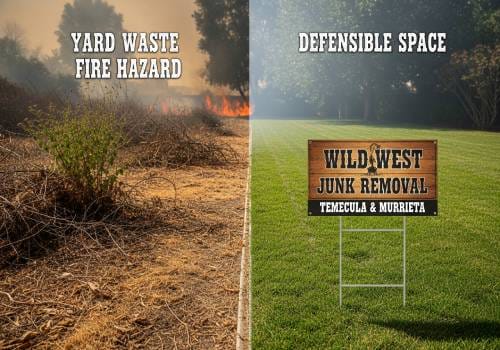
Because by late June the same pile that was green in April is dry enough to carry fire. Nothing new grows in a Temecula summer without irrigation; what changes is how dry everything already on the ground gets.
That's why vegetation clearing in this part of Riverside County front-loads into spring, and why enforcement attention peaks in early summer. Summer is a bad time to start new piles and a worse time to store old ones. If it's cut and on the ground, the priority is getting it off the property.
What If the City Sent You a Weed Abatement Notice?
Then you're on a deadline, and our weed abatement service in Temecula page covers the clock you're on. The City of Temecula's weed abatement program treats April through November as fire season, inspects in late winter and early spring, and mails notices with a date to clear by. If the city's contractor does the work instead, the owner gets the bill.
To be clear about what we do on a plain yard waste job: we haul. When a landscaper or tree crew finishes and leaves the material on the ground, we load it and take it, and booking us for the day their work wraps up is routine.
October to December
What Happens to Yard Waste in Santa Ana Season?
It comes down all at once. Fall is the single most concentrated debris window of the year in this valley: Santa Ana winds strip dead palm fronds and drop every weak limb across a whole street on the same afternoon.
Two things follow. First, palms shed. Mature Mexican fan palms in older Murrieta and Temecula neighborhoods drop fronds heavily in this window, and a full skirt coming down takes up a surprising amount of room, because fronds interlock and fill a trailer with more air than weight. Second, every dead limb that hung on through summer comes down in the same windstorm as everybody else's.
That's the scheduling problem. A big blow doesn't make one call, it makes dozens, all within about forty-eight hours. We have same-day slots most days; the two days after a significant wind event depend entirely on how early in the day you call.
- ✓Call the morning after a wind event. Not the following weekend.
- ✓Clear standing dead material in September. Before it goes airborne in October.
- ✓Send photos of palm fronds. Frond volume is very hard to judge from a description.
- ✓Plan December leaf drop as its own job. It comes later than the wind debris in the older tree-lined neighborhoods.
December to February
Is Winter a Good Time to Haul Yard Waste?
Yes, it's one of the easiest. Late January and February bring frost-dieback cleanup and dormant-season pruning, both predictable enough to book ahead.
Inland Temecula Valley gets cold snaps the coast doesn't. When a hard frost hits, bougainvillea, bird of paradise, plumeria and similar plants blacken and need cutting back. Most homeowners do that all at once in late January or February, once the freeze risk has passed. It's also the right pruning window for most fruit trees, roses, grapes and deciduous ornamentals.
Does Rain Change How a Pile Loads?
Yes, it makes it heavier and messier, but it doesn't change how we price it. Wet green waste still prices by volume. It can take longer to load, and a soaked backyard can limit how close the trailer gets, so a pile that's tarped or staged near the driveway before the rain loads faster.
After a Blow
How Fast Should You Clear Storm Debris?
Within a day or two, and call early in the day. Demand spikes hard for about forty-eight hours after a wind event, and the schedule fills from the top of the morning down.
Post-storm cleanup is rarely clean green waste. A real wind event mixes downed limbs with fence pickets, patio umbrellas, shade sail hardware and whatever blew in from three houses down. We take mixed loads and sort them at the trailer, so the organics go to green-waste recycling and the rest goes where it belongs.
Who Is Weston Molitor?
Founder · Wild West Junk Removal · Temecula, CAI started Wild West in 2021 with one trailer and a phone number, and I still answer that phone. After a big Santa Ana I'm usually reading texts before six in the morning.
People apologize for calling early after a windstorm. Don't. Early is exactly right. The folks who wait until Saturday to call about Wednesday's mess are the ones who end up waiting.
"Text me a photo the morning after the wind. You get the load size and the price before the rest of the street calls."

What Do Customers Say About Our Yard Cleanups?
They say we were quick and cleared it all. These two Google reviews are copied exactly as they were posted.
★★★★★
Absolutely the best company out there. Extremely efficient, quick, and very friendly. They went above and beyond what they were hired to do.
★★★★★
Had to get rid of some junk ASAP. They managed to pick up everything no questions asked. They arrived about 20-30 minutes after scheduling. Would recommend 100% . Thanks guys!!
Cart vs. Haul
When Does the Green Cart Stop Being Enough?
During a boom week. Temecula's green organics cart handles a steady weekly trickle, like clippings, leaves and light trimmings, but not a May clearing, a fallen palm skirt or a February pruning pile, because the limit is one cart per collection.
The cart handles the July to September stretch of this calendar without any trouble. What it can't handle is three months of debris that shows up in three weeks. The rules on what the cart will and won't take, including the fronds that get carts tagged, are in our guide to what goes in the Temecula green waste bin.
The goal is the same either way. Under California's SB 1383 organics rules, green material is supposed to stay out of the landfill, and Temecula runs its part of that through the city's organics cart program. Our trailer loads go to green-waste recycling too. The cart is one route there; a haul is the other.
What It Costs
How Is Seasonal Yard Waste Priced?
By volume, the same in every month: $195 for a quarter load, $350 for a half, $495 for three-quarters and $595 for a full 12-yard trailer. There's no busy-season surcharge.
We charge by how much room the material takes up in the trailer, not by weight, the item or the hour. A quarter load in the middle of wind season costs the same as a quarter load in August. What the season changes is how fast we can get to you, not the price.
The one thing to know about green waste is that it's bulky and light. Branches and fronds trap air, so a pile that looks modest can fill more trailer than you'd guess. That's why photos matter more for a yard job than for a furniture pickup. Dirt and sod are the exception the other way, since heavy material can move the price. Everything that goes into a yard waste quote is on our yard waste removal cost section, and the full rate card is on the junk removal prices page.
FAQ
What Else Do People Ask About Yard Waste Timing?
These are the scheduling questions we hear most. For what we haul and how a pickup works, see our yard waste removal page.
Two windows: late May, when clearing work bunches up ahead of the dry season, and the forty-eight hours after a big Santa Ana wind in October or November. Outside those, scheduling is easy, and July through September is the quietest stretch of the year.
April is the sweet spot. Growth has finished its fastest push, the material is still green and easy to handle, and you're ahead of the May rush. Cutting in March and hauling in June is the pattern to avoid.
In practice, yes. Dead fronds build up in the skirt all year, and fall wind is what brings them down in quantity. A full skirt coming loose makes far more volume than people expect, so send a photo before you guess the load size.
For a typical maintained lot, twice a year covers it: once in spring after the growth flush and once in fall after wind season. Lots that back up to open space, or that have big palms, often need a third pass in winter.
Yes. We work Monday through Saturday, 7AM to 7PM, all year, and we're closed Sunday. Saturday slots after a midweek windstorm go fast, so text a photo as soon as the wind dies down.
Yes, and the predictable windows are the easiest to plan: February pruning, April spring cleanups and the week a landscaper finishes a big job. Text a photo and the day you want, and we'll hold the slot. Storm debris is the one you can't plan, so for that, call early.
Keep Reading
What Should You Read Next About Yard Waste?
Start with the yard waste page when you're ready to book, and the green cart guide if you're trying to keep the pile small.
- ServiceYard Waste Removal in TemeculaBranches, fronds and brush hauled from $195 a load.
- GuideWhat Goes in the Temecula Green Waste BinWhat CR&R takes, and what gets a cart tagged.
- GuideChristmas Tree Disposal in TemeculaThe CR&R tree window and what to do if you miss it.
- ServiceWeed Abatement in TemeculaNotice to Abate clearing, cut and hauled in one visit.
- PricingJunk Removal PricesThe four-bracket ladder and every surcharge.
Know Which Window You're In? Ready to Get It Off the Property?
Text a few photos and the address. You get the load size and a firm price before we drive out, Monday through Saturday.
Mon to Sat: 7AM-7PM · Sun: Closed
Wild West Junk Removal · 41713 Niblick Rd, Temecula, CA 92591 · (951) 837-8072 · service@wildwestjunkremoval.com
Sources & References
- calrecycle.ca.govCalRecycle: SB 1383 Organic Waste ReductionThe statewide rule that keeps green waste out of landfills.
- temeculaca.govCity of Temecula: Weed AbatementFire season, inspection timing, notices and what follows a missed deadline.
- temeculaca.govCity of Temecula: SB 1383 ImplementationThe green organics cart program through CR&R.
Written by Weston Molitor, owner of Wild West Junk Removal. Last reviewed and updated October 15, 2026.
Hauling prices: $195 quarter load, $350 half, $495 three-quarter, $595 full 12-yard trailer, the same in every season. Current as of October 2026.