
Home › Temecula Junk Removal › Refrigerator Removal › Disposing of a Fridge With Freon
How to Dispose of a Refrigerator With Freon
Not the curb. Not a rented dumpster. Not by cutting the lines yourself. Here is what federal and California law actually require before an old fridge can legally leave your property, and every compliant way to get it gone.
EPA Section 608 compliant recovery · Certified recycler drop · Written quote before we lift · Family-owned since 2021
Start Here
The short answer
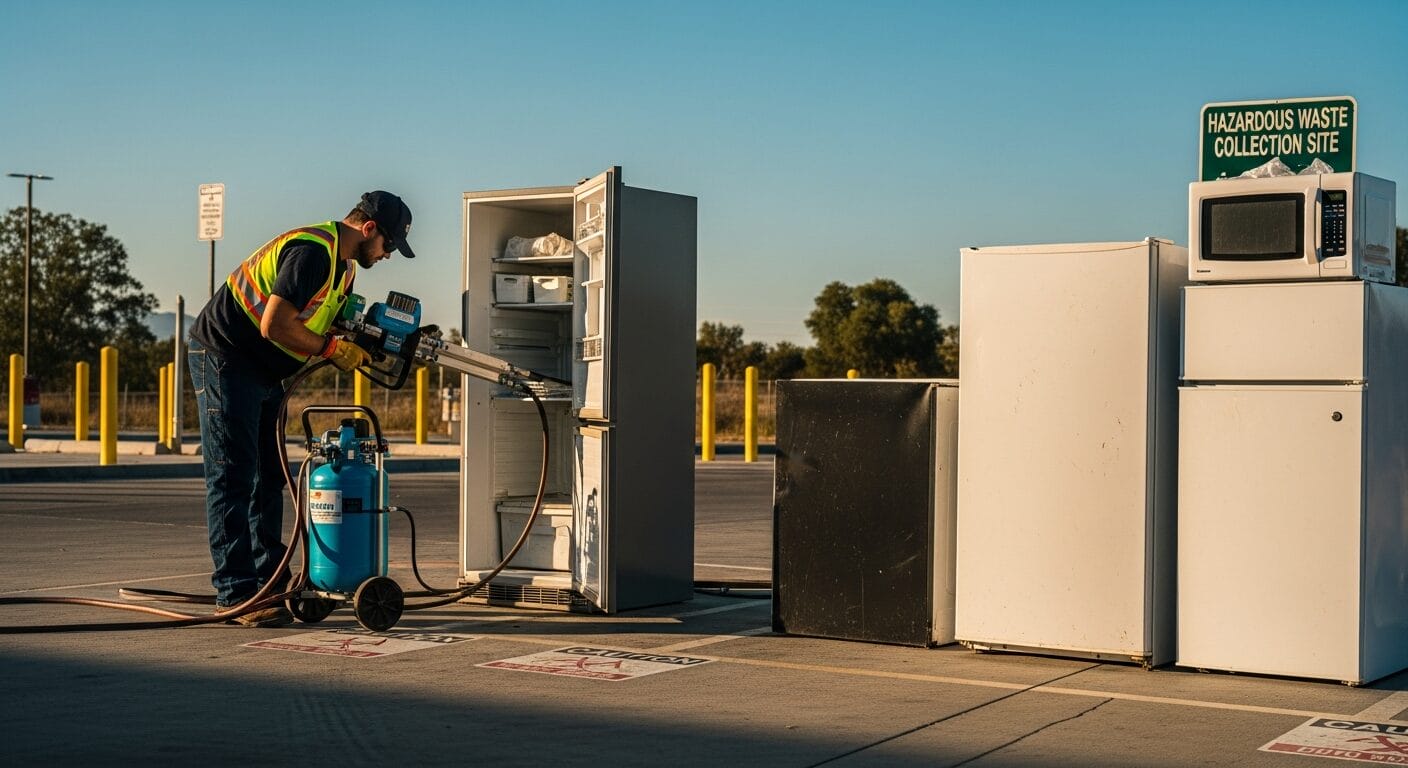
A refrigerator is not a piece of furniture with a plug on it. It is a sealed pressure system holding a federally regulated chemical, and that chemical has to come out under controlled conditions before the cabinet can be scrapped, shredded, or landfilled. That single fact is what makes fridge disposal different from every other bulky item in your garage.
You have four realistic paths: a utility recycling program if one is currently running and your unit qualifies, retailer haul-away if you are buying a replacement, a certified appliance recycler if you can transport it yourself, or a hauler who already routes to a certified recycler. What you do not have is a legal do-it-yourself path. Nobody without EPA Section 608 certification and recovery equipment can lawfully empty that system, and no amount of "it stopped cooling years ago" changes that.
Wild West Junk Removal handles the last option across Temecula, Murrieta, and the surrounding valley. Everything below is the full picture, including the options that do not involve us.
The 30-second version
Assume the fridge still has refrigerant in it. Do not put it at the curb unless your hauler tells you their bulky-item truck is set up for refrigerant recovery. Do not puncture the lines. Route it to a certified recycler, either yourself or through someone who does it every week.
Federal and State Rules
What the law actually requires
Two regulatory layers apply to a California homeowner getting rid of a fridge, and a third one covers where the cabinet ends up.
Clean Air Act, Section 608
Federal law prohibits knowingly venting refrigerant during the service, maintenance, repair, or disposal of an appliance. Before the appliance can be discarded, the refrigerant has to be recovered by a technician holding EPA Section 608 certification, using approved recovery equipment. This applies to the old ozone-depleting refrigerants and to the newer replacements alike.
California Air Resources Board
CARB runs a Refrigerant Management Program on top of the federal rules. Most of its reporting and leak-inspection weight falls on commercial and industrial refrigeration rather than a household fridge, but it is the reason California enforcement of refrigerant handling is tighter than the federal floor, and it is why certified recyclers here keep recovery records.
California universal waste rules
Until the refrigerant, oil, mercury switches, and other regulated components are removed by a qualified handler, a discarded refrigerator is treated as a regulated waste stream in California rather than ordinary trash. That is why a certified recycler dismantles in a set order and documents it, and why a general landfill cannot simply accept the unit intact.
Illegal dumping, Penal Code 374.3
Separate from the refrigerant question, leaving an appliance on public property, a vacant lot, an alley, or somebody else's curb is illegal dumping. Fines escalate with each offense and the court can add cleanup costs and community service. Dumping in commercial quantities is treated far more harshly than a single household item.
On the fines you have seen quoted online
Clean Air Act civil penalties are set per day, per violation, and the ceiling is adjusted for inflation every year, so any single dollar figure you read on a blog is out of date within twelve months. The number is in the tens of thousands of dollars per day. Treat the exact figure as unknowable without checking the current federal register entry, and treat the underlying rule as absolute: venting is prohibited, with no household exemption.
Know Your Unit
What is actually inside your fridge
"Freon" is a brand name that stuck to an entire chemical family. What is in your unit depends on the year it was built, and the year matters because the environmental stakes and the handling requirements are not identical across the three generations.
The data plate tells you. It is usually inside the door frame, on the back near the compressor, or behind the kick plate, and it lists the refrigerant type and the charge weight in ounces or grams. If the plate is gone or unreadable, assume the system is charged and move on. Do not open a line to find out.
Wild West sees all three types weekly on refrigerator and appliance removal jobs across the valley, and all three go to the same certified recycler.
R-12, roughly pre-1995
The original Freon, a chlorofluorocarbon. It damages the stratospheric ozone layer, was phased out of new US appliances by the mid-1990s under the Montreal Protocol, and carries the strictest handling expectations of the three. Recovered R-12 cannot simply be reused; it is reclaimed or destroyed.
R-134a, roughly 1995 to 2010
The hydrofluorocarbon that replaced R-12. It does not deplete ozone, which is why it was adopted, but it is a strong greenhouse gas, hundreds of times more warming than carbon dioxide per unit. Recovery is required, and California tracks HFCs closely under its climate rules.
R-600a, roughly 2010 onward
Isobutane, a hydrocarbon used in many newer high-efficiency units. Very low environmental impact, but mildly flammable, which changes how it is handled at the recycler and is one more reason not to improvise with a torch, a drill, or a saw near the coils.
"But it stopped cooling"
A fridge that no longer cools has usually lost pressure, not its entire charge. Compressor failures and slow leaks leave a meaningful quantity of refrigerant in the system. Certified recovery is what confirms an empty system. A warm interior does not.
Every Compliant Route
Your legal disposal options, honestly compared
Five routes are compliant. Which one is right depends on whether the unit still runs, whether you are buying a replacement, whether you can move 250 pounds of steel, and how fast you need the space back.
| Route | Best when | The catch |
|---|---|---|
| Utility recycling program | Your unit still runs and a program is currently open to you | California utility appliance programs have started, changed, and ended repeatedly over the past decade. Verify directly with your provider before counting on it. |
| Retailer haul-away | You are buying a replacement and the old unit sits near the entry | Requires the purchase, requires scheduling at order time, and delivery crews often decline stairs, tight turns, or anything not disconnected. |
| Municipal bulky item pickup | Your hauler confirms their appliance route recovers refrigerant | Many bulky-item programs exclude refrigerant appliances outright. You have to ask specifically, not assume, and get the answer before it goes to the curb. |
| Self-haul to a certified recycler | You have a truck, a helper, and a free morning | Loading and strapping a 250-pound appliance is the whole problem, and facility hours and intake rules vary. |
| Junk removal service | Broken, awkwardly located, or bundled with other junk | You are paying for the labor and the certified routing. Get the number in writing on-site before anything moves. |
A note on utility rebate figures
Older articles across the web still quote free pickup plus a cash rebate from Southern California Edison and other California utilities. Those programs have been repeatedly restructured, paused, and in some cases retired, and the rebate is not something to plan around in 2026. Call your provider or check their current site before you build a plan on it. If it is running and your fridge qualifies, take it. If not, one of the other four routes applies.
Step by Step
Getting the fridge out, in order
-
Read the data plate
Find the plate inside the door frame or on the back panel and note the refrigerant type and charge. Photograph it. If it lists R-600a, mention that to whoever handles the unit, because flammable refrigerant changes their process. If you cannot find the plate, treat the system as charged.
-
Empty it and let it sit
Clear the food, pull the shelves and drawers if they are loose, unplug it, and leave the doors propped for a few hours so it dries out and the odor does not travel. Tape or bungee the doors shut before it moves, and pull the ice maker line if there is one.
-
Check whether a utility program is currently open
Ask your electricity provider whether an appliance recycling program is running, what it pays if anything, and whether your unit qualifies. Working condition, size range, and access are the usual gates. If it qualifies, this is the cheapest compliant route available.
-
Ask your waste hauler the specific question
Not "do you take appliances," but "does your bulky item route recover refrigerant from a fridge." A yes means you can schedule a compliant pickup. Anything short of a clear yes means the fridge does not go to the curb, even if you suspect they would take it.
-
Or bundle it with a new-appliance delivery
If a replacement is on order, add haul-away at the time of purchase rather than at the door. Confirm what the crew will and will not do, because a fridge in a back garage or up a flight is frequently outside what a delivery crew is scheduled for.
-
Or text photos to Wild West
For anything broken, ancient, buried behind boxes, upstairs, or going out alongside the rest of a cleanout, send photos to (951) 837-8072. You get a rough number back, a firm written quote on-site before anyone lifts, and the unit goes to a certified recycler for refrigerant recovery and metal recovery.
Before the crew arrives
Move the cars out of the driveway, unlock the side gate, and clear the path from the fridge to the street. Say up front if there are stairs or a tight 90-degree turn, because that gets priced in the driveway rather than discovered halfway through the carry.
Straight Numbers
What refrigerator disposal costs
Certified handling is not free for anyone in the chain, and any company telling you refrigerant costs nothing to deal with is burying it somewhere else in the number. Here is how ours works.
Wild West prices by how much trailer space your junk takes up, and fuel plus the landfill and recycler fees are already inside those load-size prices. A refrigerator carries a $30 appliance surcharge on top, because refrigerant recovery and metal recycling get handled separately from the rest of the load. If the carry involves stairs, that is $150 on loads up to a half truck load and $300 on loads over a half load. Tell us the floor level when you call and the figure goes into your written estimate before anything moves.
Most single-fridge jobs land at the smallest load size. If the fridge is going out with a garage worth of other junk, it rides along in the load you were already paying for and the surcharge is the only addition. Full rate table on the junk removal pricing page.
No meter running, nothing added after the trailer is loaded. The number you agree to in the driveway is the number you pay.
Beyond the Refrigerant
The other regulated material in an old fridge

Refrigerant gets the headlines because it is federally regulated by name, but it is one item on a longer list. A certified recycler is pulling five or six separate streams out of a single cabinet, in a specific order, which is the actual reason a landfill cannot take the unit whole.
The upside is that most of what is left is worth recovering. Steel, aluminum, and the copper in the compressor and coils all go back into the supply chain, which is what keeps certified appliance recycling economically viable at all.
Compressor oil
Lubricating oil that has been circulating with refrigerant for years is contaminated and handled as a regulated waste. It is drained, not dumped, and never goes down a drain.
Foam insulation
Foam blown before the mid-2000s used ozone-depleting agents that keep off-gassing in a landfill. Certified processing captures the foam instead of burying it.
Mercury switches
Some older units used mercury switches in door lights and controls. Mercury is a neurotoxin and gets pulled and handled separately.
PCB capacitors
Capacitors in units built before 1979 may contain PCBs. If your fridge is that old, say so up front so the recycler flags it on intake.
Boards and displays
Control boards, displays, and modules are electronic waste under California law and route to the e-waste stream, not the scrap pile.
Sharp steel and glass
Not regulated, just genuinely dangerous. Tempered shelves shatter and cut cabinet edges slice. Gloves, blankets, and a strapped dolly, every time.
What Not To Do
The curb, the dumpster, and the DIY drain
Almost every enforcement story starts the same way. Somebody wheels the fridge to the curb on a Sunday night, the bulky-item truck takes it because the driver is not going to argue, and the refrigerant vents during compaction or at the transfer station. Nobody set out to break a federal rule. It happened anyway.
The defense of "I did not know they were not set up for it" does very little for you, because the obligation attaches before the truck arrives. One phone call to your hauler removes the whole problem.

The curb
Lawful only if your hauler confirms their appliance route performs refrigerant recovery. Many do not. Get a yes before the fridge goes out, and if the answer is no, it stays in the garage until you have another plan.
A rented dumpster
Roll-off containers go straight to a transfer station or landfill with no recovery step anywhere in the chain. Most rental agreements prohibit refrigerant appliances outright, and the liability follows whoever put it in. Our own dumpster rentals are no exception, and we tell customers the same thing.
An uncertified scrap yard
A certified yard can take the fridge and recover the refrigerant properly. A yard that crushes appliances without recovery is violating federal law, and handing the unit over does not put you comfortably outside that. Ask about Section 608 before you unload.
Draining it yourself
Puncturing a line, cutting the coils, or opening the system to atmosphere is prohibited venting under the Clean Air Act. There is no small-quantity exemption and no homeowner exemption. Recovery equipment and certification, or nothing.
Rentals and Portfolios
For landlords and property managers
The tenant left a fridge. The obligation is now yours, regardless of who bought it or who plugged it in.
Abandoned appliances
Once a unit is left behind and you are clearing the property, you are the party discarding it and the refrigerant rules attach to you. Roll it into the turnover cleanout rather than treating it as a separate headache.
Multiple units at once
Renovations and portfolio clearances often mean four or five fridges. Send photos of all of them together and they get scheduled as one job rather than five, which is both cheaper and faster than piecemeal pickups.
Keep the paper
Note the disposal date and the receiving facility in your property file. It costs nothing at the time and it is the only thing that answers a regulatory question two years later. Ask the crew for the facility name.
Turnover speed
Every vacant day is lost rent. Same-day slots most days across Menifee and the surrounding valley mean an appliance does not become the thing holding up a make-ready. Call early in the day.
Before You Do Anything
Refrigerator disposal checklist
Photograph the data plate and note the refrigerant type and charge weight.
Assume the system is still charged, even if the unit stopped cooling years ago.
Do not puncture, cut, or open any refrigerant line for any reason.
Ask your utility whether an appliance recycling program is currently open to you.
Ask your waste hauler specifically whether their appliance route recovers refrigerant.
Do not place it in a rented dumpster or roll-off container.
If buying new, add haul-away at the time of purchase, not at the door.
Disclose a pre-1979 unit so the recycler can flag it for PCB capacitors.
Empty it, unplug it, dry it out, then tape the doors shut before it moves.
Clear the path, move the cars, and flag stairs or tight turns before the crew arrives.
Common Questions
Freon and fridge disposal, answered
In most cases, yes. Federal law under Section 608 of the Clean Air Act requires that refrigerant be recovered by a certified technician before an appliance is discarded, and a standard trash or bulky-item route does not do that. Leaving an appliance on public property or someone else's frontage is also illegal dumping under California Penal Code 374.3. The one lawful exception is when your own waste hauler confirms that their appliance route recovers refrigerant. Call and ask that specific question before the fridge goes out, because the obligation attaches whether or not the truck ends up taking it.
Almost certainly. Refrigerant systems rarely empty themselves completely, so a fridge that stopped cooling from a leak or a failed compressor usually still holds a meaningful charge. Units built before roughly 1995 typically contain R-12, units from about 1995 to 2010 contain R-134a, and many newer high-efficiency units use R-600a isobutane. Check the data plate inside the door frame or on the back panel for the type and charge weight, and if the plate is missing or unreadable, treat the system as charged and handle it accordingly.
Under EPA Section 608, recovery has to be performed by a technician holding Type II or Universal certification, using approved recovery equipment rather than improvised tools. You do not usually need to find one yourself. Certified appliance recyclers employ them, and haulers who handle appliances route units to those facilities. Wild West Junk Removal delivers every refrigerator to a certified recycler where recovery happens before the cabinet is scrapped, so the certification requirement is met without you sourcing a technician separately.
No. Intentionally venting refrigerant to the atmosphere is prohibited under the Clean Air Act, and that includes puncturing a line, cutting the coils, or opening the sealed system in any other way. There is no small-quantity exemption, no household exemption, and no exemption based on the refrigerant being a newer non-ozone-depleting type. Civil penalties are assessed per day and per violation. The only lawful path is certified recovery with approved equipment.
Sometimes, but do not plan around it. California utility appliance recycling programs have been launched, restructured, paused, and in some cases retired over the past decade, and older articles online still quote rebate amounts that are no longer offered. Contact your electricity provider directly and ask whether a program is currently open and whether your unit qualifies. Programs that do run generally require a working, plugged-in unit within a set size range and easy access for pickup, which rules out most broken, very old, or hard-to-reach fridges.
Yes, with conditions. Major appliance retailers offer haul-away of your old unit when they deliver a new one, usually for a modest fee, and they route those units to recyclers that handle refrigerant properly. The conditions are the catch: you have to be buying a replacement, you have to arrange haul-away at the time of purchase rather than at the door, and delivery crews frequently decline units that are up a flight of stairs, behind stored boxes, or still connected. For a standalone removal with no new purchase, a certified recycler or a junk removal service is the practical route.
No. Roll-off containers go to a transfer station or landfill with no refrigerant recovery step anywhere in the chain, which means the refrigerant vents during handling or compaction. Most rental agreements prohibit refrigerant-containing appliances outright, and responsibility follows the person who put the unit in the box. That applies to our own dumpster rentals too. If you have a dumpster on site and a fridge to lose, the fridge gets handled as a separate appliance pickup.
Pricing is by the volume your junk takes up in the trailer, with fuel and the landfill and recycler fees already included in the load-size rate. A refrigerator adds a $30 appliance surcharge, which covers refrigerant recovery and metal recycling being handled separately from the rest of the load. A stair carry is $150 on loads up to a half truck load and $300 on loads over a half load, so tell us the floor level when you call. Most single-fridge jobs land at the smallest load size, and if the fridge goes out with other junk it rides in the load you were already paying for. Text a photo to (951) 837-8072 for a rough number, and you get a firm written figure on-site before anything moves.
Three generations show up in household units. R-12 is a chlorofluorocarbon used before roughly 1995, the original Freon, and it depletes the ozone layer. R-134a is a hydrofluorocarbon used from about 1995 to 2010 that does not harm ozone but is a strong greenhouse gas. R-600a is isobutane, common in high-efficiency units built after roughly 2010, with very low environmental impact but mild flammability that changes handling at the recycler. All three require certified recovery before the appliance is scrapped.
You text photos to (951) 837-8072 and get a rough estimate back. The crew arrives, gives you a firm written price in the driveway before anyone lifts anything, moves the unit on an appliance dolly with straps and blankets, sweeps up where it stood, and delivers it to a certified recycler where the refrigerant is recovered before the cabinet is dismantled and the metal recycled. Fuel and disposal fees are inside the load-size price, with the $30 appliance surcharge and any stair carry quoted up front rather than added afterward. We cover Temecula, Murrieta, Menifee, Wildomar, Winchester, French Valley, Lake Elsinore, Canyon Lake, and Fallbrook, Monday through Saturday, 7am to 7pm.
That fridge has held down the corner of the garage long enough
Certified refrigerant recovery, a written price before we lift, and a swept floor where it stood. Same-day slots most days. Call early in the day.
Wild West Junk Removal
41713 Niblick Rd, Temecula, CA 92591
(951) 837-8072 · service@wildwestjunkremoval.com
Mon to Sat: 7AM-7PM · Sunday closed
- EPA, Stationary Refrigeration and Air Conditioning, Section 608Federal refrigerant recovery and technician certification requirements.
- California Air Resources Board, Refrigerant Management ProgramState-level refrigerant oversight above the federal floor.
- CalRecycle, Appliance RecyclingHow discarded appliances are handled and diverted in California.
- California Penal Code section 374.3Illegal dumping of waste matter and associated penalties.
- EPA, Responsible Appliance Disposal programBest-practice framework for appliance disposal partners.
Written for homeowners, landlords, and property managers in Southwest Riverside County. Refrigerant regulations, penalty amounts, and utility program terms change; verify current requirements with the EPA, CARB, and your own utility and waste hauler before acting.