
Hoarder Cleanout Services in Temecula Handled With Care, Not Commentary
A hoarded home is a health problem, a legal problem, and almost always a family problem at the same time. Wild West clears it room by room, sweeps the floor underneath, and quotes a firm price before anything moves. No judgment from our crew, ever.
Family owned since 2021 · Licensed and insured · Firm price before we load · Donation before landfill · Mon to Sat: 7AM-7PM
Wild West Junk Removal · 41713 Niblick Rd, Temecula, CA 92591 · (951) 837-8072 · Mon to Sat: 7AM-7PM · Sun: Closed
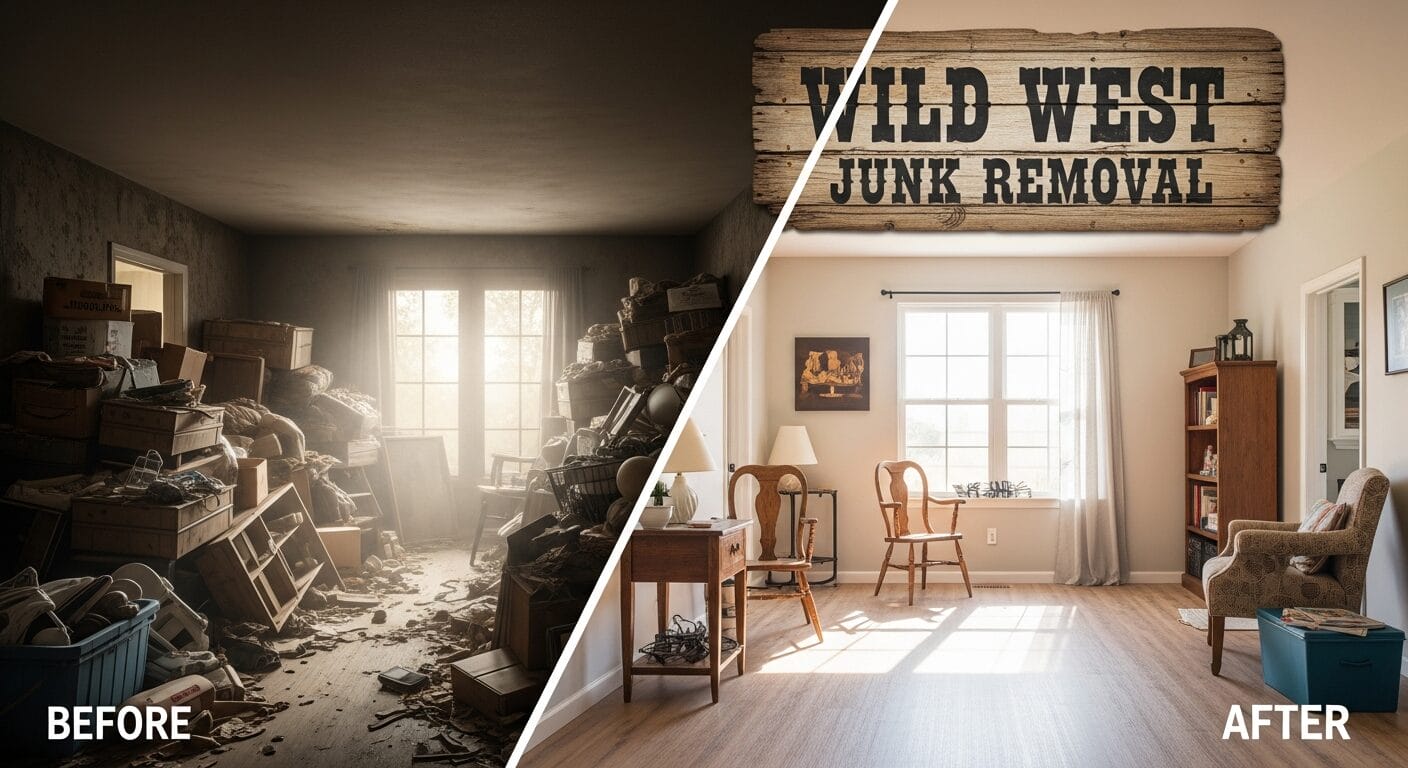
Understanding the situation
It Didn't Happen Overnight
A hoarded home does not reach the state where a family member finally makes the call in a matter of weeks. It builds the way most things do, gradually, one decision at a time, over months and years and sometimes decades. The space that is now shoulder-width corridors and impassable rooms was once an ordinary house in Temecula or Murrieta. That matters, because it changes how the cleanout has to be approached.
The Mayo Clinic defines hoarding disorder as persistent difficulty discarding possessions because of a perceived need to save them, to the point that accumulation disrupts living areas and daily functioning. It is a recognized mental health condition, not a lifestyle choice and not a character flaw. It frequently travels with anxiety, depression, or OCD, which means the person living in the space is usually carrying a great deal more than the physical accumulation.
The International OCD Foundation's Hoarding Center estimates that roughly 6 percent of the U.S. population, around 19 million people, meets clinical criteria. Most are never formally diagnosed. Most families who eventually call a cleanout crew have been navigating this quietly for a long time before they pick up the phone.
Our crew's job, and the part that is not our job
We handle the physical side of the problem: hauling, sorting, disposal, and the floor underneath. We are not counselors and we do not pretend to be. If the person living in the home is working with a therapist who specializes in hoarding disorder, loop that person in before the cleanout is scheduled. A clearing done without that support in place can undo a lot of progress.
Weston Molitor
I started Wild West in 2021 with one trailer and a phone number, and I still answer that phone. Hoarding jobs are the hardest work we do, and they are the work I am proudest of, because the difference between the morning and the evening on one of these is enormous for the family.
We help solve customer problems. The most consistent one is dealing with years of stuff accumulated while somebody has been living in a home for a long time. Nobody on my crew is going to make a face, make a comment, or tell a story about your house later.

Severity classification
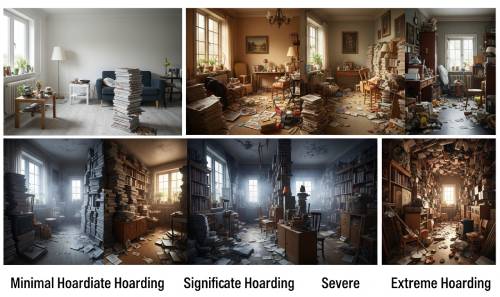
The Five Hoarding Levels, And What Each One Actually Takes
The International OCD Foundation uses a five-level severity scale. Knowing roughly where a situation sits changes crew size, timeline, and whether specialized contractors need to work alongside us rather than after us. Nobody expects you to diagnose the level yourself. Send photos and we will tell you.
| Level | What the home looks like | What the job takes |
|---|---|---|
| 1 · Minimal | Slight extra clutter. All rooms accessible. No odors, no pest activity. | Standard junk removal, one visit. |
| 2 · Moderate | Clutter across multiple rooms, at least one room with blocked function. Mild odor. | One to two trailer loads, still a single-day job. |
| 3 · Significant | Multiple rooms inaccessible or barely functional. Visible rodent activity, strong odors, early structural concerns. | Multi-day. Pest control should run concurrent, not after. |
| 4 · Severe | Rooms uninhabitable. Structural damage, infestation, blocked exits, biohazard potential. | Planned operation, two to four days, hazard assessment before entry. |
| 5 · Extreme | No utilities. Sewage issues. Heavy structural damage. Human or animal waste. | Licensed biohazard and remediation contractors working alongside the hauling crew. |
Not sure which level applies?
Text photos of every room to (951) 837-8072 — all of them, including hallways, the garage, and any outbuildings. Include the worst areas and the access routes. We will give you a realistic read on scope and a rough estimate before you commit to a visit.
Real risks
What Is Actually Happening Inside the House
The health risks in a significantly hoarded home are not speculative. EPA indoor air quality research has long found that indoor air in enclosed, poorly ventilated spaces can run two to five times more polluted than outdoor air. In a hoarded home that figure is compounded by what is generating the pollutants in the first place.
Mold and mildew
Moisture trapped under years of paper, cardboard, and food creates growth conditions no surface cleaning reaches. If it has penetrated subfloor or wall cavities, remediation is a separate job that comes before the space is habitable again.
Rodents and pests
A hoarded home is ideal shelter, food, and nesting. Droppings and urine are airborne allergens and pathogen vectors. Level 3 and above usually needs professional pest control before or concurrent with the cleanout, not after it.
Fire risk
The National Fire Protection Association identifies clutter as a contributing factor in residential fire deaths. Blocked exits, combustibles stacked near heat sources, and no clear path for firefighters is the specific combination that kills people.
Structural loading
Residential floors are designed for roughly 40 to 50 pounds per square foot. Books, magazines, and dense accumulation can exceed that in a localized area, causing deflection or joist damage. Ceiling-height stacks are a toppling hazard for everyone in the room, our crew included.
Air quality
Dust, decomposing organic matter, dander, spores, and off-gassing from stored products combine into an environment that is harmful over years. Long-term occupants often develop chronic respiratory issues without connecting them to the house.
Biohazardous conditions
Level 4 and 5 situations can involve human or animal waste, decomposed food, or worse. These require PPE and, for active biological hazards, licensed remediation that is separate from junk removal. We identify these on arrival and handle them accordingly.
Never attempt a Level 3 or higher cleanout without protective equipment. Airborne particulates, potential biohazard exposure, and unpredictable structural conditions injure people who go in wearing a t-shirt and gloves. Our crews wear gloves, respirators, and eye protection as standard procedure, not as an optional precaution. If you are doing any portion of this yourself, wear an N95 or better before you walk in.
California law
What the Law Says About Substandard Housing
Hoarding is not only a health issue. California sets specific habitability standards, and conditions that fall below them trigger code enforcement, civil liability, and in serious cases a requirement to vacate.
Under this section, a dwelling can be declared substandard when it contains mold, vermin infestation, fire hazards, or unsanitary conditions. Riverside County code enforcement can issue citations that accumulate per day until the conditions are remediated. If you have already received one, bring it to the scheduling call so we can prioritize the compliance deadline.
Code enforcement citations
Temecula and Murrieta both run active code enforcement programs. A neighbor complaint, a utility service call, or an emergency response to the property can all trigger an inspection. Citations carry a compliance deadline and escalating penalties.
Landlord liability
Property owners can face exposure for hoarding conditions in rental units, both from tenants harmed by those conditions and from code enforcement acting against the property record. Getting ahead of it is the cheapest version of this problem.
Condemnation
In Level 4 and 5 situations, a property can be declared uninhabitable and residents required to vacate until it meets habitability standards. This is the outcome most families are trying to get in front of when they call.
Probate complications
A hoarded property moving through probate cannot be settled until it meets habitability standards, adding weeks or months of carrying costs. Timely estate cleanout protects the net value of the estate.
Disposal liability follows the property owner
Under California Penal Code §374.3, improper disposal of waste, including hazardous materials, carries fines that can reach $10,000 per offense. Property owners can be held liable for how items from their property were disposed of even when someone else did the hauling. Confirm that whoever you hire routes hazardous materials to licensed facilities. We do, and we will provide documentation if you need it for a file.
How we do it
The Six-Step Cleanout Process
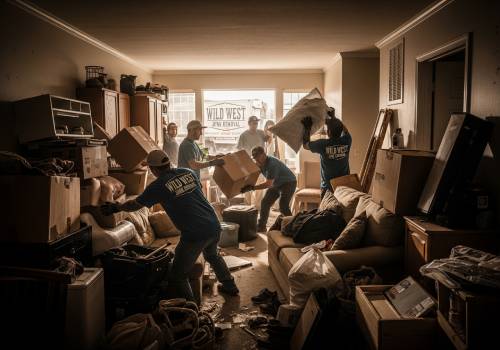
The same sequence on every hoarding job. Not rushed, not chaotic, and never a crew of strangers wandering through the house grabbing things.
-
Photo estimate, then on-site assessment
Text photos of every room, hallway, garage, and the yard. We give you a rough range before scheduling. On arrival we walk the entire property before touching anything, identifying structural hazards, biohazard areas, access constraints, and items needing individual review. Firm written pricing before work starts.
-
Identify keep items before clearing begins
Before a single item moves, we work with the owner or designated representative to locate and stage what is being preserved: legal documents, financial records, photographs, valuables, sentimental items. Thirty to sixty minutes here prevents the irreversible mistakes that get made during an active clearing.
-
Systematic room-by-room clearing
One room cleared completely, floor to ceiling and into the corners, before the next one starts. Not a general sweep of the whole house at once. Items sort into three streams as we go: donation, recycling, disposal. Never commingled.
-
Hazardous item identification and staging
As clearing progresses we flag what cannot go into a standard trailer: propane, paint and solvents, pesticides, certain batteries, suspected asbestos-containing material, and biological material. These are staged separately and routed per their specific disposal requirements.
-
Floor cleaning as each room clears
A Wild West standard, not an upcharge. The floor under accumulated material routinely reveals mold, moisture damage, rodent evidence, or structural concerns. Cleaning as we go surfaces those while we are still on site to document them, and it changes what the family sees: rooms come back clean, not just empty.
-
Final walkthrough and next steps
When every room is cleared and every floor is swept, we walk the property with you, document the final condition, confirm where donated items went, and note anything that needs follow-up: remediation, structural inspection, pest control. The job is done when you have a usable space and a clear picture of what it still needs.
What it costs
Hoarding Cleanout Pricing Is Still by Volume
We charge by how much room the material takes up in the trailer, not by weight, not by the item, and not by the hour. A hoarding cleanout is usually several loads at these same rates rather than a different price list. Larger multi-day jobs are quoted on site after the walkthrough, using these rates as the basis.
| Load size | Volume | What that usually looks like | Price |
|---|---|---|---|
| Quarter load | 3 cubic yards | A single room's worth of accumulation, or a first pass at one bedroom. This is our minimum pickup. | $195 |
| Half load | 6 cubic yards | A heavily accumulated bedroom plus a closet, or a Level 2 garage. | $350 |
| Three-quarter load | 9 cubic yards | Several rooms at Level 2, or one Level 3 room with dense material. | $495 |
| Full load | 12 cubic yards | Whole-house clearing runs as repeated full loads. Best value per yard. | $595 |
What can change the price
- Stairs
- $150 on loads up to one-half truck load, $300 on loads over one-half truck load, for carrying items up or down stairs. Tell us the floor level when you call and the figure goes in your written estimate.
- Appliances
- $30 each. Covers refrigerant handling and the separate disposal stream refrigerators, freezers and AC units legally require.
- Mattresses
- $15 each, any size.
- Extra loading time
- A full load includes one hour of loading. Beyond that hour, $75 per hour per crew member.
- What a full load means
- 12 cubic yards in a 12ft x 8ft x 4ft dump trailer, loaded by a two-person crew.
Every surcharge that applies to your job is quoted before anything moves, and nothing is added after the load is on. Hoarding cleanouts frequently reveal more volume than the top layer suggested, which is exactly why we re-quote on site before loading rather than holding you to a number estimated from photos. Full rate card on our pricing page.
What gets removed
What We Haul Out of Hoarded Homes
We mean it when we say we take almost everything. In a hoarding cleanout that covers a wide and often unusual range of material, most of it in quantities that surprise people who have not seen one of these jobs.
Furniture, all conditions
Sofas, beds, dressers, tables, chairs, case goods from every decade, broken or water-damaged or disassembled. Usable pieces are staged for donation first. Furniture removal details.
Electronics and appliances
TVs, computers, monitors, phones, kitchen and laundry appliances. California requires covered electronics to route to certified recyclers, which is where ours go. E-waste recycling details.
Paper, cardboard, publications
Newspapers, magazines, catalogs, mail, boxes, packaging. Often the single highest-volume category in a hoarded home. Clean paper and cardboard are separated for recycling. Volume is not a problem.
Clothing and textiles
Clothing in any quantity, bedding, linens, towels, shoes, accessories. Genuinely wearable items go to local charity partners. Everything else is disposed of appropriately rather than dumped on a donation center.
Food and kitchen waste
Expired and spoiled food is one of the most important categories to get out early. It is the primary driver of pest activity and a major air quality factor. We handle it with appropriate containment.
Yards, garages, outbuildings
Hoarding rarely stops at the back door. We clear exterior accumulation, disassemble old sheds and structures, and treat the yard as part of the scope. Garage cleanout details.
Special handling required
Hazardous Materials Turn Up Constantly
Hoarded homes routinely contain items that cannot legally go into a standard junk removal trailer in California. Disclose everything you know about when you request the estimate. These categories affect crew safety protocols and pricing, and finding them mid-job can pause the work.
Paint, stains, solvents
Latex and oil-based paint, stains, varnishes, and thinners require household hazardous waste disposal. Riverside County holds periodic collection events. Ask us for the current schedule.
Pesticides and herbicides
Garden chemicals, rodent poisons, insecticides, and pool chemicals all require HHW disposal. Some vintage products contain compounds that have since been banned and carry specific protocols.
Propane and fuel
Propane tanks, full, partial, or supposedly empty, plus gasoline and kerosene containers, cannot ride in a standard trailer. Tell the crew before work begins.
Automotive fluids and batteries
Motor oil, antifreeze, brake fluid, and car batteries are banned from standard trash in California and require separate disposal.
Suspected asbestos
Pre-1980 homes may have asbestos in floor tile, pipe insulation, popcorn ceilings, and roofing. If accumulation may have disturbed it, testing comes before clearance and licensed abatement handles anything confirmed.
Medical waste and sharps
Needles, syringes, lancets, and used supplies require medical waste disposal. California prohibits sharps in regular waste. Pharmacy and hospital take-back programs are the right route.
Biohazardous material
Human or animal waste, bodily fluids, and decomposed organic matter require licensed biohazard remediation. We identify it, pause work in the affected area, and refer to a remediation partner while the rest of the job continues.
Large lithium batteries
E-bike packs, power tool batteries, and solar storage present real fire risk in compactors and need certified e-waste handling. Flag large accumulations up front so we can stage them separately.
Undisclosed hazardous material discovered on site can pause the work, require a revised estimate, or in serious cases require a hazmat contractor before clearing continues. Nothing on this list surprises us. Finding it at hour three of a three-day job is what causes problems.
A common and specific scenario
When a Family Member Has Passed
Estate hoarding cleanup is where two hard things overlap: grief and a property deadline. The house has to be cleared, remediated, and either sold or occupied. The one person who knew what everything was and why it was kept is no longer there to say. A family member already managing a loss now has to make keep-or-discard calls on decades of accumulation, often against a probate clock.
Before we start these jobs, we help the family identify and stage legal documents, financial records, insurance policies, photographs, and identified valuables. These surface constantly during hoarding cleanouts, usually buried: a will inside a stack of magazines, banking records in a box labeled for the kitchen. We flag paper for family review rather than treating all of it as disposal.
The practical reality is that a hoarded property which cannot pass a habitability inspection cannot be sold, and every day it sits unremediated costs the estate in taxes, HOA dues, insurance, and mortgage. Clearing it early protects the net value of what is being passed along.
If you are on a probate timeline
Contact us as early in the process as you can. Same-day slots are available most days and same-week scheduling is normal, but a week of lead time gives the estate far more flexibility than a rush clearance against a deadline. Text photos to (951) 837-8072 to start the estimate even before you have confirmed you will need us. Name one family member as the designated decision-maker before the job begins; one authority prevents mid-job delays and disagreements.

Ready to get the house back?
One call, a firm price before we load, and a crew that will not make you feel worse about it. Monday through Saturday, 7am to 7pm, closed Sunday.
Before we arrive
Readiness Checklist That Tightens Your Quote
Not everything here is possible in every situation. Do what you can. Each item cuts delay, prevents a mistake, or makes the job faster.
- Text photos of every room. All rooms, hallways, garage, yard, outbuildings. Complete coverage gets you an accurate estimate and the right crew size on day one.
- Designate one decision-maker. One person authorized to make keep-or-discard calls, on site or reachable by phone for the full job. Not two people with competing authority.
- Identify keep items in advance. Documents, financial records, photographs, valuables, sentimental items. Flag them before clearing starts and move them to a staging area if you can.
- Disclose hazardous materials. Paint, propane, pesticides, automotive fluids, medical waste, suspected asbestos, biohazard conditions. Before the estimate is finalized, not after we arrive.
- Disclose pest and mold conditions. Active infestation and visible mold change crew safety protocols and determine whether pest control needs to run alongside us.
- Mention stairs and access. Stairs carry a surcharge, so telling us the floor level up front means the number you get by text is the number you get in the driveway. Clear the driveway and unlock gates and outbuildings.
- Give us any code enforcement deadline. If a citation is driving this, the compliance date changes how we prioritize crew and room order.
- Coordinate mental health support first. If the occupant is working with a therapist or counselor, loop them in before the cleanout, not after.
- Note anything specifically for donation. If you want certain categories routed to charity rather than a transfer station, tell us before loading starts.
- Have a rough post-cleanout plan. Knowing whether the space becomes a rental, a listing, or a functional room again helps us prioritize what condition each room is left in.
What customers say
Real Reviews, Never Incentivized
They showed up on time, worked fast, and were super professional. The crew was friendly, respectful, and went above and beyond to make sure everything was cleaned up perfectly. Fair prices, great service.
Weston and his team are on it. I run a commercial operation and sometimes we need to bring in some professionals to get rid of some insane types of junk. They respond as fast as any company I have seen, and get the job done 100% of the way with no shortcuts.
Nick and the crew were on time and very professional. They removed reclining couches, entertainment center, coffee table, end tables from our upstairs loft. They were very careful and cleaned the area afterwards. Great price!
Reviews are quoted from our Google Business Profile and lightly trimmed for length. Wild West Junk Removal follows FTC endorsement guidelines: we have never offered a discount, gift, or anything else in exchange for a review. Read every review on Google.
Your questions, answered directly
Hoarding Cleanout FAQ
The questions families, property managers, and estate representatives ask most often before calling. Our sitewide junk removal FAQ covers everything else.
It depends on square footage, severity, and how much real-time decision-making is needed. A single-room Level 2 situation might take half a day. A full-home Level 3 cleanout typically runs one to two full days. A Level 4 property with multiple rooms impassable generally takes two to four days minimum. We give you the realistic range at the estimate stage rather than after you are committed. Text photos of the full property to (951) 837-8072 for a rough timeline before scheduling.
We price by volume, and hoarding jobs use the same rate card as any other cleanout: a quarter load is 3 cubic yards at $195 and is our minimum, a half load is 6 cubic yards at $350, three-quarter is 9 cubic yards at $495, and a full load is 12 cubic yards at $595. A whole-house hoarding cleanout usually runs as several full loads. Labor, the drive, dump fees, recycling, and sweeping the floors are included. Surcharges for stairs, extra loading time, appliances, and mattresses are published on this page and quoted before anything moves. Text photos to (951) 837-8072 and we will tell you which bracket you are in.
Yes. Under California Health and Safety Code §17920.3, a dwelling can be declared substandard when it contains mold, vermin infestation, fire hazards, or unsanitary conditions serious enough to endanger occupant health. Riverside County code enforcement can issue citations that accumulate per day until conditions are remediated. In serious Level 4 and 5 situations, residents can be required to vacate until the property meets habitability standards. If you have already received a citation, bring it to the scheduling call so we can factor in the compliance deadline.
Documented ones. EPA research has found indoor air in enclosed, poorly ventilated spaces can be two to five times more polluted than outdoor air, before accounting for what is generating the pollutants. In a hoarded home you are typically dealing with some combination of mold from moisture trapped under organic material, rodent and insect infestation with the associated pathogen exposure, fire risk from blocked exits and combustibles near heat sources, structural floor loading, and in Level 4 and 5 cases biohazardous conditions including human or animal waste. Nobody should enter a Level 3 or higher home without an N95 or better, gloves, and eye protection.
We identify them and handle them appropriately, which sometimes means bringing in someone else. Human or animal waste, blood or bodily fluids, and decomposed organic matter require licensed biohazard remediation that goes beyond what standard junk removal is licensed to do. We flag those conditions, pause work in the affected area, and refer to a remediation partner for that portion while the rest of the cleanout continues around it. Always disclose known biohazard conditions when you request an estimate, because it affects scope, pricing, and crew safety protocols before we arrive.
For most hoarding cleanouts, having a decision-maker present at least for the first few hours meaningfully improves the outcome. The crew will hit items that need judgment: keep or remove, donate or dispose, things of unclear value someone should see before we decide. For estate jobs where the original occupant is gone, a family member should be reachable by phone for the full duration even if they cannot be on site. Documents, valuables, and sentimental items surface throughout the process, and having someone reachable prevents unnecessary disposal of things that matter.
No. This is the single most common worry we hear, and it is the reason a lot of families wait years before calling. Our crews have cleared hundreds of homes in every condition on the five-level scale. Nobody makes a face, nobody makes a comment, and nobody tells a story about your house later. We show up, we work, and we treat the people in the home the way we would want our own family treated. Hoarding disorder is a recognized medical condition, and we approach the job that way.
We sort as we load. Furniture, clothing, and household goods in genuinely usable condition are staged separately and taken to local donation partners, including the Habitat for Humanity Inland Valley ReStore on Jefferson Avenue in Temecula. We do this when the condition actually supports it. Items well past usable go to appropriate disposal rather than onto a donation pile, because dumping unusable goods on a charity just moves your disposal cost onto them.
Paint and solvents, pesticides and herbicides, propane tanks, automotive fluids and batteries, suspected asbestos-containing materials in pre-1980 homes, medical waste and sharps, and large lithium batteries. All of these require handling separate from standard hauling. We routinely find combinations of them in garages and storage areas that have not been opened in years, sometimes things the homeowner had forgotten entirely. Disclose everything you know about up front. We are not surprised by any of it.
Scale and document risk, mainly. An estate with normal household contents clears in a day. An estate with years of hoarding accumulation can take three to five days and will surface documents that matter: wills, insurance policies, financial records, property deeds, buried throughout the material. We are deliberately careful with paper on these jobs and flag it for family review rather than treating all of it as disposal. We also move carefully around anything that might contain valuables regardless of how it is stored. The emotional stakes are higher too, and the crew's approach has to hold both the grief and the deadline at once.
Usually, yes. We run Monday through Saturday, 7am to 7pm, closed Sunday, and we have same-day slots most days. Call early in the day and if we have a crew free we can often start the same afternoon on smaller jobs. Multi-day Level 3 and above cleanouts get scheduled as a block, so those normally start within the week rather than the same day. If a code enforcement or probate deadline is driving the timing, say so on the first call and we will work backward from it.
Temecula, Murrieta, Menifee, Hemet, Fallbrook, Lake Elsinore, Winchester, Rainbow, Canyon Lake, and the surrounding communities across Southwest Riverside County. Larger hoarding jobs take us into broader Riverside County, parts of San Diego County, and Orange County. We are based in Temecula at 41713 Niblick Rd. Text photos to (951) 837-8072 to confirm availability and get a rough estimate.
References
Where Our Claims Come From
We would rather point you at the primary source than ask you to take our word for it. Rules, programs, and clinical guidance change, so verify current details directly.
- International OCD Foundation, Hoarding Center. Prevalence data, the five-level severity scale, and clinical resources for people living with hoarding disorder and their families.hoarding.iocdf.org
- Mayo Clinic, Hoarding Disorder. Clinical definition, symptoms, causes, and diagnostic criteria.mayoclinic.org
- National Fire Protection Association, Clutter and Home Fire Safety. Fire risk created by residential clutter and blocked egress.nfpa.org
- U.S. EPA, Indoor Air Quality. Research on indoor pollutant concentrations relative to outdoor air.epa.gov
- California Health & Safety Code §17920.3. Substandard building conditions and code enforcement authority.leginfo.legislature.ca.gov
- California Penal Code §374.3. Illegal dumping penalties, including for hazardous waste.leginfo.legislature.ca.gov
- Riverside County Department of Waste Resources. Landfills, transfer stations, and free household hazardous waste collection for residents.rcwaste.org
- CalRecycle, Electronic Waste Management. California rules on covered electronic devices and approved recyclers.calrecycle.ca.gov
Related Wild West pages: Pricing guide · Estate cleanout · Garage cleanout · Property manager turnovers · Everything we take · Contact us