
Home › Temecula Junk Removal › Crib & Car Seat Disposal Rules
Crib and Car Seat Disposal Rules in California
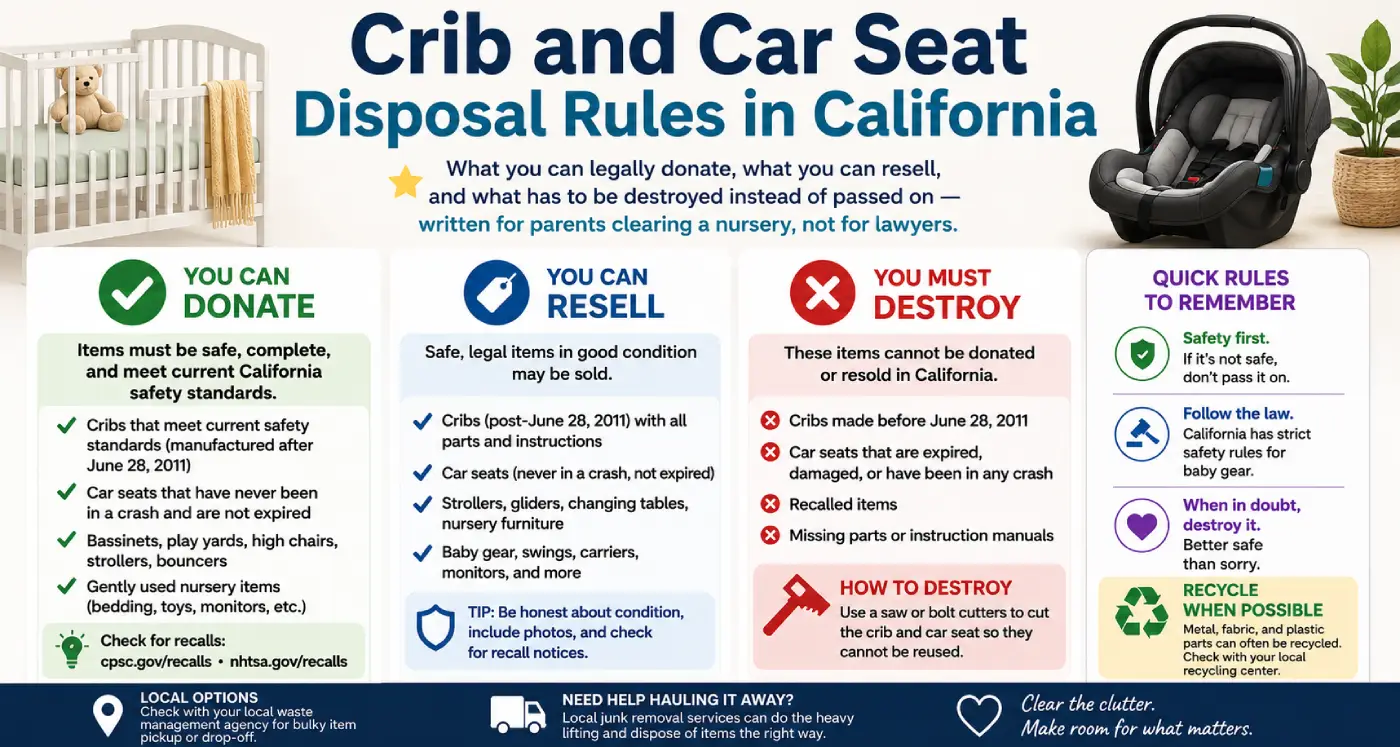
What you can legally donate, what you can resell, and what has to be destroyed instead of passed on — written for parents clearing a nursery, not for lawyers.
Reviewed by Weston Molitor, owner, Wild West Junk Removal • Temecula, CA
The short version
Almost everything that comes out of a nursery can be handed to another family. Two things can't: cribs and car seats. Both sit under federal safety rules that follow the product after you're finished with it, and both are the reason a thrift store will wave you off at the door.
The confusion is understandable. A crib and a dresser look like the same category of object — big, wooden, screwed together, sitting in the same room. Legally they are not remotely the same. A dresser is furniture. A crib is a regulated juvenile product, and handing a non-compliant one to a friend, a buyer, or a donation center is not a favor. It's a transfer of a known hazard.
This page is the item-by-item version of that distinction, plus the practical part nobody writes down: how you actually render a crib or a car seat unusable so it can't come back into circulation.
Last reviewed August 2026. Federal standards and recall listings change — verify a specific model against the sources at the bottom of this page before you act on it.
Nursery items, one by one
Start here. Find the item, read the row, and you'll know which of three piles it belongs in: rehome it, dispose of it, or destroy it first.
| Item | Donate? | Resell? | What to do instead |
|---|---|---|---|
| Drop-side crib | No | No | Dismantle so it can't be reassembled; recycle wood and metal separately |
| Crib made before June 28, 2011 | No | No | Treat as non-compliant unless the label proves otherwise; dismantle |
| Crib made after June 28, 2011, with intact label and hardware | Rarely | Rarely | Legal if it meets the current standard, but most charities still refuse cribs outright |
| Crib mattress | No | No | Not eligible for California's free mattress recycling program — see below |
| Car seat, expired | No | No | Strip and cut the straps, then recycle the shell or trash it |
| Car seat, in a moderate or severe crash | No | No | Same as expired — destroy it, and check whether your insurer will reimburse a replacement |
| Car seat, unexpired and never crashed | Case by case | No | Only to someone who knows its full history; never to a stranger |
| Booster seat (backless or high-back) | Case by case | No | Same expiration and crash rules as a harnessed seat |
| Bassinet or cradle | Yes | Yes | Must meet the current bassinet standard and be recall-free |
| Play yard / pack 'n play | Yes | Yes | Check the recall list first; older models have a long recall history |
| Changing table | Yes | Yes | Rails and strap anchor must be intact |
| Glider, rocker, ottoman | Yes | Yes | Ordinary furniture — no juvenile-product rules apply |
| High chair | Yes | Yes | Harness must be complete and the model recall-free |
| Anything under an open recall | No | No | Get the remedy from the manufacturer, or destroy it |
Why "case by case" on car seats
Unlike a non-compliant crib, there's no blanket federal ban on giving away an unexpired car seat that has never been in a crash. What there is instead: no way for a stranger to verify either of those claims. That's why almost every charity, consignment shop and resale platform refuses them, and why the honest answer for a seat leaving your hands is usually "destroy it."
Cribs: what the rule actually says
Cribs are among the most tightly regulated products in an American home, and the regulation doesn't stop at the cash register. It reaches the second-hand market.
The June 2011 federal crib standard
Since June 28, 2011, every full-size and non-full-size crib manufactured, sold, or resold in the United States has had to meet the U.S. Consumer Product Safety Commission's current mandatory standards (16 CFR 1219 and 1220). Traditional drop-side cribs do not meet them and cannot be made to.
Because a non-compliant crib is a product that fails a mandatory safety standard, it can't lawfully be distributed in commerce — and that reaches resale shops, consignment, yard sales, online listings and donation. This is why Goodwill and Habitat ReStore turn cribs away at the door, and why "I'll just give it to my sister" isn't the clean answer it sounds like.
Roughly speaking, four things disqualify a crib from being passed on:
Drop-side rails
The moving side rail can detach from the frame and open a gap an infant can slip into. Banned from sale and donation outright.
Made before the standard
Even fixed-side cribs built before June 2011 may fail current slat strength, hardware durability and mattress-support testing.
Under an open recall
A recalled crib without its remedy applied is a recalled crib. It gets destroyed, not relisted.
Missing label or hardware
No manufacturer label, no model number, no original bolts — compliance can't be verified, so no legitimate buyer or charity will take it.
Daycares, preschools and short-term rentals
Since December 2012, licensed child care facilities and places of public accommodation — which includes hotels and, in practice, vacation rentals that supply a crib — have been required to provide cribs meeting the current federal standard. If you're retiring a fleet of old units, that's a compliance deadline, not a decluttering project.
The crib mattress trap in California
California has one of the best mattress recycling programs in the country. Crib mattresses are not in it.
Under the state's mattress stewardship law, a recycling fee is collected on every mattress and box spring sold in California, which funds free drop-off at hundreds of locations through the Mattress Recycling Council's Bye Bye Mattress program. Condition doesn't matter and age doesn't matter. It's genuinely free.
California's program excludes juvenile products, including crib and bassinet mattresses. Connecticut counts a crib mattress as a mattress; California does not. Neither do Oregon or Rhode Island.
So a standard twin from the guest room rides free, and the crib mattress in the same load does not. Individual drop-off sites sometimes accept them independently of the state program — call the specific location first rather than assuming.
Practically, that leaves three options for a crib mattress: check whether your local transfer station takes it as bulky waste, ask a drop-off site whether they'll handle it outside the program, or put it on a hauler's truck with the rest of the room. What it should not be is set at the curb with a "free" sign — a used infant sleep surface is exactly the item you don't want a stranger picking up.
Car seats: expiration, crashes and why nobody wants yours
Car seats are the other item that reliably stalls a nursery cleanout. They feel far too expensive to throw away, and they are also the single hardest thing in the room to give to somebody else.
They expire, and the date is stamped on the shell
Every seat carries a manufacture date and a manufacturer-set useful life — commonly six to ten years, printed on a label or moulded into the plastic. The plastic embrittles with heat cycling, harness webbing degrades, and the standards the seat was certified against move on. Look on the underside or the side of the shell; if you can't find a date, treat the seat as expired.
A crash retires the seat
Federal guidance from NHTSA is to replace a car seat after a moderate or severe crash. Some manufacturers go further and say replace after any crash at all — the manual for your specific model is the authority. Damage from a crash is frequently invisible, which is precisely the problem with passing one along.
Why they don't go in the blue bin
A car seat is a composite: a polypropylene shell, EPS or EPP foam, steel reinforcement, nylon webbing, and fabric. Curbside recycling can't process a mixed assembly like that, so a whole seat put in the recycling cart gets pulled and landfilled. Separated, most of the mass is recyclable — which is what the strip-down below is for.
The retailer trade-in route
Target runs a car seat trade-in event twice a year, typically once in spring and once in fall, accepting infant seats, convertibles, bases, harness and booster seats — including expired and damaged ones — at drop-off boxes near Guest Services, in exchange for a discount toward new baby gear. It's the easiest disposal path for a single seat if your timing lines up with the window. Check the current dates before you load the car; the event runs for about two weeks each time.
How to check a recall in about two minutes
Two different agencies, two different lookups. Cribs and juvenile furniture go to the CPSC. Anything that rides in a vehicle goes to NHTSA.
-
Find the label
On a crib, it's usually on the inside of an end panel or the mattress-support frame. On a car seat, it's on the shell or the base. You want manufacturer, model number, and date of manufacture.
-
Search the right database
Cribs, bassinets, play yards, high chairs and gates: CPSC recall listings. Car seats and boosters: NHTSA's recall lookup, searchable by brand and model.
-
Take the remedy if there is one
Many recalls come with a free repair kit or replacement. That's worth claiming before you write the item off — it's the difference between a usable product and a load of scrap.
-
No remedy? Destroy it
An unremedied recalled item shouldn't be sold, donated, gifted or left at a curb. Follow the destruction steps below so it can't re-enter circulation.
If the model has no label at all, stop looking. An unidentifiable crib or car seat can't be verified as compliant or recall-free, and unverifiable is functionally the same as non-compliant for anyone deciding whether to accept it.
How to actually take one out of circulation
"Destroy it" sounds dramatic. In practice it's twenty minutes with a socket set and a pair of scissors, and it's the step that separates responsible disposal from moving a hazard to somebody else's house.
A crib
- Break it down to panels. Sides, ends, mattress support, hardware bag.
- Cut or snap the rails. Enough that the panels can't be reassembled into a functioning crib.
- Pull the hardware. Bolts, brackets and the metal mattress support go into the scrap metal stream; solid wood goes into wood.
- Remove the label. So the pieces can't be reassembled and relisted with a legitimate-looking model number.
- Never curb it whole. A complete crib with a "FREE" sign is the exact failure mode the rule exists to prevent.
A car seat
- Strip the fabric cover and padding. Cover goes in the trash; some foam is recyclable, most isn't.
- Cut the harness straps. This is the single most important step — a seat with cut straps can't be quietly reused.
- Remove metal parts. Buckles, hardware and any steel reinforcement go to scrap.
- Check the shell for a recycling code. Many are marked #5 polypropylene. Some transfer stations take rigid plastic; most curbside programs won't.
- Write "EXPIRED — DO NOT USE" on the shell in permanent marker before it leaves your hands.
City of Temecula residents also get two free bulky item pickups a year through CR&R, which handles a single dismantled crib at the curb perfectly well — as long as it has actually been dismantled first.
What local charities will and won't take
Everything that isn't a crib, crib mattress, or car seat is genuinely wanted, and it's worth the phone call. Gliders, dressers, changing tables, high chairs, gates, toys, books and clothing all move quickly through shelters and family programs in the Temecula Valley — we keep a running list of Temecula charities that accept household goods.
Two things worth knowing before you load the car. First, most donation centers will not accept anything with a missing harness, a missing manual, or visible damage, regardless of category — a partial item costs them more to sort than it's worth. Second, policies on juvenile products vary between individual branches of the same organization, so the answer you get from one location isn't necessarily the answer you'll get from the next one over. Call the specific site.
And if you're unsure which pile something belongs in, send us a photo of the label. We'll tell you straight, including when the answer is "that one's fine, list it."
Reviewed by
Weston Molitor
Owner • Wild West Junk Removal, Temecula CAWeston started Wild West Junk Removal in Temecula in 2021 and still runs jobs himself. Nursery clearouts come up most weeks — families upgrading a room, grandparents emptying a spare bedroom, property managers turning a unit — and the crib-and-car-seat question comes up on nearly every one of them.
Nothing on this page is legal advice. It's the practical read of the rules we work under every week, with the primary sources linked below so you can check any of it yourself. More about the company.
"The worst outcome isn't a crib in a landfill. It's a drop-side crib in somebody's spare room because a stranger picked it up off a curb."

Crib and car seat disposal FAQs
If the crib doesn't meet the current federal safety standard, yes — the restriction covers resale shops, consignment, yard sales, online listings and donation, not just retail stores. Any crib manufactured before June 28, 2011, and every drop-side crib regardless of age, should be treated as non-compliant. A crib made after that date with an intact manufacturer label and complete original hardware can lawfully change hands, but most charities decline cribs as a blanket policy anyway.
Dismantle it and make sure it can't be reassembled. Take it down to panels, cut or snap the rails, pull the hardware and metal mattress support for scrap, and remove the manufacturer label so the pieces can't be relisted with a legitimate-looking model number. What you should not do is put it at the curb intact with a free sign — that's the exact outcome the rule exists to prevent.
In almost every case, no. There's no blanket federal ban on giving away a car seat that is unexpired and has never been in a crash, but there's also no way for the recipient to verify either of those things — so charities, consignment shops and resale platforms refuse them as policy. If the seat is expired, was in a moderate or severe crash, or is under an open recall, it should be destroyed rather than passed on.
Look for a label or moulded stamp on the underside or side of the shell showing the date of manufacture, and often an explicit expiration or "do not use after" date. Useful life is set by the manufacturer and commonly runs six to ten years from manufacture. If there's no legible date anywhere on the seat, treat it as expired — an unidentifiable seat can't be verified as safe by anyone.
No. California's mattress stewardship program covers mattresses and box springs but specifically excludes juvenile products, including crib and bassinet mattresses. Connecticut counts a crib mattress as a mattress; California, Oregon and Rhode Island do not. Some individual drop-off sites accept them independently of the state program, so it's worth calling the specific location rather than assuming either way.
Find the manufacturer, model number and date of manufacture on the product label — inside an end panel or on the mattress-support frame for a crib, on the shell or base for a car seat. Cribs, bassinets, play yards, high chairs and gates are searchable through CPSC recall listings; car seats and boosters go through NHTSA's recall lookup. Many recalls come with a free repair kit or replacement, which is worth claiming before you write the item off.
Strip the fabric cover and padding, cut the harness straps, and remove the buckles, metal hardware and any steel reinforcement for scrap. Cutting the straps is the step that matters most, because it makes quiet reuse impossible. Check the shell for a recycling code — many are #5 polypropylene, which some transfer stations accept even though curbside programs generally won't — and write "expired, do not use" on it in permanent marker before it leaves your hands.
Yes, once it's been taken apart. City of Temecula residents get two free bulky item pickups a year through CR&R, which handles a dismantled crib at the curb without any trouble. Schedule it in advance, and break the crib down before pickup day rather than setting an intact one out overnight where somebody can carry it off.
Sources
- CPSC.gov U.S. Consumer Product Safety Commission — federal crib standards (16 CFR 1219 and 1220), effective June 28, 2011, and the December 2012 compliance date for child care facilities and places of public accommodation.
- CPSC.gov/Recalls Searchable recall listings for cribs, bassinets, play yards, high chairs and other juvenile products.
- NHTSA.gov Car seat recall lookup, and federal guidance on replacing a car seat after a moderate or severe crash.
- ByeByeMattress.com Mattress Recycling Council — California accepted and unaccepted items, including the exclusion of crib and bassinet mattresses.
- TemeculaCA.gov City of Temecula bulky item pickup through CR&R, two free collections per household per year.
- Target.com Car seat trade-in event terms, accepted seat types and drop-off procedure.
If it can't be rehomed, we'll take it
Once you've worked out what has to go, we're the Temecula crew that dismantles cribs properly instead of reselling them, and takes the rest of the room in the same trip. Send a photo of the label if you want a second opinion first — that part's free either way.
Wild West Junk Removal
41713 Niblick Rd, Temecula, CA 92591
(951) 837-8072 • service@wildwestjunkremoval.com
Mon–Sat 7AM–7PM • Sunday closed