
Carpet Lifespan · Temecula Valley
How Long Does Carpet Actually Last? Signs It's Time to Replace It
I've pulled a lot of floors out of Temecula houses, and almost nobody can tell me the year their carpet went in. Here's how to check yours in ten minutes, what the wear actually means, and when the honest answer is "clean it and leave it alone."
Family-owned in Temecula since 2021 · Licensed & insured · Same-day carpet tear-out often available
Wild West Junk Removal · 41713 Niblick Rd, Temecula, CA 92591 · (951) 837-8072
Mon to Sat: 7AM-7PM · Sunday: Closed · Family-owned, licensed and insured · Serving Temecula, Murrieta, Menifee and southwest Riverside County
By Weston Molitor, founder of Wild West Junk Removal · Published September 3, 2026
Five years of pulling floors in the valley
I Know How Old a Carpet Is Before the Corner Comes Up
The tag on the back of the carpet almost never tells me the year. The floor does. It's the gray road running from the bedroom door to the closet, the shadow of a couch that got moved once, and the smell that comes up the second the pad lifts off the slab.
Here's the thing I've noticed after five years of tearing carpet out of Temecula homes: people don't replace carpet on a schedule. They replace it when a flooring guy is already coming for the kitchen, when the house is going on the market, or when a leak makes the decision for them. The carpet itself was usually done years earlier. Nobody checked because nobody knew what to check.
So this page is the check. It's the same one I do with my eyes in the first thirty seconds of a walk-through, written out so you can do it yourself with a flashlight and a pair of pliers. I make my money once the carpet is already coming out. I have no reason to tell you yours is finished if it isn't, and I'll tell you when cleaning or a restretch is the right call instead.
The number everyone quotes, and what's behind it
How Long Carpet Lasts by Fiber and Grade
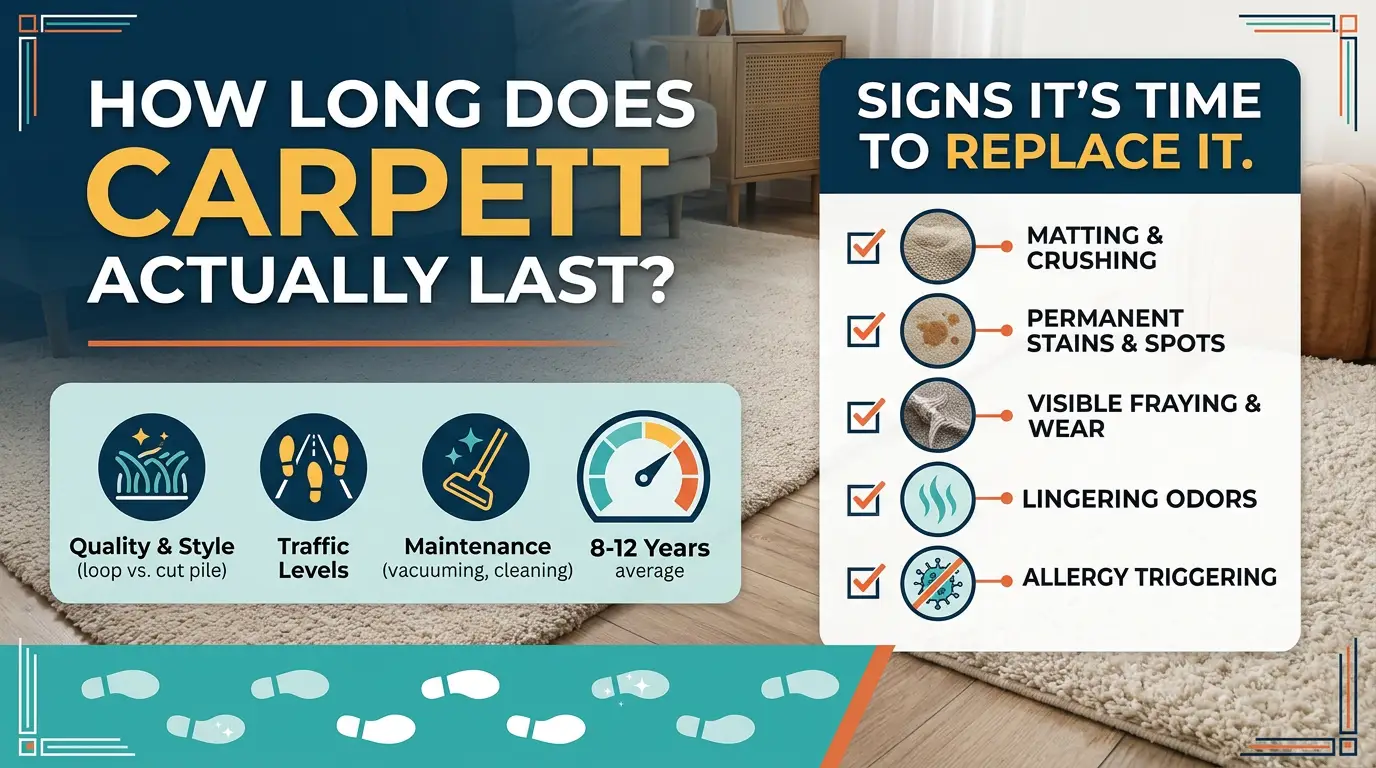
The number you'll see everywhere is eight to ten years. That's the figure on InterNACHI's life expectancy chart for home components, the one home inspectors use, and it lines up with what the University of Nebraska extension service published years ago: a 20-to-24-ounce nylon carpet, which is a normal mid-grade residential carpet, "wears" about eight to ten years. Both of those assume normal traffic and reasonable maintenance.
The problem with one number is that carpet isn't one product. The stuff a tract builder rolls into a new house and the stuff somebody paid to have picked out at a flooring showroom are different materials with different lifespans, and they age at different speeds depending on what's under them. Here's the range I actually see, in years, by what the carpet is made of:
3–5 yrs
Builder-grade — thin polyester or olefin over a thin pad. What most tract homes get, and what mats first
8–10 yrs
Mid-grade nylon — the chart number. Holds up if it's vacuumed and deep-cleaned on schedule
12–15+ yrs
Dense nylon or wool over a quality pad — heavy face weight, tight twist, low traffic
Two things decide which column you're in, and neither is the color or the brand. The first is fiber. Nylon springs back after you step on it; that's called resiliency, and the Nebraska fiber chart rates nylon good to excellent for it. Olefin, which is what most cheaper Berber-style loop carpet is made of, rates lower and gets worse in high piles, and it loses strength in sunlight unless it was chemically treated for it. Polyester feels soft in the store and is stain-resistant, but it doesn't recover from crushing the way nylon does.
The second is density: how much yarn is packed into each square yard, and how tightly it's twisted. The extension service puts it plainly: the denser the carpet, the more durable it is. A dense, low-pile nylon in a hallway will outlast a thick, plush polyester in the same hallway by years, even though the plush one felt like the nicer carpet on day one.
The pad has its own clock
Every lifespan number above assumes the pad under the carpet is still doing its job. Cheap rebond pad breaks down into crumbs and dust on the slab well before a good carpet does, and once the pad goes, the carpet takes every footstep with nothing under it and mats fast. When I lift a corner and the pad comes up in pieces, the carpet's remaining life is measured in months regardless of what the fiber looks like.
Do this tonight
The Ten-Minute Carpet Check
You need a flashlight, a pair of needle-nose pliers, and a corner of the room nobody looks at. This is the same inspection I do before I quote a job, minus the part where I'm standing in your hallway.
- ✓Stand in the doorway and look at the traffic lane, not the room. The path from the door to the bed, the couch, or the closet should be the same height and color as the carpet along the walls. If it's visibly flatter, grayer, or shinier, the pile in that lane is crushed. Vacuuming won't lift it and neither will cleaning.
- ✓Rake it with your fingers against the grain. Healthy cut pile stands back up when you run your hand through it. Pile that stays down, or feels matted and stiff like felt, has lost its twist. That's permanent.
- ✓Pull back a corner in the closet. Grab the carpet near the wall with the pliers and lift it off the tack strip a few inches. You're looking at the pad. Firm and springy is fine. Crumbly, dented, or stuck to the floor in chunks means the pad is finished, and the carpet is living on borrowed time.
- ✓Look at the back of the carpet while it's up. Backing that's cracked, brittle, or separating from the face is delaminating. Once the two backing layers let go of each other, the carpet can't be restretched or repaired.
- ✓Find a stain that keeps coming back. A spot you've cleaned three times that reappears a week later isn't in the carpet. It's in the pad, and it wicks back up every time the carpet gets damp. That's a pad problem, and pad problems don't clean.
- ✓Smell it on a warm day with the AC off. Close the room up for an hour. A musty or ammonia smell that shows up when the room heats up is coming from the pad or the slab, not the surface. Cleaning will hide it for about two weeks.
- ✓Look for ripples and buckles. Carpet that's lifted off the floor in waves has lost tension. If it's under ten years old and the backing is sound, that's a restretch, not a replacement. If it's old and the backing is brittle, restretching just tears it.
- ✓Check under something that never moves. Slide the dresser over a foot. The color and pile height under it is what the carpet looked like new. The difference between that patch and the middle of the room is how much life is gone.
If you hit two or more of those, the carpet is done, and the sections below explain why. If you only hit one, keep reading, because some of these have a cheap fix and I'd rather you spend a couple hundred dollars on that than a few thousand on a floor you didn't need yet.
Wearing out vs. uglying out
What Cleaning Fixes, What a Stretch Fixes, and What Nothing Fixes
The carpet industry has a phrase for what actually happens to most carpet: it doesn't wear out, it "uglies out." A flooring inspection expert quoted in Buildings magazine put it this way: modern synthetic carpet almost never structurally wears through. It just stops looking like carpet. Matting, crushing, permanent traffic lanes, and soiling that won't come out are appearance failures, and appearance failures are what send carpet to my trailer.
That matters because of how warranties are written. Read the fine print on a "20-year wear warranty" and you'll find it covers abrasive wear only, defined as losing more than 10 percent of the face fiber by weight. Shaw's warranty documents say it directly: the coverage does not include appearance retention, matting, crushing, or normal appearance changes. Ten percent fiber loss on a nylon carpet basically never happens in a house. So the warranty is real, and it's also almost never the thing that fails. Don't count on it to buy you a new floor.
What that leaves you with is a sorting job. Every symptom on the checklist falls into one of three buckets: a cleaning fixes it, an installer fixes it, or nothing fixes it.
| What you found | What it is | Fix it | Replace it |
|---|---|---|---|
| Dull, dingy, but pile still stands up | Embedded soil | Yes — professional hot-water extraction | No. This is the cheapest test there is; spend the cleaning money first |
| Ripples, waves, buckling | Lost tension | Yes — restretch, if the backing is sound and the carpet is under about ten years old | Only if the backing is brittle or already delaminating |
| Small snag, pull, or burn in one spot | Localized damage | Yes — a patch from a closet remnant | No, unless the same carpet is matted everywhere else |
| Flat, shiny traffic lane that won't fluff after cleaning | Crushed pile, lost twist | No — the fiber structure is gone | Yes. This is the single most common reason carpet comes out |
| Stain that returns after every cleaning | Contamination in the pad | No — cleaning the surface just re-wets the pad | Pad at minimum; usually the carpet over it too |
| Crumbly pad, grit under the carpet | Pad breakdown | No | Yes. The carpet will mat within months on a dead pad |
| Musty or ammonia smell that comes back | Pet urine or moisture in pad and slab | No — it's below the surface | Yes, and check the subfloor before new carpet goes down |
| Faded strip in front of the slider | UV damage | Cosmetic only | Your call. The fiber is weakened, but it isn't a health issue |
| Wet for more than 48 hours | Mold risk in pad and backing | No | Pad always. Carpet almost always. See below |
The cleaning row is the one I want to underline. The Carpet and Rug Institute says to have carpet professionally deep-cleaned every 12 to 18 months, and to vacuum high-traffic areas daily, medium-traffic areas about twice a week, and light-traffic rooms weekly. Almost nobody does that. If your carpet has never been professionally cleaned and the pile still stands up when you rake it, cleaning it is the honest first move. It's the cheapest way to find out whether the floor is dirty or dead, and a lot of carpet I get called about is just dirty.
The part you can't see from standing up
The Pad, the Pets, and the 48-Hour Rule
Everything that ends a carpet's life early happens underneath it. The surface is the last thing to show it.
Carpet pad is a sponge. It absorbs whatever gets through the face fiber and it holds onto it, which is why a room can look clean and still be the source of a smell you can't find. Dog urine is the big one in this valley. It passes straight through the carpet, soaks the pad, and wicks into the concrete slab underneath, and the slab is porous enough to hold it. Cleaning companies will tell you the truth about this if you ask: they can treat the carpet, but they can't get to the pad or the slab without lifting the floor. Once the pad is saturated, that room's carpet is done, and the pad has to go with it.
Water is the other one, and there's an actual clock on it. The EPA's guidance on mold and moisture is that wet materials need to be dried within 24 to 48 hours to keep mold from getting established, and that porous materials like carpet may have to be thrown out once mold gets into them because you can't reliably clean it out of the fibers. The EPA's own mold course goes further: to dry carpet and backing inside that window, you have to pull the carpet and pad up off the floor and put fans on them. You cannot dry a pad through the carpet. A wet-vac on the surface makes the room feel dry while the pad stays soaked against the slab.
Slab leaks, washer hoses, and the water heater in the garage
The three most common ways carpet gets wet around Temecula are a slab leak nobody noticed for a week, a washing machine hose that let go while everyone was at work, and a water heater that failed into the adjacent bedroom. In all three cases, by the time the carpet feels damp on top, the pad has been wet for longer than 48 hours. Pull the carpet back and look. If the pad is dark, swollen, or smells, it's past saving, and the carpet over it usually is too. Water-damaged carpet also can't go into California's carpet recycling stream, so tell whoever hauls it.
The last thing underneath is the subfloor itself, and I mention it because I find the problem before you do. When pad comes up off a slab that's been wet, there's sometimes efflorescence, a white powder, or staining that means moisture is still coming through the concrete. On raised foundations, soft spots in the plywood show up the moment the pad is off. Neither of those is a carpet problem, but both of them are why new carpet should never go down over an old pad without somebody looking at what's under it.
The sign that isn't on the floor
What Your Nose and Lungs Already Know
Carpet is a filter. That's not a figure of speech; it's how the American Lung Association describes it. Carpet traps dust mites, pet dander, pollen, mold spores, tracked-in dirt, and fine particle pollution, and those things come back out of it when you vacuum, when you walk across it, and when you tear it out. The part of that page worth reading twice is this: carpets older than ten years typically hold higher levels of pollutants and allergens than newer ones. Ten years is also the top of the lifespan chart. Those two numbers agreeing is not a coincidence.
What it looks like in a house is subtle. Somebody's allergies are worse at home than at work. The kids sneeze after playing on the family room floor. You vacuum and the room smells dusty for an hour afterward instead of cleaner. Nobody connects those to the carpet because the carpet looks fine from standing height, and because a lot of the accumulation is in the pad where no vacuum reaches. The Lung Association specifically points out that children get more exposure because they're on the floor with their hands in their mouths, which is a fair description of every toddler I've met.
I'm not going to tell you old carpet is making anyone sick, because I'm a hauler and that's not my call. I'll tell you what I see instead: the amount of fine dust that comes out of a fifteen-year-old carpet and pad when we cut and roll it is startling, and my crew wears masks for a reason. If the allergy pattern in your house lines up with a carpet that's past the ten-year mark, that's a sign worth adding to the list even when the floor itself looks okay.
Local conditions
Why Carpet Ages Faster in the Temecula Valley
A lifespan chart is written for an average house somewhere. Ours aren't average in a few ways that matter, and all of them shorten the number.
The sun. Most of the homes I work in have a west- or south-facing slider onto the patio, and the strip of carpet in front of it gets hit with direct sun for hours a day, most days of the year. Fading is the visible part. The invisible part is that UV weakens synthetic fibers, and cheaper olefin in particular, which the fiber charts note loses strength in sunlight unless it was treated for it. The faded strip in front of the slider is usually also the first place the pile goes flat.
The dust. We live in a semi-arid valley with wind, construction, and dirt lots. Grit tracks in on shoes and sits at the base of the pile, and every step grinds it against the fiber. That's the mechanism that actually wears carpet down, and it's why the Carpet and Rug Institute pushes doormats and shoes-off so hard. Houses that back onto open land or a horse property get more of it.
The dogs. This valley is a dog valley. Two big dogs on a builder-grade carpet is a three-year floor, and I say that with affection for the dogs.
The age of the housing stock. Here's the one that catches people. A huge share of the houses in Harveston, Wolf Creek, Paseo Del Sol, Morgan Hill, and the newer parts of Murrieta and Menifee went up between the late 1990s and the late 2000s, and most of them got builder-grade carpet over a thin pad. If that carpet was never replaced, it's now two or three times past the top of its expected life. I pull original carpet out of those houses every month, and the owners are always surprised it lasted that long. It didn't, really. It just stayed on the floor.
Renters, landlords, and the useful-life question
Carpet age comes up in almost every security deposit dispute in this valley. California law only lets a landlord deduct for damage beyond normal wear and tear, which the California Courts self-help guide and Civil Code section 1950.5 both spell out, and a carpet worn thin from foot traffic is wear and tear. In practice, courts and property managers prorate against a useful life in the same eight-to-ten-year range the inspectors use, so a tenant can't be billed for a brand-new floor to replace one that was already near the end of its life. If you manage units, that's the argument for replacing on a schedule instead of at the next dispute. Turnover is when we handle it, usually as part of a property manager turnover cleanout.
Once you know
Once You Know, Here's What's Next
If the checklist came back with two or more hits, the carpet's done and the rest is logistics. That part is easier than the deciding was.
The first choice is whether you're pulling it yourself or having it pulled. One bedroom with a utility knife and a Saturday is a reasonable DIY job. A whole house, a staircase, glued-down pad on a slab, or an installer showing up Thursday is where people call me. The carpet removal page walks through what a tear-out actually involves, what changes the price, and how the old carpet gets sorted so the clean nylon ends up in California's recycling program instead of a landfill.
The second choice is where the old carpet goes, and there are more options than most people think. I wrote up every route for getting rid of old carpet, including the two free ones, so you can pick based on how much carpet you have and what shape it's in. Water-damaged and pet-soaked carpet can't be recycled, which narrows the list fast.
And if the carpet is coming out because a room is getting redone or a house is getting emptied, the couch, the bed frame, and the pile in the garage ride in the same trailer through furniture removal at no real difference in the trip. Current load sizes are on the pricing page, and photos of the rooms texted to (951) 837-8072 get you a written number back the same day.
Weston Molitor
Founder · Wild West Junk Removal · Temecula, CAI started Wild West in Temecula in 2021 and I'm still on the truck most days. I didn't write this to sell anyone new flooring; I don't sell flooring. I wrote it because I keep pulling carpet out of houses where the owner had been wondering for five years whether it was time, and the answer was sitting under a closet corner the whole time.
"Pull back the corner in the closet. If the pad comes up in crumbs, you already have your answer, and I'd rather you got it from a pair of pliers than from me."

Quick answers
Carpet Lifespan Questions
Cut the normal number roughly in half. A mid-grade nylon that would go eight to ten years in a quiet house tends to run four to six with a couple of large dogs, and builder-grade polyester or olefin can be matted flat in three. It isn't only the claws and the traffic; it's the urine that gets through to the pad and the slab, which no cleaning reaches. If you have dogs and you're picking new carpet, a dense, low-pile nylon over a pad with a moisture barrier is the combination that buys the most years.
It depends on whether the pile still stands up. If you rake the carpet against the grain and the fibers spring back, the carpet is dirty, not dead, and a hot-water extraction every 12 to 18 months, which is what the Carpet and Rug Institute recommends, will add real years by pulling out the grit that grinds the fiber down. If the pile stays flat when you rake it, the twist is gone and cleaning will only make it look better for a few weeks. Cleaning is still the cheapest test: spend that money before you spend the money on a new floor.
Often, yes, and I'll say so when it's the right call even though I don't get the job. Ripples and buckling mean the carpet has lost tension, not that the carpet is worn out. If it's under about ten years old, the pile still stands up, and the backing on the underside is flexible and intact, a flooring installer can restretch it for far less than a replacement. If the backing has gone brittle or the two backing layers are separating, stretching just tears it, and you're back to replacing.
Pull back a corner in a closet and look at it. Good pad is firm and springs back when you press it. Pad that's crumbly, dented into permanent hollows, stuck to the slab in chunks, or stained and smelly is finished. A stain on the carpet that comes back after every cleaning is another pad sign, because the contamination is wicking up from underneath. The pad should always be replaced when the carpet is, and if the pad is dead, the carpet over it doesn't have long left either.
Start with the house. If it was built between the late 1990s and the late 2000s and the previous owner didn't mention new flooring, you're likely looking at the original builder-grade carpet. Then check a closet corner: some carpet has a manufacturer tag or printed date on the backing near the seam, and the pad often has a brand and date stamped on it. If neither is there, compare the pile and color under a piece of furniture that never moves against the middle of the room. The bigger that difference, the closer the carpet is to the end regardless of the actual year.
Not automatically, but there's a clock on it. The EPA's guidance is that wet materials need to be dried within 24 to 48 hours to prevent mold, and that drying carpet inside that window means pulling the carpet and pad up off the floor and putting fans on both. If a clean-water leak was caught the same day and the pad was dried properly, the carpet is usually fine. If the pad stayed wet for more than two days, or the water came from a sewer backup or a slab leak that ran for a week, plan on replacing the pad and almost always the carpet. Wet-vacuuming the surface doesn't dry the pad.
Sources
Lifespan ranges above are general figures and vary by fiber, density, padding, traffic, and maintenance. Health and legal information referenced here is general and not a substitute for advice from a doctor, an attorney, or a licensed flooring inspector. Program rules and legal standards change; confirm current terms before you rely on them.