
Green Waste Bin Rules · Temecula, CA
What Can and Can't Go in the Temecula Green Waste Bin: Fronds, Cactus, Sod, Treated Wood, and Food Scraps
I look inside a lot of green barrels in Temecula. Usually it is the one sitting at the curb with a tag on the lid and a pile of fronds next to it. The lid tells you grass and leaves. It does not tell you what to do with a dead agave, a strip of sod, the old fence boards, or the food scraps the state now wants in there. Here is the list I wish was printed on the cart, and where the no items actually go.
Family-owned in Temecula since 2021 · Licensed & insured · Green waste routed to compost, not landfill
Wild West Junk Removal · 41713 Niblick Rd, Temecula, CA 92591 · (951) 837-8072
Mon to Sat: 7AM-7PM · Sunday: Closed · Family-owned, licensed and insured · Serving Temecula, Murrieta, Menifee and southwest Riverside County
The short version
Your Green Cart Is an Organics Cart Now
That is the one thing most people in Temecula still have not caught up with, and it changes both lists. The cart takes more than it used to on the kitchen side, and less than you would guess on the yard side.
Since SB 1383 kicked in, the green cart at every house in Temecula is meant for three things: yard trimmings, food scraps, and food-soiled paper. Everything in it rides to CR&R's digester in Perris, where it gets turned into natural gas and compost. That plant is also the reason for most of the surprising no's. The machine chews through leaves and lettuce just fine. It does not do well with a palm frond, a shovel of dirt, or a fence board soaked in preservative, and CR&R would rather leave your cart at the curb than send that load to Perris.
Quick answer
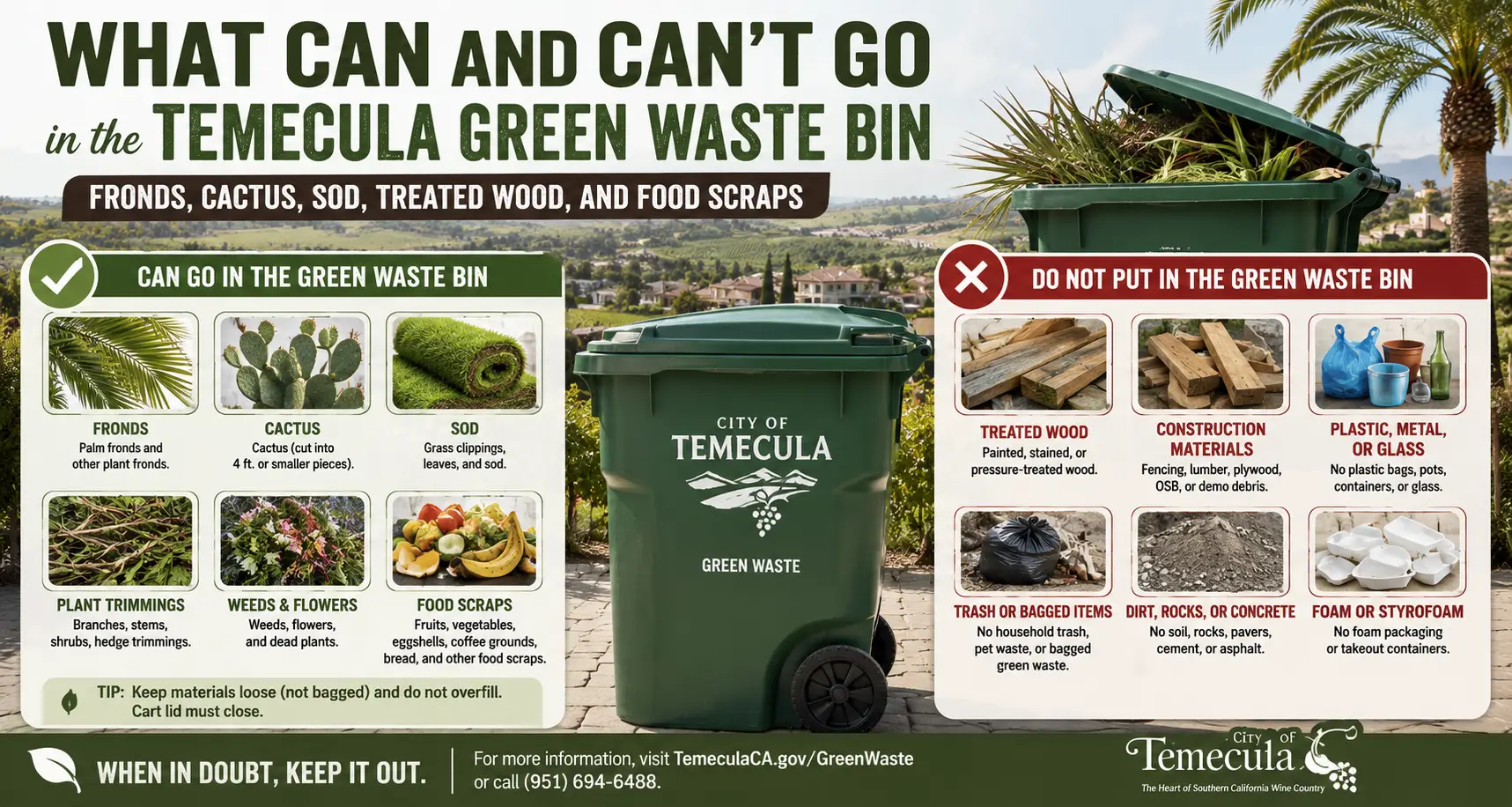
Yes: grass, leaves, weeds, hedge trimmings, small branches that let the lid close, flowers, fallen fruit, food scraps of every kind, coffee grounds, napkins, paper towels, greasy pizza boxes, and your Christmas tree cut in pieces.
No: palm fronds, cactus and agave, sod, dirt and rocks, treated or painted lumber, logs and stumps, pet waste, and any plastic bag, including the ones labeled compostable.
Three carts, one rule
Black, Blue, Green
Temecula's trash is handled by CR&R under a city franchise, and the city is clear that only CR&R's own carts get emptied. Bags on the ground, a spare can from the hardware store, a neat pile next to the barrel: none of it goes. So the first rule is that whatever you want gone has to fit inside the right cart with the lid down.
Black cart: trash
What is left after you pull the recyclables and the organics. This is also where the green-cart rejects end up when they are small enough to fit: a few fronds, a chunk of agave, a broken paper plate with a plastic coating.
Blue or grey cart: recycling
Bottles, cans, paper, cardboard. The city's list is specific that yard waste and food waste never go in here. One bag of lawn clippings can spoil a recycling load.
Green cart: organics
Yard trimmings, food scraps, and food-soiled paper. Anything that grew and is not on the no list below. This is the cart the rest of this article is about.
The yes list
What Goes in the Green Cart
If it grew in the yard or came off your plate, it probably belongs here. The test on the yard side is size, not species: branches have to be short enough that the lid closes.
- Grass clippings and lawn thatch, dumped in loose. Not bagged.
- Leaves and pine needles, including the ones that blew over from the neighbor's liquidambar.
- Hedge, shrub, and rose trimmings, cut to fit. Thorns do not bother the digester; they only bother you.
- Small branches and twigs, cut down so the lid shuts. Thin enough to snap by hand is the safe size.
- Weeds, dead annuals, and spent vegetable plants. Seeds and all. The digester runs hot enough that it does not matter.
- Cut flowers and dead houseplants. Knock the soil off the roots and keep the pot.
- Fallen fruit that rotted under the citrus or the fig, wasps included.
- Food scraps: peels, plate scrapings, leftovers, meat and fish, dairy, bread, rice, coffee grounds, eggshells.
- Food-soiled paper: napkins, paper towels, pizza boxes, coffee filters, tea bags, paper plates that are not coated in plastic.
- Your Christmas tree, cut into pieces that fit, with every ornament and strand of tinsel off. CR&R starts picking those up the first collection day after December 26.
The SB 1383 part
Food Scraps Go in the Green Cart Now, and Nobody Told You Twice
Temecula was early on this. The city says residents were cleared to put food scraps in the green cart back in April 2016, when CR&R opened its anaerobic digester in Perris. Then on January 1, 2022, California's SB 1383 made it mandatory for every home in the state. So the kitchen trash is supposed to be light now, and everything you used to scrape into the black cart is supposed to go green.
What counts is anything you eat and anything left over from making it. Meat, fish, dairy, bread, rice, cooked leftovers, the science project from the back of the fridge, coffee grounds, tea bags, eggshells. Add the paper that touched it: napkins, paper towels, the greasy half of the pizza box, coffee filters, uncoated paper plates.
The bag rule is the part that gets carts tagged. No plastic bags. Not grocery bags, not the green ones from the store that say compostable. The sorters in Perris cannot tell a compostable bag from a regular one at line speed, so they pull all of them, and a cart full of bagged scraps is a contaminated cart. Put scraps in loose, or in a paper bag, or wrapped in a sheet of newspaper.
The city hands out free kitchen pails to make this easier. Pick one up at the City Hall front desk at 41000 Main Street or at the Welcome Center at 28690 Mercedes Street. Fill it during the week, dump it in the green cart the night before pickup, rinse it, repeat. That is the whole system, and it is documented on the city's SB 1383 page.
Keeping it from stinking in August
Put yard trimmings or a layer of newspaper in the bottom of the cart before the food goes in, so nothing sticks. Freeze meat and fish scraps until the night before collection. Put the cart out every week even when it is half empty. Park it in shade, hose it out once a month, and a shake of baking soda handles the rest. I have seen carts in Temecula that had not been rinsed in a year, and I promise the flies were not the digester's fault.
The gray-area list
The Things That Get a Cart Left at the Curb
These are the items I get asked about most, and the ones I see next to tagged carts. Where CR&R's own program materials draw the line, I have said so. Where the answer varies from city to city, I have told you what to assume in Temecula and how to check.
| Item | Green cart? | Where it goes instead |
|---|---|---|
| Palm fronds and palm skirts | No | CR&R lists fronds as a landfill item across its organics programs. A handful can go in the black cart if it fits. A full trim or a skirt is a haul. |
| Cactus, agave, yucca, ice plant | No | Too fibrous and too wet for the digester, and the spines go through gloves. Small pieces in the black cart. A dead agave the size of a couch is a haul. |
| Bamboo | No | Same problem as fronds. It wraps the grinders. Black cart in short pieces, or a haul. |
| Sod, dirt, soil, rocks, gravel | No | Not in any curbside cart in any real amount. Dirt fails the compost, and it makes the cart too heavy for the arm. Priced by weight on a haul. |
| Pressure-treated lumber, railroad ties, landscape timbers | No | Regulated treated wood waste under DTSC rules. It goes to an approved landfill with paperwork, never to the curb. See the note below. |
| Painted, stained, or plywood scraps | No | Black cart if it is a few small pieces. A fence or a deck is construction debris. |
| Logs, stumps, root balls, limbs thicker than your wrist | No | Branches that let the lid close are fine. Anything that needs a chainsaw is a haul or a dumpster. |
| Dog and cat waste, litter | No | Black cart. CR&R is explicit on this one. |
| Horse and livestock manure | No | Not through the residential cart. On a horse property the volume makes it a manure route anyway. |
| Plastic bags, including compostable ones | No | Paper bags, newspaper, or nothing. |
| Meat and fish bones | Check | CR&R's digester programs in other cities put bones in the trash because they do not break down. I would do the same here until CR&R Temecula says otherwise. |
| Cooking oil and grease | Check | A greasy paper towel is fine. A bottle of used fryer oil is not. Take that to a household hazardous waste event. |
Treated wood is its own category. Old fence posts, deck boards, retaining wall timbers, and railroad ties are almost always pressure-treated, which means they carry arsenic, chromium, copper, or creosote. California's Department of Toxic Substances Control regulates that as treated wood waste. It cannot go in the green cart, it should not go in the black cart, and the landfill wants it separated from the rest of a load. That is why we ask about it when you text us a photo of a tear-out.
Why the no's are no's
It Comes Down to What the Perris Plant Can Eat
Your green cart is not going to a compost pile behind a fence somewhere. It goes to an anaerobic digester, which is a sealed tank where bacteria break organics down without oxygen and the gas that comes off runs CR&R's trucks. Before anything reaches the tank it gets sorted and ground. The sort line pulls plastic, glass, and metal. The grinder handles the rest, and the rest has to be soft enough to grind and clean enough to compost.
"A palm frond is a bundle of rope with a blade on the end. The machine that turns your lettuce into gas cannot do anything with rope."
Weston Molitor, Wild West Junk RemovalThat is the whole story on fronds, bamboo, and agave. They do not rot on any useful schedule, and long fibers wrap the shafts on grinding equipment. Dirt and rock are a different failure: they wear the machinery, they push the finished compost out of spec, and a cart half full of sod is heavy enough to stall the arm on the truck. Treated lumber is the worst of the three, because the preservatives that keep a fence post from rotting are exactly the chemicals nobody wants in compost spread on a farm.
None of this makes those materials trash in the ordinary sense. Fronds chip fine on the right machine, sod can be screened, and treated wood has its own landfill path. They just cannot ride in the same cart as your grass clippings, and the driver knows it when he sees a skirt hanging out of the lid.
Rules the driver checks
Five Ways a Green Cart Gets Skipped
Most skipped carts on my street have nothing to do with what is inside. They are handling mistakes, and every one of them is in the city's own trash FAQ.
- The lid is open. An overfilled cart does not get serviced. If the lid will not close, pull material out until it does and save the rest for next week.
- There is a pile next to the cart. Bags, bundles, and loose branches beside the barrel are not collected. Only what is inside a CR&R container goes.
- Plastic bags inside. Same rule as the kitchen scraps. Grass in a trash bag is a contaminated cart, even if the bag is clear.
- Timing. Carts go out by 6 a.m. on pickup day, no more than 24 hours ahead, and come back in within 12 hours of pickup. Temecula's property maintenance rules also want them stored out of sight in between.
- A contamination tag. SB 1383 requires CR&R to audit routes, and Temecula posts its route audit notices on the SB 1383 page. Since 2024 the state has required cities to follow up on repeat contamination with notices and, eventually, fines. One tag is a warning. Fix the cart and it stays a warning.
If the problem is volume rather than contents, you have three legal options before you call me. CR&R will rent an extra green cart or a temporary three-yard green bin; the number is (800) 755-8112. The city runs citywide cleanup days at Chaparral High School that take green waste from residents with proof of address. And a couple of times a year, one big cleanout with a hauler is cheaper than a second cart you pay for all year.
When the barrel is not the answer
The Bin Is for a Weekly Trickle. Everything Else Is a Load.
A 96-gallon cart holds about half a cubic yard. One skirt off a fan palm is more than that. So is a dead agave, a strip of lawn you ripped out, or the boards off a 40-foot fence. That is where yard waste removal comes in: we load it, haul it, and route the organics to a composting or chipping facility that can handle fronds and skirts, sort out the sod for the right destination, and separate treated wood for the landfill that is allowed to take it. Loads start at $195 for a quarter trailer, and the SB 1383 disposal receipts come with the invoice for anyone who needs them.
If you are trying to figure out when a pile is likely to outgrow the cart, I wrote a month-by-month yard waste calendar for the Temecula Valley. Short version: April growth, June dry-out, and the fall Santa Anas are the three times a year the green cart loses. Text a photo of the pile to (951) 837-8072 and I will tell you what it is, what it costs, and whether any of it can just go in the cart.
Weston Molitor
Founder · Wild West Junk Removal · Temecula, CAI started Wild West in Temecula in 2021 and I still run the trailer. I did not learn the green cart rules from a flyer. I learned them from the carts I get called about after they were left at the curb, and from the loads we get turned around on when a frond or a fence board is buried in the brush. Sort it right and the cart works. Know what it will not take and you save the tag.
"If you have to ask whether it goes in the green cart, it is usually the thing I haul."

Quick answers
Green Waste Bin Questions
No. CR&R, which runs Temecula's carts, lists palm fronds as a landfill item in its organics programs because the fibers do not break down in the Perris digester and they jam the grinders. A few fronds can go in the black trash cart if they fit with the lid closed. A full trim, a skirt, or a pile from a windstorm is a haul.
Yes, all of them, including meat, dairy, and leftovers. Temecula has allowed food scraps in the green cart since 2016, and SB 1383 made it mandatory statewide in 2022. Do not bag them in plastic, even compostable plastic. Put them in loose, in a paper bag, or wrapped in newspaper. The city gives away free kitchen pails at City Hall and the Welcome Center.
No. Soil and rock are not accepted in any curbside cart in any real quantity. They wear the sorting equipment, push the finished compost out of spec, and make the cart too heavy for the truck arm. Knock the dirt off plant roots before they go in. A lawn tear-out or a dirt pile is a haul, and it gets priced by weight.
No. Fence posts, deck boards, and landscape timbers are almost always pressure-treated, which California regulates as treated wood waste. It cannot go in the green cart or the trash cart. It has to be separated and taken to a landfill approved to accept it. Painted or stained scraps and plywood are not organics either; small pieces go in the black cart and a whole fence is construction debris.
Assume no. Cactus, agave, yucca, and ice plant are too fibrous and too wet for the digester, and the spines are a hazard on the sort line. Small pieces can go in the black trash cart. A big agave or a row of prickly pear is a haul.
The driver may leave the cart and tag the lid, and CR&R audits routes for contamination under SB 1383. The first tag is a warning. Since 2024 the state has required cities to follow up on repeat contamination with notices and eventually fines. Pull the item, put the cart back out next week, and it stays a warning.
Three options. Rent an extra green cart or a temporary three-yard green bin from CR&R at (800) 755-8112. Take it to a City of Temecula cleanup day at Chaparral High School, which accepts green waste from residents with proof of address. Or text a photo to Wild West at (951) 837-8072 and we haul it the same day, fronds and sod included, with the organics routed to a composting or chipping facility.
Sources
Cart rules above were checked against City of Temecula and CR&R program materials in September 2026. Programs change, and CR&R's Temecula flyer is the final word on edge cases like bones and bamboo; call (800) 755-8112 if you are not sure. Pricing is Wild West's published volume pricing and includes loading and disposal.