
Home › Electronic Waste Tips › What Is E-Waste?
What Is E-Waste?
E-waste is any discarded product with a plug, a battery, or a circuit board in it. That simple definition covers a lot of ground — and most of it is illegal to put in a California trash can. Here is what counts, what is actually inside it, what the law says, and how to get it out of your garage legally.
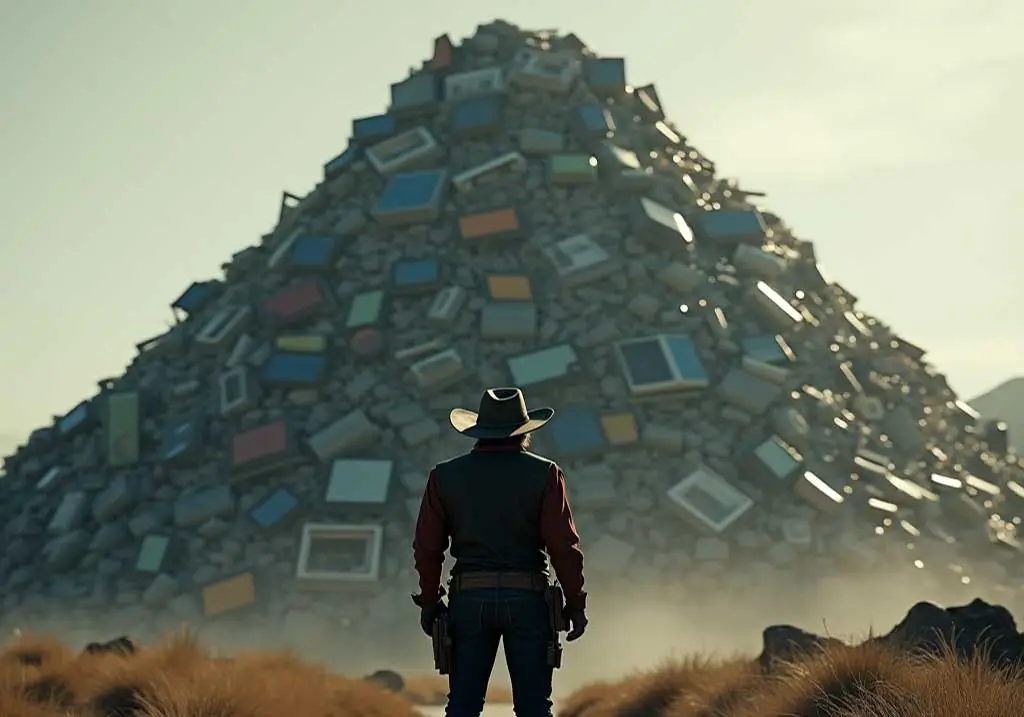
What Counts As E-Waste
Electronic waste — e-waste for short — is the catch-all term for electrical and electronic equipment that has reached the end of its useful life. If it once ran on a cord, a battery, or a solar cell and you no longer want it, it is e-waste. That is the whole definition. Everything else is detail.
A cracked iPad is e-waste. So is the treadmill in the spare room, the LED shop light in the garage, and the video doorbell you swapped out last spring. The defining trait is not size or price. It is the presence of powered components: circuit boards, batteries, capacitors, wiring, screens.
That definition carries more weight in California than almost anywhere else in the country, because the state does not treat these items as ordinary trash. Most of them are classified as universal waste, a subcategory of hazardous waste, which means landfill disposal is prohibited by law rather than merely discouraged.
I have been hauling junk in the Temecula Valley since 2021, and the single most common thing my crew hears at the curb is some version of "I didn't know I couldn't just throw that away." Most people don't. The rules were written for manufacturers and recyclers, not homeowners, and almost nobody reads them.
The short version
If the item has a plug, a battery, or a screen, keep it out of the black bin and the blue bin. Both are the wrong answer in Riverside County.
The Six Types Of E-Waste We Actually See On Temecula Driveways
Regulators sort e-waste into formal streams. Homeowners sort it by where it lives in the house. Here is the practical version, based on what comes off the truck most often.
Screens and displays
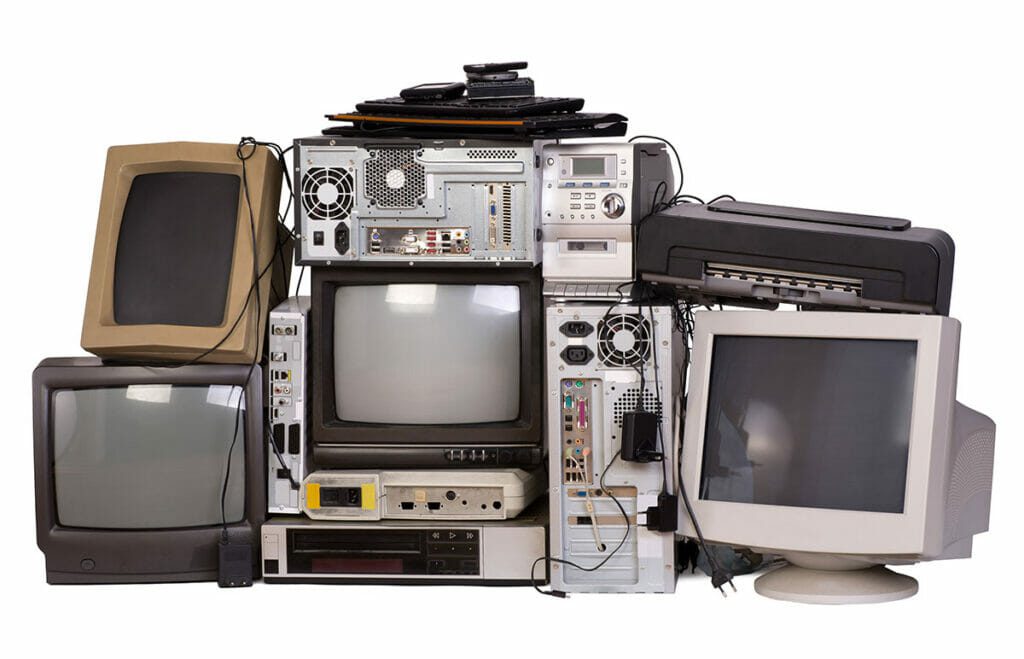
Televisions, computer monitors, laptops, tablets, digital photo frames, and portable players with an LCD screen. Anything with a video display over four inches is a Covered Electronic Device under state law. Old CRT tube TVs and monitors are the single most regulated item in the category because of the leaded glass — one 27-inch tube can hold several pounds of it.
Computing, IT and telecom gear
Desktop towers, servers, hard drives, printers, scanners, copiers, routers, modems, UPS battery backups, and the drawer of cables everyone keeps. This is the category where data security matters as much as chemistry. Never hand a drive to anyone who cannot tell you where it goes next.
Personal electronics
Phones, smartwatches, cameras, headphones, game consoles, e-readers, drones, vapes, and the chargers and power banks that came with them. Small, easy to forget about, and almost all of it has a sealed lithium cell inside.
Small household electronics
Microwaves, vacuums, coffee makers, hair dryers, air purifiers, and anything else with a motor or a control board. Individually light, collectively the bulk of a garage cleanout. Printers are notorious for leaking toner if they get crushed in a compactor.
Batteries and lamps
Lithium-ion packs, power tool batteries, e-bike and scooter batteries, button cells, ordinary alkalines, fluorescent tubes, and CFL bulbs. In California these are handled as universal waste and never belong in a curbside bin. Lithium cells are a leading cause of fires at transfer stations and recycling facilities.
Powered lawn, shop, fitness and solar
Treadmills, ellipticals, electric mowers, air compressors, pool pumps, and solar landscape lights — plus retired solar panels, inverters, and home battery systems as first-generation residential solar reaches end of life. Heavy, awkward, and almost always the item people call us about because it will not fit in a car.
One useful distinction: white goods
Refrigerators, freezers, window ACs, washers, and dryers are usually classed as white goods rather than e-waste. They are still regulated — anything with refrigerant has to be evacuated by a certified technician before the metal can be recycled — but they travel a different disposal path than a laptop does. Keeping the two straight matters when you are pricing out a cleanout. Our refrigerator and appliance removal page covers that side of it.
How Much Of It We Generate
The volume is the reason e-waste became its own regulatory category. The UN's fourth Global E-waste Monitor, published in 2024, put worldwide generation at roughly 62 million tonnes in 2022 and projected about 82 million tonnes by 2030. Documented collection and recycling accounted for about 22 percent of it — the volume is climbing roughly five times faster than formal recycling. The rest was landfilled, incinerated, stockpiled in closets and garages, or shipped somewhere with looser rules. The metals sitting inside that year's pile were valued at around $91 billion.
Three forces drive the growth. Devices get replaced on a shorter cycle than they used to. More products that never used to have electronics now contain a board and a battery. And repair is often harder or more expensive than replacement, so a device with one failed component gets retired whole.
Older articles — including an earlier version of this page — cited roughly 50 million tonnes. That figure came from the 2020 edition of the Monitor and is now out of date.
What Is Actually Inside It
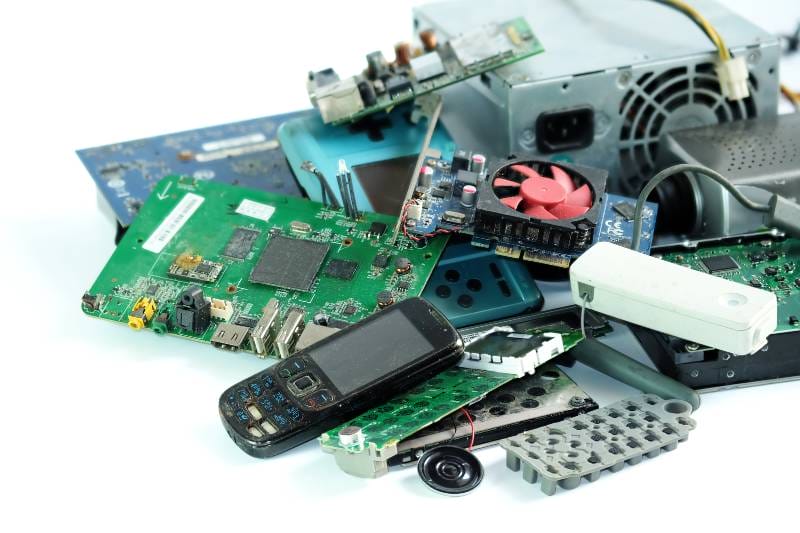
E-waste is regulated because of chemistry, not bulk. A working device keeps its hazardous components sealed inside a case. A crushed, corroded, or burned one does not. Not every material below is present in every device, but each one shows up often enough that regulators treat the whole category as hazardous by default.
| Material | Where it shows up | Why it is controlled |
|---|---|---|
| Lead | CRT tube glass, older solder on circuit boards, some batteries | A neurotoxin with no safe exposure level for children. A single old tube television can hold four to eight pounds of it. |
| Mercury | Backlight lamps in older flat panels, fluorescent tubes, some switches, relays, and thermostats | Damages the nervous system and kidneys, and accumulates up the food chain once it reaches water. |
| Cadmium | Older rechargeable cells, some resistors, semiconductors, coatings, and pigments | Kidney and bone toxicity, and it persists in soil for decades once released. |
| Brominated flame retardants | Plastic housings, cable insulation, printed circuit boards | Interfere with hormone signaling, and they release dioxins and furans when burned. |
| Lithium cells | Phones, laptops, tools, e-bikes, vapes, power banks | Damaged or compressed cells ignite. They are a leading cause of fires in collection trucks and sorting facilities. |
| Refrigerants and blowing agents | Mini fridges, wine coolers, dehumidifiers, portable ACs | Potent greenhouse gases that must be recovered rather than vented. |
The same devices also carry materials worth recovering: gold, silver, palladium, copper, aluminum, steel, and rare earth magnets. That recoverable value is what makes formal recycling economically possible in the first place.
What Happens When It Is Dumped Or Burned
An intact device sitting in your garage is not dangerous. In a lined municipal landfill, it is relatively inert for a while, too. The problem is that devices do not stay intact. Compaction cracks screens and housings, moisture and acid conditions corrode solder and cells, and the metals begin moving with the leachate. Where liners are absent or failing, that leachate reaches groundwater.
Open burning is worse and it is common in the informal recycling economies that receive exported e-waste. Burning cable insulation to expose copper is the classic example: it recovers a few dollars of metal and releases dioxins, furans, and heavy metal particulates directly into the air people are breathing, often with no protective equipment involved. The World Health Organization has documented impaired neurological development in children, kidney damage, and respiratory harm in communities where e-waste is processed this way. Those are the outcomes the California rules exist to prevent.
Lithium batteries are an immediate hazard, not a long-term one
A punctured or crushed lithium cell can go into thermal runaway within seconds — or hours after the damage, once it has been loaded and forgotten. Battery fires in trash trucks and transfer stations have become one of the waste industry's most expensive recurring problems, and nearly all of them start with a battery that was tossed in with regular trash. It is the single biggest reason we pull batteries out on site rather than tossing devices in the truck bed.
What California Law Actually Says, And What The Internet Gets Wrong
Let's clear up a myth first, because it is repeated on a lot of junk removal websites — including an earlier draft of this one. There is no federal Electronic Waste Recycling Act. The Electronic Waste Recycling Act of 2003 is California legislation — Senate Bill 20, authored by Byron Sher — and its recycling fee took effect on January 1, 2005. Roughly half the states have passed something similar. Congress has not.
California does not allow electronic waste in household trash. Under the state's universal waste rules, e-waste and batteries must be taken to an authorized collection point rather than binned, and that applies to households as well as businesses. Here is how the pieces fit together.
A recycling fee at the register
SB 20 · 2003
When you buy a covered device with a screen larger than four inches, you pay a state recycling fee — currently $4 to $6 depending on screen size. That fee funds the payment system CalRecycle uses to reimburse approved collectors and recyclers. It is why dropping a TV at a county collection event usually costs you nothing at the door.
A landfill prohibition
Universal waste · DTSC
Covered electronic waste cannot go in household trash. Electronics and batteries are managed as universal waste under Department of Toxic Substances Control oversight, and disposal is simply not an option handlers are permitted to choose.
Material restrictions
RoHS · California
California adopted RoHS-style limits capping how much lead, mercury, cadmium, and hexavalent chromium can be present in covered devices sold in the state. That is why the chemistry inside a 2026 television is meaningfully different from a 2006 one.
Export controls
SB 568 · 2023
Signed in October 2023 and in effect since January 2024, SB 568 requires anyone exporting e-waste out of California to first demonstrate that no in-state recycler could handle it, on top of the existing 60-day notice to DTSC. This is the provision aimed squarely at the old practice of relabeling waste as donated goods and shipping it overseas.
Battery-embedded products
SB 1215 · 2022
SB 1215 expanded the covered-device program to products with built-in batteries — cordless tools, toys, small appliances, which is to say most of modern consumer electronics — with the expansion taking effect January 1, 2026. The rules were written for TVs and monitors in 2003 and had to grow to cover everything that now ships with a sealed cell inside.
A stricter version for businesses
Hazardous waste generator rules
A company disposing of retired equipment is a hazardous waste generator under state law and is expected to be able to document where that equipment went. That is a paperwork obligation homeowners do not carry, and it is where most of the enforcement actually lands.
Will I get fined?
You will not get fined for putting an old router in your kitchen trash. Enforcement targets handlers, haulers, and businesses. But the correct options are genuinely easy — and mostly free.
How E-Waste Recycling Works
Collection and triage
Devices are sorted by type and condition. Anything repairable or resalable is pulled out first, because reuse beats recycling on both cost and environmental terms.
Depollution
Batteries, mercury lamps, capacitors, toner, and refrigerant-bearing components are removed by hand before anything goes into a shredder. This is the step that separates a permitted recycler from a scrap yard.
Data destruction
Drives are wiped to a documented standard or physically destroyed, with a certificate issued when the customer requires one.
Shredding and separation
What remains is size-reduced, then split into ferrous metal, non-ferrous metal, plastic, and circuit board fractions using magnets, eddy currents, and density sorting.
Refining
Board fractions go to smelters that recover gold, silver, palladium, and copper. Recovered metal re-enters manufacturing, which is where the environmental savings against virgin mining actually come from.
Weston Molitor
Founder & Owner, Wild West Junk Removal
"The thing nobody tells you is that e-waste is the category where cutting corners is invisible. If we dump a couch somewhere we shouldn't, you'd see it. If a hauler takes your old TV and drives it to a transfer station that just buries it, you'll never know. The receipt looks the same either way."
"That's why we separate electronics on the truck instead of at the yard. Batteries come out on site. Screens ride flat, not stacked, because a cracked CRT is a hazmat problem instead of a recycling problem. It slows a job down by maybe ten minutes and it's the entire difference between doing this right and pretending to."
"And if you've got one laptop? Take it to a county event. I'll tell you that on the phone. We're worth calling when the pile is heavy, awkward, upstairs, or bigger than your car."

Three Ways To Handle It — Including The Two That Don't Involve Us
We would rather you make the right call than the profitable one. If you have one laptop and a free Saturday, do not hire a truck. The table below is the honest version.
| Option | Best for | Cost | The catch |
|---|---|---|---|
| County HHW collection | One or two small items you can lift and drive | Free for residents | Limited hours and load limits; you do the loading and the driving. Not an option for a 300-pound console TV or anything in an upstairs bonus room. Schedules are on the Riverside County Waste Resources site. |
| Retail or manufacturer take-back | Phones, laptops, small devices, trade-ins | Free | Narrow acceptance lists. Most won't touch a CRT, a treadmill, or a full office cleanout. |
| Wild West Junk Removal | Volume, weight, stairs, or anything you can't move alone | From $195 minimum pickup | It costs money. You are paying for labor, transport, and the certified disposal chain — not for the recycling itself. |
Our pricing is by volume, not by item: a quarter load (about 3 cubic yards) is our $195 minimum pickup, a half load (6 cubic yards) is $350, three-quarter (9 cubic yards) is $495, and a full 12-cubic-yard load is $595. Full numbers live on the junk removal pricing page, and the electronics side of the operation is described on our electronics recycling and e-waste pickup page.
What To Do With Your Own Old Electronics
Five minutes of prep saves you money whichever option you pick.
- Gather everything into one place first. Most people underestimate the pile by half until it is all in the garage together. Then photograph the whole pile, not just the biggest item — a wide shot gets you an accurate quote instead of a surprise at the driveway.
- Wipe your drives. Sign out of accounts, factory reset phones and tablets, and use full-disk encryption or a secure erase on a computer. Pull the hard drive yourself if you want it physically destroyed. Your data is your call, not ours.
- Pull loose batteries and tape the terminals. Remote controls, smoke detectors, tool packs. Bag them separately. Loose lithium cells rattling around a load with metal are the one thing that genuinely worries us.
- Don't break the screens. Cracking a CRT or an LCD to make it fit turns a routine recycling item into a hazardous cleanup. Leave it whole and let us deal with the door frame.
- Box the small stuff. Cables, chargers, remotes, adapters. One box of loose cords loads in seconds. Twenty individual cords scattered across a garage floor does not.
- Set aside anything that still works. A five-year-old laptop is far more useful to a school or nonprofit than it is to a shredder. If you'd rather see it reused than shredded, say so — we route functional gear toward donation when there is a taker for it.
- Take the rest to a state-approved collection event or drop-off site, or have it hauled if the volume or the weight makes that impractical.
Common Questions
In California, most of it is. Electronic devices and batteries are regulated as universal waste, a streamlined subcategory of hazardous waste created so that households and small businesses can hand these items off without full hazardous waste paperwork. The classification exists because of what is inside the devices, not because of how they look or how old they are.
Six practical categories cover almost everything we load: screens and displays such as TVs and monitors; computing, IT and telecom gear such as towers, hard drives, printers, and routers; personal electronics such as phones, consoles, and cameras; small household electronics including microwaves and vacuums; batteries and lamps including lithium packs and fluorescent tubes; and powered lawn, shop, fitness, and solar equipment like treadmills, electric mowers, and retired panels. Large appliances with refrigerant are usually classed separately as white goods.
No. California prohibits disposing of electronic waste and batteries in household trash. They have to go to an authorized collection point, a permitted recycler, or a hauler that delivers them to one. This applies to a phone charger as much as it does to a television.
No. The Electronic Waste Recycling Act of 2003 is California law, passed as Senate Bill 20, with its recycling fee in effect since January 1, 2005. There is no equivalent federal electronics recycling statute. Roughly half of U.S. states have passed their own e-waste laws, and California's is generally regarded as the model the others were built from.
That fee is the covered electronic waste recycling fee established by SB 20. It applies to devices with a video display larger than four inches and currently runs $4 to $6 depending on screen size. The money funds the state payment system that reimburses approved collectors and recyclers, which is why dropping a TV at a county collection event usually costs you nothing at the door.
E-waste generally means devices built around circuit boards and displays: computers, TVs, phones, printers, and small powered household items. Large appliances such as refrigerators, washers, and air conditioners are usually classed as white goods and follow a separate path, because units containing refrigerant must have it recovered by a certified technician before the metal is recycled.
For covered devices with video displays, such as televisions, monitors, and laptops, the recycling cost was already paid as a fee when the item was purchased new, so approved collection sites usually accept them from residents at no charge. Items outside that covered list, printers being the common example, may carry a handling fee. Paying a hauler is a separate transaction: you are buying the labor and the transport, not the recycling itself.
Honestly, no. If you have one or two small items you can lift and drive, take them to a Riverside County household hazardous waste collection event or a retail take-back counter for free. We are worth calling when the load is heavy, awkward, upstairs, or larger than your vehicle, or when you simply do not have a free Saturday.
At a legitimate recycler, drives are either wiped to a documented standard or physically destroyed, and a certificate can be issued if you need one for a business or a compliance record. That said, the safest assumption is that you are responsible for your own data. Wipe or encrypt every drive before the device leaves your possession rather than relying on a step you cannot watch.
Reuse beats recycling almost every time. Extending the life of a working machine avoids the energy and materials required to manufacture a replacement, while recycling only recovers a fraction of what went into the original device. Wipe the drive, confirm the recipient can actually use the hardware, and only send it for recycling when it is genuinely at end of life.
Have a pile of it in the garage?
Text a photo, get a real number, and have it gone. We sort electronics out of every cleanout we run and route them to certified recyclers instead of the landfill. Family-owned in Temecula since 2021, licensed and insured, Mon–Sat 7AM–7PM.
Sources & further reading
Related reading: TV removal · appliance and refrigerator removal · what we take and what we cannot take. Reviewed and updated September 4, 2026 by Weston Molitor, founder of Wild West Junk Removal, Temecula, California.