
Contractor Compliance Guide · Temecula Valley
What Does CALGreen Require for Construction Waste in Temecula?
Most permitted building projects in California have to keep at least 65% of their nonhazardous construction and demolition debris out of the landfill, measured by weight, and prove it with receipts before final inspection. The plan goes in with the permit, the weight tickets come in at the end, and the tickets are where jobs get stuck.
Family-Owned Since 2021 · Licensed & Insured · Mon to Sat 7AM-7PM

Wild West Junk Removal · 41713 Niblick Rd, Temecula, CA 92591 · (951) 837-8072 · Mon to Sat: 7AM-7PM · Sun: Closed · Family-owned, licensed and insured since 2021
The Rule
What Does the 65% Rule Actually Say?
It says a covered project has to recycle, reuse or salvage at least 65% of its nonhazardous construction and demolition debris by weight, or meet a stricter local ordinance if your city has one.
CALGreen is the California Green Building Standards Code, Title 24, Part 11. The waste rule sits in Section 4.408.1 for residential work and Section 5.408.1 for everything else. The number went from 50% to 65% on January 1, 2017, and it hasn't moved since. CalRecycle's summary of the 2019, 2022 and 2025 editions shows the same 65%, and CalRecycle explains how cities and counties enforce it.
There's a reason the state pushes this hard. The EPA counted 600 million tons of construction and demolition debris in the U.S. in 2018, more than twice the municipal solid waste generated that year. Most of it is concrete, wood, metal and drywall that has somewhere better to go.
I'm not a building official and I won't pretend to be one. What I see is the other end: the piles, the loads, and a contractor digging through a truck cab for a receipt from three months ago. The 65% is rarely the problem. The paperwork is.
Three Routes
What Are the Three Ways to Comply?
A waste management plan, a hauler or facility that documents the diversion for you, or the waste stream reduction alternative. A project only has to meet one of them.
What Is a Construction Waste Management Plan?
It's a written plan that names the materials you'll divert, says whether you'll sort them on site or haul them mixed, and names where each one goes. It goes in with the permit application and the receipts follow at the end. That's the default route, Sections 4.408.2 and 5.408.1.1.
Can a Hauler or Facility Document It for You?
Yes, if the waste company or facility can give you verifiable documentation that it meets 65%. That's Sections 4.408.3 and 5.408.1.2, and a lot of remodel and tenant-improvement crews land here because the facility does the weighing and the math.
What Is the Waste Stream Reduction Alternative?
It's a pass for new construction that throws away very little. Low-rise residential, three stories or less, passes at 3.4 pounds of disposal per square foot or less. Nonresidential new construction and high-rise residential pass at 2 pounds or less. A gut remodel won't come close, so don't count on it there.
Asbestos, lead paint waste and other regulated hazardous material sit outside all three routes. Licensed abatement contractors handle them under separate rules, and they never count toward the 65%.
Covered Projects
Which Projects Have to Divert 65%?
New buildings, nonresidential additions of 1,000 square feet or more, nonresidential alterations with a permit valuation of $200,000 or more, and residential additions or alterations that increase the building's conditioned area, volume or size.
That list comes straight from CalRecycle's summary. The one that surprises small contractors is the residential line. A bump-out or a garage conversion that adds conditioned space is in, even when the job feels small.
| Project | Covered by the state code? | What applies |
|---|---|---|
| New residential construction | Yes | 65%, or 3.4 lb/sq ft low-rise and 2 lb/sq ft high-rise |
| New nonresidential construction | Yes | 65%, or 2 lb/sq ft |
| Residential addition or alteration | If it adds conditioned area, volume or size | 65% for the added or altered area |
| Nonresidential addition | 1,000 sq ft or more | 65% |
| Nonresidential alteration | Permit valuation of $200,000 or more | 65% |
| Demolition-only permit | Outside CALGreen | Cities and the county set their own rules |
| Permit-exempt repair or like-for-like swap | No | No plan needed |
Two rows catch people. A demolition-only permit isn't covered by CALGreen itself, according to CalRecycle, but local governments are expected to deal with it, so check before you assume you're off the hook. And land-clearing debris, meaning trees, stumps, rocks and soil, runs on its own rule. Nonresidential projects have to reuse or recycle all of it under Section 5.408.3, and plenty of permit desks won't let that tonnage pad your 65%.
The Plan
What Goes in a Waste Management Plan?
Four things: which materials you'll divert, whether they're sorted on site or hauled mixed, where each stream goes, and roughly how much there'll be.
- ✓Name the materials. Concrete and masonry, framing lumber, drywall, metal, cardboard and packaging, roofing. A vague plan gets a vague approval and then fails when the report comes in.
- ✓Say sorted or mixed. Separate stacks of clean concrete and metal usually get full credit. A mixed load gets credited at the receiving facility's recovery rate, and that difference decides a lot of reports.
- ✓Name the facility for each stream. A lot of permit desks keep an approved list, and a load hauled somewhere off the list can count for nothing.
- ✓Estimate the tons. If you've run similar jobs, use your own numbers. They hold up better than a generic factor when the final report has to match the plan.
Then pick one person to collect every receipt from day one. Not whoever happened to drive the truck that day.

Weight Tickets
What Does a Weight Ticket Need to Show?
The facility's name, the date, the job address the load came from, the material type, and the weight, ideally in tons.
A receipt you can't tie to your project isn't evidence. Tickets with no job address get rejected all the time, and "debris" isn't a material type. Mixed C&D, clean concrete and scrap metal are credited differently, so the ticket has to say which one it was. Weight beats volume, because a volume-only ticket forces a conversion the reviewer may not accept.
Check every ticket before you pull off the scale. A smeared thermal print you find six months later can't be fixed, and that load is gone from your numbers.

Does a Mixed Debris Box Count as 100% Recycled?
Usually not. A mixed load is credited at the receiving facility's certified recovery rate, not at 100%, so if that rate sits right around 65%, the mixed part of your job adds nothing above the line.
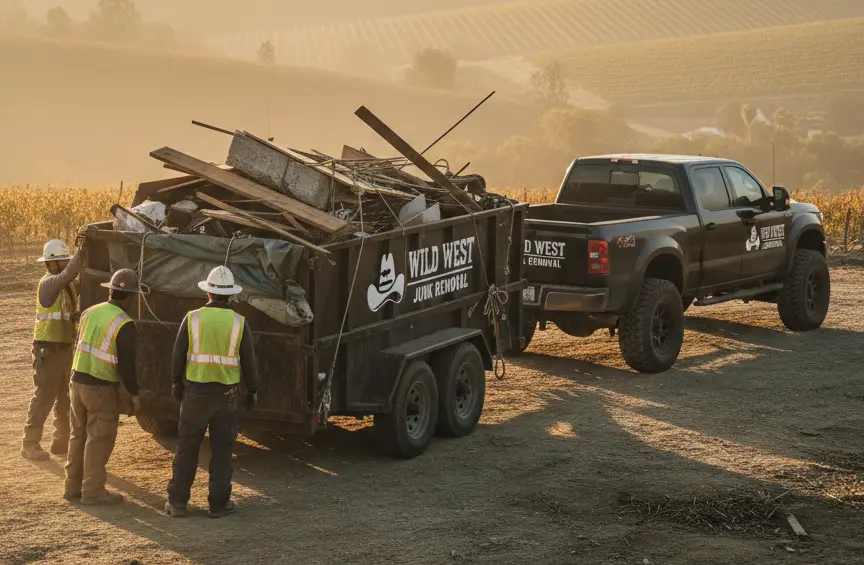
Pulling the heavy, clean streams out first is what builds a cushion. Concrete and metal are the big ones, because they're heavy and they recycle cleanly. That's why our crew pulls concrete, metal, clean lumber and cardboard aside on site instead of throwing everything in together.
Local Rules
What Changes Inside Temecula and Riverside County?
Mostly who issued your permit, because each desk can have its own form, its own approved-facility list and its own deposit rules.
A job inside Temecula city limits goes through the City of Temecula's Building and Safety desk. A job on unincorporated county land, like French Valley or Winchester, goes through Riverside County, and the county's construction and demolition program asks for a Waste Recycling Plan before the permit issues and a Waste Reporting Form with receipts before final inspection. The same county page lists C&D recyclers. Murrieta, Menifee, Wildomar and Lake Elsinore each run their own desks too.
Then there's the trash franchise. Temecula's trash and recycling service runs through CR&R, and some cities limit who can haul construction debris for hire inside their limits. Before the job starts, ask the desk that issued your permit three questions: which form do you want, which facilities do you credit, and which haulers are allowed on this job.
Codes, forms and franchise terms change. Call the Building and Safety desk for your parcel before you submit anything. This page is a field guide, not legal advice.
Field Mistakes
Where Do Diversion Reports Go Wrong?
On habits more than on the number. Nobody owns the tickets, sorting starts too late, or the job stops matching the plan.
- Nobody owned the tickets. The office filed the plan and whoever had the truck did the hauling. Name one person on day one.
- Sorting started too late. Once drywall, framing scrap and packaging are in one pile, the clean concrete that would have carried your rate is buried in it. Set the separate stacks before demo starts.
- Debris went in the wrong container. Project debris tossed in a household or commercial trash cart isn't credited, and in a lot of cities it breaks the collection rules too.
- The job stopped matching the plan. The plan said sorted on site and the job ran mixed. The report has to match the plan or explain why it changed.
- Land-clearing tonnage got counted. It's a big number that often earns nothing toward the 65%. Ask before you build the report around it.
Getting It Hauled
When Does It Make Sense to Hand Off the Hauling?
When your crew's time is worth more than the landfill run, or when the debris has to be gone before an inspection and nobody has a free afternoon.
We load by hand, pull concrete, metal, clean lumber and cardboard aside on site, and leave the floor broom-clean. Loads run from $195 for a quarter of our 12-yard trailer to $595 for a full one, with loading, hauling and disposal in the price. The construction debris removal page covers how we run a job-site clear, and the junk removal prices page has the full ladder and the add-ons.
If you're keeping a CALGreen file, tell me on the first call. We'll sort the load the way your plan says, and you'll know before booking what paperwork comes back with it. For a long build where your own crew loads at its own pace, our 40 yard dumpster rental may fit better, and tear-downs are covered under demolition cleanup. Leftover tile, doors and cabinets that still have a life in them are in our guide to leftover building materials, and reuse counts toward the 65% too.
Who Is Weston Molitor?
Owner & Founder · Wild West Junk Removal · Temecula, CA"I'm not the guy who signs off your final. I'm the guy who can make sure the concrete didn't end up in the same pile as the drywall, and that's usually the part that decides the report."
Weston started Wild West Junk Removal in Temecula in 2021 and runs it with a two-person crew and a 12ft × 8ft × 4ft dump trailer. Wild West has hauled 5,000+ loads since 2021 across Temecula, Murrieta, Menifee and the rest of Southwest Riverside County.

FAQ
What Else Do Contractors Ask About CALGreen?
These are the CALGreen questions that come up most when a contractor or owner-builder calls about debris.
No. The 2025 edition took effect January 1, 2026, and CalRecycle's summary of the 2019, 2022 and 2025 editions lists the same 65% minimum and the same three ways to comply. A city or the county can still set a stricter local number.
It depends on the permit. A residential remodel that doesn't add conditioned area, volume or size usually falls outside the state requirement, and one that does is in. A permit-exempt repair needs no plan at all. The reliable test is to ask the desk that issued your permit before work starts.
Whoever pulled the permit. Plenty of owners hand the job to the general contractor in the contract, but the desk looks to the permit holder when the report is missing or short. Settle who keeps the tickets before work starts.
Often, yes, because CALGreen counts reuse and salvage along with recycling. Get a receipt from the reuse center, like a Habitat ReStore donation receipt, and ask your desk how it wants donated items documented before you count on them.
It depends on the desk. Some hold the final inspection until you explain the gap or show more receipts, and cities that collect a diversion deposit can keep part or all of it. Ask what happens if you come in short when you file the plan, not after.
No. The 65% requirement covers nonhazardous construction and demolition waste. Asbestos, lead paint waste and other regulated hazardous material are handled under separate rules by licensed abatement contractors and are left out of the diversion math entirely. Wild West can't haul either one.
Need the Debris Gone Before Final?
Text a few wide photos of the pile and your inspection date to (951) 837-8072. You'll get a load size and a firm price back before we roll out, Monday through Saturday, 7AM to 7PM.
Wild West Junk Removal · 41713 Niblick Rd, Temecula, CA 92591 · (951) 837-8072 · Mon to Sat: 7AM-7PM · Sun: Closed
Sources & References
- calrecycle.ca.gov CalRecycle: 2019, 2022 & 2025 CALGreen Construction Waste Management Requirements Covered projects, the three ways to comply, and the 3.4 and 2 lb/sq ft alternatives.
- calrecycle.ca.gov CalRecycle: CALGreen and SB 1383 The 65% requirement and how jurisdictions enforce it.
- rcwaste.rivco.gov Riverside County: Construction & Demolition Waste Recycling Waste Recycling Plan before the permit, Waste Reporting Form and receipts before final, and the C&D recycler list.
- epa.gov EPA: Sustainable Management of C&D Materials 600 million tons of C&D debris in 2018, more than twice municipal solid waste.
- wildwestjunkremoval.com Construction Debris Removal in Temecula Job-site clears, load prices, and what we haul.
- wildwestjunkremoval.com Leftover Building Materials After a Remodel What to keep, return, donate or haul when the job is done.
- wildwestjunkremoval.com Junk Removal Prices The four load sizes and every add-on.
Written by Weston Molitor, owner of Wild West Junk Removal. Last reviewed and updated October 14, 2026.
This guide summarizes the state code as CalRecycle and Riverside County publish it, as of October 2026. It isn't legal advice, and your permit desk has the final word. Wild West pricing as of October 2026: $195 quarter load (about 3 cubic yards), $350 half, $495 three-quarter, $595 full 12-yard trailer; stairs $150 or $300, appliances $30 each, mattresses $15 each.