
Fly Season Timing · Temecula Valley Horse Country
Fly Season in the Temecula Valley: A Month-by-Month Manure Removal Calendar
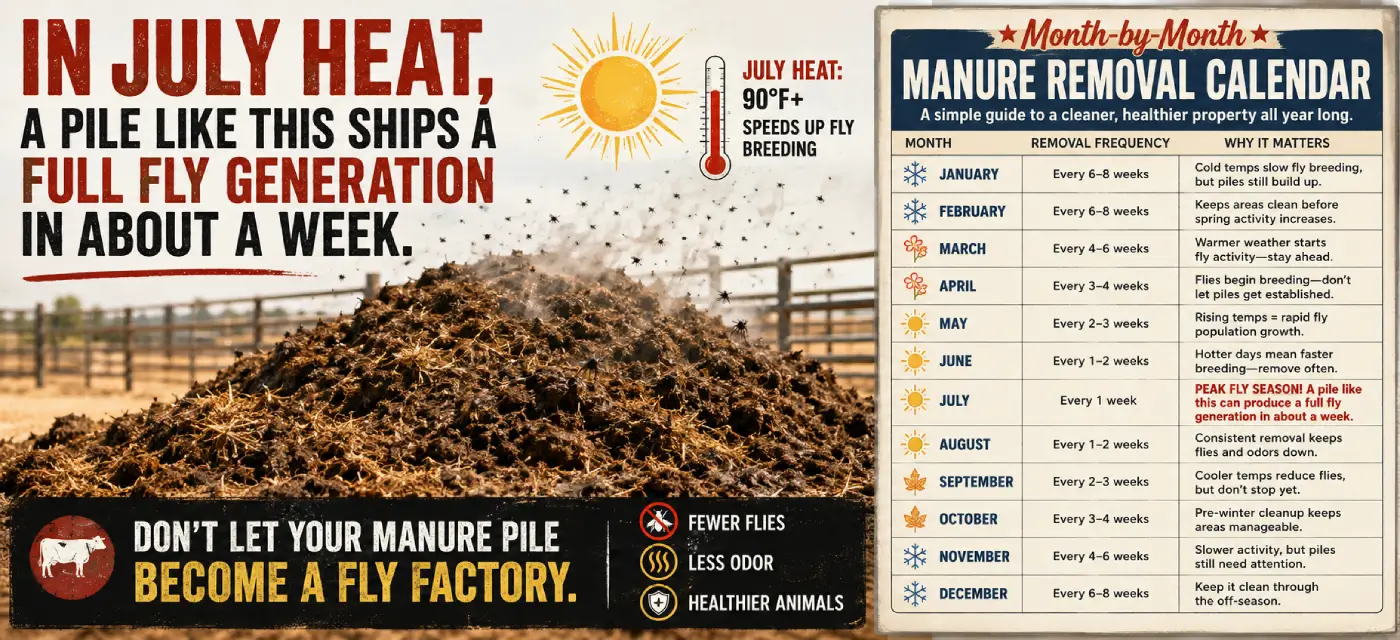
By the time you are swatting flies, the pile has been breeding them for weeks. I haul manure off Temecula horse properties all year, and the barns that stay ahead of flies are not the ones that spray the most. They are the ones that change their pickup schedule with the month. Here is the calendar I run my routes on.
Family-owned in Temecula since 2021 · Licensed & insured · Recurring routes through local horse country
Wild West Junk Removal · 41713 Niblick Rd, Temecula, CA 92591 · (951) 837-8072
Mon to Sat: 7AM-7PM · Sunday: Closed · Family-owned, licensed and insured · Serving Temecula, Murrieta, Menifee and southwest Riverside County
The science in one minute
The Clock Inside the Pile
I am not a bug guy. I am a guy with a trailer. But you cannot haul manure in this valley for five years without learning how flies work, because the customers who call me in a panic in July all have the same problem, and it is never the flies. It is the pile.
Here is the short version, and it lines up with what the University of California's pest management people publish. A female house fly lays her eggs right in fresh manure. In warm weather those eggs hatch in less than a day. The larvae eat and grow inside the pile, turn into pupae, and come out as adults. How fast all that happens is set almost completely by temperature.
~1 month
Egg to adult when daytime highs sit in the 60s
~7 days
Egg to adult in mid-90s summer heat
4 days
Max pile age before summer manure is actively rearing larvae
Same fly, same pile, four times faster in August than in February. And our winters never really stop the clock. Inland Riverside County stays mild enough that the flies do not die off. They slow down, sit in the warm middle of a pile as pupae and larvae, and wait for March. I have forked into a pile in January that was steaming in the middle. That is where next summer's flies are.
The 4-day rule
Once summer heat arrives, any manure that has sat four days or more is not just waste anymore. It has live larvae feeding in it. Haul the pile inside that window and the eggs leave on my trailer. Miss it, and even a spotless pickup cannot recall the generation that has already crawled into the dirt underneath to pupate. So pickup frequency is not about keeping the place tidy. It is about staying ahead of a clock that runs at a different speed every month.
Frequency: monthly
January – February: The Reset Window
Nights in the 40s and short days stretch fly development out so far that the population basically stalls. You will not see adults, and it is tempting to let the pile ride until spring. Don't. The inside of a manure pile stays warm when the air does not, and that core is exactly where pupae spend the winter. A pile that goes into March untouched is not dormant. It is loaded.
One thorough cleanout a month through January and February is the cheapest fly control you will buy all year. Every pupa that leaves on my trailer in winter is a breeding female that never shows up in May. This is also the easiest time for me to get a trailer onto most properties, before the spring rains turn the approaches to soup.
Frequency: every two weeks
March – April: The Wake-Up
The first run of 70-degree afternoons flips the switch. The overwintered pupae start coming out, and those early adults head straight for the freshest manure they can find to lay. Development time drops from more than a month to about three weeks.
Spring here fools people. You are not swatting anything yet, so it feels like winter rules still apply. Biologically the season has already started. The barns on my route that go to a two-week pickup in March have noticeably lighter summers than the ones that call me after the first bad afternoon in May, because they are removing the founding generation before it multiplies.
Frequency: weekly
May – June: The Acceleration
Highs push into the 80s and the cycle drops toward ten days. This is also when stable flies peak. Stable flies bite. They are the ones hammering your horses' legs and bellies until the animals stomp holes in the ground, and they breed best in the wet mix of soiled bedding, spilled hay, and manure that builds up around pile edges and under feeders. The main pile is only half the problem in stable fly season.
- ✓Go weekly. A ten-day fly cycle beats a two-week pickup every single rotation.
- ✓Clear the perimeter. When we load a pile in May and June we take the soggy edge material and scrape the footprint. Ask for that if your hauler does not do it already.
Frequency: weekly minimum · twice weekly for multi-horse properties
July – September: Peak Clock Speed
This is the stretch the 4-day rule exists for. Afternoons in the 90s, pile cores hotter than that, and egg to adult in about seven days. Run the math on a weekly pickup. Manure dropped the morning after my truck leaves is six days old when I come back. That is inside the window, barely.
That is why one horse on a weekly schedule stays ahead in summer while a four- or five-horse property on the same schedule slowly loses ground. More horses means more fresh laying spots showing up every day between pickups, and in July that daily deposit is producing adults before the trailer comes back. On the bigger properties I split the week. Two smaller hauls beat one big one, not because of the volume but because nothing ever gets old enough to hatch.
Frequency: weekly through mid-October, then every two weeks
October – November: The Long Taper
Inland Southern California does not get an off switch in the fall. October afternoons in the 80s are normal, and the fly cycle stretches out gradually instead of stopping. The mistake I see every year is dropping the summer frequency on Labor Day because the calendar says fall. Late-October fly pressure around Temecula barns is real most years.
Hold the weekly rhythm until daytime highs reliably drop out of the 80s, then step down. The flies you let breed in a warm October are the flies that overwinter and start your March.
Frequency: one full cleanout
December: Close the Books
Whatever else happens in December, end the year with a complete removal. The pile, the perimeter, and the packed layer at the base where pupae concentrate. This is the other end of the January logic. The fewer immature flies that go into winter on your property, the smaller the March emergence, and the easier every month of next year's calendar gets. December is also a good month to fix drainage around the pile site, because a wet footprint in spring is a stable fly nursery.
Why this works
Why Timing Beats Spraying
Fly sprays, traps, and fly predators all have a place, but they share the same weakness. They work on flies that already exist. Every adult you catch in a trap in August came out of manure that sat too long in July.
Sanitation, meaning getting the breeding material off the property before the larvae mature, is the first thing on the list in the UC IPM guidance on flies, and it is the first thing on the Penn State Extension fly control checklist for horse farms. It is the only step that shrinks the next generation instead of skimming the current one. A pickup schedule matched to the monthly clock above is that step, done twelve times a year instead of in one panicked scramble in the middle of summer. If you compost on site instead of hauling, the University of Minnesota Extension manure guide covers how hot a pile has to run to kill fly larvae, and most backyard piles never get there.
Put it on autopilot
The Whole Point Is That Nobody Has To Remember It
Wild West runs standing routes through Temecula, Murrieta, Menifee, De Luz, and Wine Country, and I move the pickup frequency with the season. Tighter in the hot months, lighter in the cool ones, so your pile never gets old enough to breed.
If you would rather set a manure pickup schedule once and stop thinking about flies, text a photo of your pile and your setup to (951) 837-8072. I will tell you what frequency fits the month and how many horses you have, and I will tell you straight if your access is going to be a problem for the trailer.
Weston Molitor
Founder · Wild West Junk Removal · Temecula, CAI started Wild West in Temecula in 2021 and I still run loads. This calendar is not from a textbook. It is from five summers of picking up piles in De Luz, Wine Country, and out toward Menifee, and noticing which barns had flies and which ones did not. The difference was almost always the pickup schedule.
"The customers who call me in July wish they had called me in March. I would rather you call me in March."

Quick answers
Fly Season Questions
Earlier than most people think. Around Temecula the first real push of flies shows up with the first stretch of 70-degree afternoons, which is usually March. By the time you notice them in May, that first generation has already bred two or three times. If you want a light summer, the pickup schedule needs to tighten in March, not in May.
It changes with the month. Roughly: once a month in January and February, every two weeks in March and April, weekly from May through mid-October, then every two weeks through November, and one full cleanout in December. In July, August, and September a property with four or more horses does better on two smaller pickups a week than one big one, because the goal is to never let manure sit more than about four days in summer heat.
In 90-degree weather a house fly can go from egg to adult in about seven days. Eggs hatch in under a day, the larvae feed in the pile for a few days, then they pupate and come out as adults. That is why a pile that has been sitting a week in August is already producing the next generation, even if it looks the same as it did on day one.
Yes, and it is the cheapest fly control on the calendar. Flies in the Temecula Valley do not die off in winter. They ride it out as pupae and larvae in the warm middle of a pile. Every pile that gets hauled in January or February takes that overwintering stock with it, so there are fewer flies to start the season in March. A monthly cleanout in the cool months is worth more than any spray you buy in July.
Sprays, traps, and fly predators can help, but they all work on flies that already exist or on eggs already in the pile. Taking the manure off the property before the larvae mature is the only thing that shrinks the next generation, and it is what university pest management guidance lists first. Use the other tools if you like, but use them on top of a pickup schedule, not instead of one.
Yes. We run standing routes through Temecula, Murrieta, Menifee, De Luz, and Wine Country, and we set the frequency to the month. Tighter in the hot months, lighter in the cool ones, and we move it with the weather rather than the calendar. Text a photo of your pile and setup to (951) 837-8072 and we will tell you what frequency makes sense for the time of year and how many horses you have.
Sources
Development times above are typical house fly figures for the temperatures shown and vary with humidity, pile moisture, and bedding mix. Pickup frequencies are what works on our routes in the Temecula Valley; a property with more horses, wetter ground, or a shaded pile may need to run tighter.