
Mattress Lifespan · Temecula Valley
How Long Does a Mattress Last, and How Do You Know It's Done?
Six to eight years for innerspring, seven to ten for memory foam and hybrids, and ten to fifteen for latex, and a sag you can see is the surest sign it's done. Most people can't tell me the year they bought the mattress we're carrying out. Here's how to actually check yours, without guessing and without a sales pitch attached.
Family-owned in Temecula since 2021 · Licensed & insured · Same-day mattress pickup often available
Wild West Junk Removal · 41713 Niblick Rd, Temecula, CA 92591 · (951) 837-8072
Mon to Sat: 7AM-7PM · Sunday: Closed · Family-owned, licensed and insured · Serving Temecula, Murrieta, Menifee and southwest Riverside County
By Weston Molitor, founder of Wild West Junk Removal · Published September 3, 2026
Five years of carrying these out of bedrooms
What Gives Away a Mattress's Age Before You Say a Word?
The give, the smell, and the shape it holds. I can usually tell how old a mattress is before the homeowner tells me, and it's never from the tag. It's the give when I pick up my end, the smell that comes off it once it's off the bed, and the shape it holds — or doesn't — once it's standing on end against the trailer.
Most people don't replace a mattress because a calendar told them to. They replace it because something finally got uncomfortable enough to act on, sometimes years after it should have. That's not laziness. A mattress fails a few millimeters of support at a time, and you adjust to it without ever noticing you're adjusting. When a bed that's pushing fifteen years old comes out of a house, the line I hear is almost always some version of "it still looked fine." Looking fine and doing its job are two different things by the time a mattress is that old.
This isn't a pitch to replace yours early. I make my living on the other end of that decision, once you're done with the old one, not before. If anything it's the opposite: I'd rather you get the full life out of what you paid for, and actually know when it's over instead of guessing.
It depends what's inside it
How Long Is Each Type of Mattress Built to Last?
Six to eight years for innerspring, seven to ten for memory foam and hybrids, and ten to fifteen for latex. Every mattress is a stack of materials wearing out at a different rate, and what's underneath the cover decides how long the whole thing holds up. As a rough baseline, before anything about your body weight or how it's been treated gets factored in:
6–8 yrs
Innerspring — coils lose tension and start to sag first
7–10 yrs
Memory foam & hybrid — foam layers compress and stop rebounding
10–15 yrs
Latex — slowest to break down, priciest to start
An orthopedic physician quoted by Summit Orthopedics puts the general rule at ten years before a mattress is likely overdue, noting that coil springs specifically lose their bounce over time and stop supporting the way they did new. Baylor Scott & White Health cites research pointing to a shorter five-to-seven-year window for some mattresses, and is blunt about the workaround people try first: sliding a board under a sagging mattress is a short-term patch, not a fix.
Those are averages, not guarantees. Body weight, how many people sleep on it every night, and whether it ever got wet all move the number in either direction. A queen carrying two adults wears out faster than a guest room mattress that gets used four nights a year. A queen that two adults sleep on every night can be worn out at six years while a guest-room twin is still fine past twelve.
Ten minutes, no guessing
How Do You Run the Sag Test?
Lie on it, look at it empty in daylight, and run the checks below. You don't need a mattress store's opinion to find out where yours stands. Run this before you buy anything.
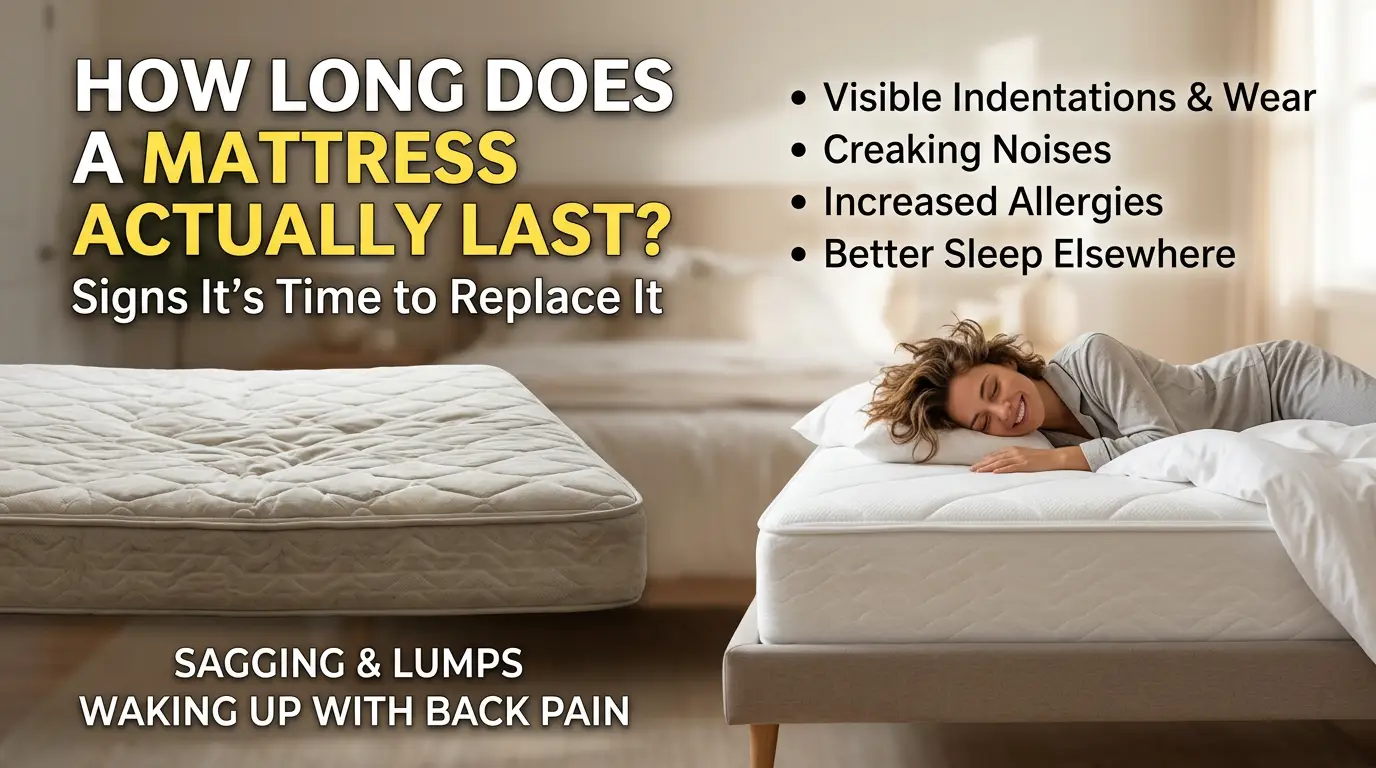
- ✓Lie flat on your back in your normal spot and have someone check for a visible dip where your hips and shoulders land.
- ✓Look at it empty, in daylight. A mattress that's lost its shape shows a permanent trough even with no one lying on it.
- ✓Listen for the coils. A creak or a metallic ping on an innerspring means the wire itself is fatigued, not just the padding on top.
- ✓Check the edges. If you catch yourself sleeping toward the middle because the perimeter has collapsed, the structural foam is gone, not just the softness.
- ✓Notice how you get up. Waking up stiffer than you went to bed is your spine telling you the surface stopped supporting it hours before your alarm did.
Two or more of those true at once, and you're not looking at a mattress that needs a topper. You're looking at one that's done.
What your back already knows
What Is Your Body Already Telling You?
If you wake up stiff or sore, the mattress may have lost its support. Cleveland Clinic points to research showing a medium-firm mattress can meaningfully improve sleep quality and help reduce chronic back pain — which only works if the mattress in question is still capable of being medium-firm. A mattress that's sagged past its support layer isn't medium-firm anymore no matter what the tag says, it's just soft in the wrong places.
Baylor Scott & White Health makes the connection directly: switching from an old, worn mattress to a new one has been shown to reduce back pain and improve sleep quality, because a mattress that's lost its support reinforces poor posture and strains muscles all night long, every night, without you clocking it as the cause.
I'm not a doctor and I won't pretend to be one from the cab of a truck. But I've heard the same complaint from enough customers — a bad lower back, a stiff neck every morning, waking up more tired than they went to bed — that I started asking how old the mattress was before I even quoted the pickup. More often than not, it had been a decade or better.
The part you can't see
What's Living in an Old Mattress?
Dust mites, mostly. Set the support question aside for a second, because there's a second thing happening in an old mattress that has nothing to do with sagging. Mayo Clinic notes that dust mites thrive in warm, humid places and feed on shed skin cells, and that bedding and mattresses are exactly the environment they prefer. The longer a mattress is in use, the more of that buildup it's holding, and for anyone with allergies or asthma, that shows up as symptoms with no obvious cause — until the mattress gets replaced and the symptoms ease up.
I strip the linens off a lot of mattresses before they go on my trailer, and the underside of an old one tells its own story — discoloration, a smell that a fresh bag of laundry never fully covers, corners that never see a vacuum. None of that is a health inspection on my part. It's just what fifteen years of nightly use looks like once you finally see the whole mattress instead of the sheet on top of it.
Save your money
Will Flipping It Fix It?
Usually not. Flipping or rotating a mattress used to be standard advice, and on an older two-sided innerspring it can genuinely extend the life a little by spreading out wear. Most mattresses built in the last fifteen years or so — memory foam, pillow-top, most hybrids — aren't made to be flipped at all. There's only one usable side, and rotating head-to-foot does nothing for foam that's already stopped rebounding.
A topper is the same idea wearing a different hat. It can make a mattress feel softer for a few months, but it can't restore support a broken-down foam layer or fatigued coil no longer provides — it just adds a thin layer on top of a problem that's still there underneath. I'd rather tell a customer to save the forty dollars on a topper than have them call me again in eight months once it stops working either.
Once you know
What Do You Do Once You Know?
If your mattress failed the sag test above, the next question is just logistics, and that part's simple.
If the store is delivering your new one, it has to offer to take the old one at no charge, so ask when you order. If not, one mattress is $210 with us, carried out from any room, or $225 with the box spring. The full rundown on how mattress removal actually works in Temecula covers pricing, certified recycling under California's mattress recovery law, and same-day availability. If the frame, box spring, or a whole bedroom set is coming out with it — most of the time it is — that rides in the same trip through furniture removal at no real difference in price.
Weston Molitor
Founder · Wild West Junk Removal · Temecula, CAI started Wild West in Temecula in 2021 and I still run loads myself. I didn't write this page to talk anyone into a new mattress — that's not my business. I wrote it because half the mattresses I carry out are years past the point where they were doing their job, and the owner never had a way to check besides "it still looks okay."
"Nobody's ever called me happy about a fifteen-year-old mattress. They're just relieved to finally know for sure."

Quick answers
What Else Do People Ask About Mattress Lifespan?
It depends on what's inside it. Innerspring mattresses typically run six to eight years before the coils lose tension, memory foam and hybrid models run seven to ten, and latex can hold up ten to fifteen. Those are averages — body weight, how many people sleep on it nightly, and moisture exposure all shift the real number for your specific mattress.
Only if it's an older, two-sided innerspring, and even then flipping only slows the wear rather than reversing it. Most mattresses made in the last fifteen years, including memory foam, pillow-top, and most hybrids, are built with only one usable side, so there's nothing to flip to.
Health systems including Cleveland Clinic and Baylor Scott & White both point to research connecting mattress support to back pain and sleep quality, and to switching from an old, worn mattress to a new one as a way to reduce both. A mattress that's lost its support reinforces poor posture all night without you noticing it happening.
Run the sag test above first. If your mattress shows a visible dip at rest, sags at the edges, or creaks under normal movement, that's the mattress. If the mattress checks out fine and the discomfort is specifically neck or shoulder pain rather than lower back or hip pain, the pillow is worth ruling out next.
Sometimes, but most mattress warranties only cover sagging beyond a specific depth, often an inch or more, measured with no one on the mattress. A mattress that feels worn but doesn't meet that exact threshold typically isn't a warranty claim even though it's no longer doing its job. Check your specific warranty terms before assuming either way.
If a store is delivering the new one, have it take the old one; California requires retailers to offer that at no extra charge when they deliver. Otherwise, City of Temecula residents can use one of their two free CR&R bulky-item pickups, or we'll carry it out from any room for $210. The mattress removal page lines up every option.
Sources
Lifespan ranges above are general figures and vary by construction, body weight, and use. Health information referenced here is general and not a substitute for medical advice — if back or neck pain persists after replacing an old mattress, talk to a doctor.