
Moving a Mattress Solo · Temecula Valley
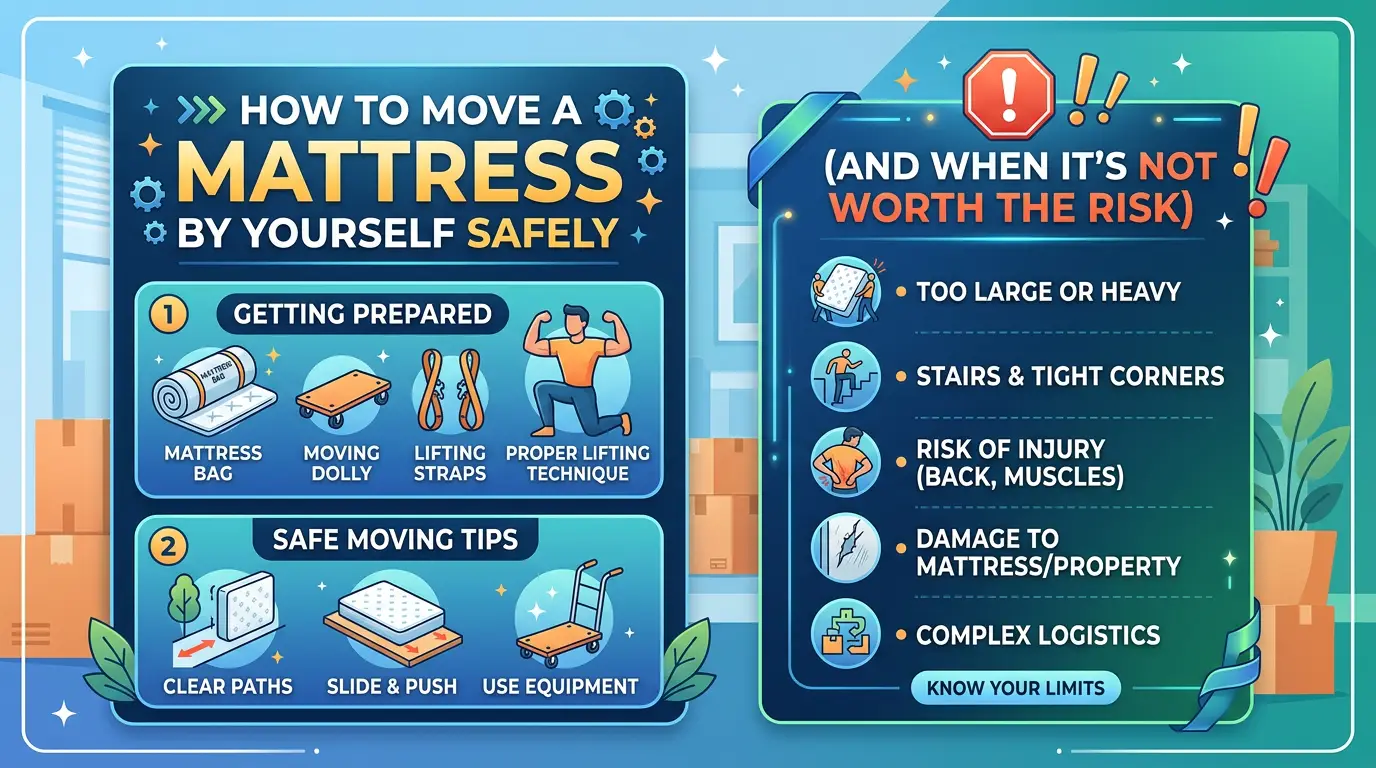
How to Move a Mattress by Yourself Safely (and When It's Not Worth the Risk)
I've pulled more than one mattress out of a stairwell it got wedged in halfway down. Here's how to move one alone without wrecking your back or the mattress, and the short list of situations where the smart move is to set it down and make a call.
Family-owned in Temecula since 2021 · Licensed & insured · Two-person crew, straps, and blankets on every mattress pickup
Wild West Junk Removal · 41713 Niblick Rd, Temecula, CA 92591 · (951) 837-8072
Mon to Sat: 7AM-7PM · Sunday: Closed · Family-owned, licensed and insured · Serving Temecula, Murrieta, Menifee and southwest Riverside County
By Weston Molitor, founder of Wild West Junk Removal · Published September 3, 2026
The call I get a couple of times a month
The Mattress Usually Wins the First Round
Here's how it goes. Somebody in a Harveston townhome decides Saturday morning that the old queen is going out today, gets it halfway down the stairs, and it folds itself into the turn at the landing like it was designed to. They call me from the step above it. Or a guy in Paseo del Sol gets the whole thing out to the garage, feels something in his lower back on the last shove, and by Monday he's calling from the couch asking if we can come get it because he can't.
And then there's the one I see on Winchester Road a few times every summer: a mattress on the roof of a sedan, held on by a rope through the open windows, lifting at the front edge like a sail every time the car gets over forty.
I'm not going to tell you a mattress can't be moved alone. I've walked twin and full mattresses down a flight of stairs by myself more times than I can count, and a lot of you reading this can do the same. What I'll tell you is which mattresses are a one-person job and which ones aren't, how to do the one-person ones without hurting yourself, and the handful of situations where the money you'd save isn't worth what it costs. I run a mattress removal service in Temecula, so you can assume I'd like the call. But I'd rather you read this and do it right than call me from urgent care.
Everybody underestimates this part
First, Know What You're Actually Lifting
A mattress doesn't look heavy. It's soft, it's the thing you sleep on, it isn't a dresser. Then you try to stand a queen hybrid up on its edge and it just doesn't come, and that's the moment most people find out what they bought.
| Size | Innerspring | All-foam | Hybrid or latex |
|---|---|---|---|
| Twin / Twin XL | 35 to 50 lb | 40 to 60 lb | 50 to 75 lb |
| Full | 45 to 60 lb | 55 to 75 lb | 70 to 100 lb |
| Queen | 55 to 80 lb | 70 to 100 lb | 100 to 150 lb |
| King / Cal King | 70 to 100 lb | 90 to 130 lb | 130 to 180+ lb |
The number on that chart is only half the problem. The federal safety folks at NIOSH have a lifting formula that the whole industry uses, and it starts from 51 pounds as the most one person should lift under ideal conditions, then knocks that number down for every way the real lift falls short of ideal. Ideal means the load is close to your body, at waist height, with two good handholds, no twisting, and a short carry. Read that list again and picture a mattress. It has no handles. It's 75 or 80 inches long, so its weight sits way out in front of you. You're picking it up from the floor. You're twisting it through a doorway. You're carrying it fifty feet and down a flight. Run a mattress through the NIOSH equation and the safe number for one person drops well below the weight of almost anything bigger than a twin.
51 lb
NIOSH's starting point for what one person should lift, and that's under ideal conditions a mattress never gives you
0
Handholds on a mattress. Grip is one of the things the lifting formula penalizes hardest
2
People we send on every queen-and-up pickup, with straps and moving blankets, no exceptions
That's why a 75-pound queen feels so much worse than a 75-pound dresser. It isn't in your head. It's a worse lift by every measure the ergonomics people track, and NIOSH's own guidance puts manual lifting behind a big share of the half-million strains and sprains reported every year, most of them to the lower back. The good news is that the method below is built so you never actually carry the thing. You stand it up, you slide it, and you steer it.
Before you touch the bed
The Honest Test: Can You Do This Alone?
Run this list first. If you can say yes to all of it, you're in one-person territory and the rest of this page will get you through it. If you hit a no, skip to the section on when it's not worth it, because that's where your situation lives.
- ✓It's a twin, twin XL, or full. Or it's a queen that's all foam, under about ten inches thick, and you've already stood it on its edge once to confirm you can. King, hybrid, and latex are two-person mattresses. Not a suggestion.
- ✓Ground floor to ground floor, or one straight, wide flight. No landing with a turn. No exterior apartment stairs with a rail on one side and a drop on the other.
- ✓You've measured the tightest spot. The hallway, the door, the turn at the top of the stairs. A queen on its edge needs 80 inches of vertical clearance and about a foot of width, plus room to pivot.
- ✓The mattress is dry, clean, and doesn't need to arrive pretty. A mattress that's leaving can take a scuff. A mattress you're keeping, especially a new one under warranty, is a two-person, bag-it-first job.
- ✓Someone is within shouting distance. They don't have to lift. They have to be able to hear you if the mattress pins you on the stairs.
- ✓It's under 90 degrees, or you're doing it before 9 a.m. Temecula in August and September doesn't care how strong you are. More on that below.
Two things that change the math
First, the box spring. It's lighter than the mattress but it's rigid and it doesn't bend around a corner, so a box spring that fits through a door flat may not fit standing up, and you can't fold it to find out. Second, your back. If it's ever gone out on you, or a doctor has told you to stay away from heavy lifting, that includes this. A bad lift on a mattress rarely announces itself in the moment. It shows up the next morning when you try to get out of bed, which is a rotten joke given what you were moving.
Stand it up, slide it, steer it
How to Move It Solo Without Hurting Yourself
The trick isn't strength. It's that you never carry the mattress flat. Flat is where it flops, and flopping is where your back goes. Get it on its long edge and keep it there from the bedroom to the truck.
Strip it and bag it
Sheets, protector, topper, and pillows off. Then get a mattress bag with handles from the hardware store, sized to the mattress, usually ten to twenty dollars. The bag does two jobs: it keeps the mattress clean, and it turns a floppy slab with no handholds into something you can grip that slides on carpet and tile. Tape the open end shut. One exception: if we're picking it up, skip the plastic, because it gets in the way at the dismantling facility. The reasons are in the prep checklist on the service page. If it's going in your own truck, or to your new house, bag it.
Clear the path and prop every door
Walk the route once with nothing in your hands. Hall table out. Runner rug rolled up. Anything on the stairs gone. Prop the exterior door open with something heavy, because a one-handed door dance with a mattress is how door frames get gouged. If a doorway is close, pull the door off its hinges. It's two or three pins and it buys you two inches.
Stand it on its long edge
Stand at one long side of the bed, grab the far edge, and pull it toward you so the mattress folds slightly and pivots up on the near edge. Then walk around and let it settle upright against your leg. On its edge, a queen is about a foot wide and slides like a sled. Everything from here on happens in that position. If you can't get it upright and keep it there without a fight, that's your answer about doing this alone, and you found out in the bedroom instead of on the stairs.
Fold it only if it's foam, and only for a minute
An all-foam mattress that isn't too thick can be curved in half and cinched with a couple of ratchet straps, which turns a queen into something you can actually hug. Purple's own guidance is that foam can be folded for short periods, and Amerisleep puts it at under an hour for a gentle curve. Innerspring and hybrid mattresses don't fold. There's a steel border rod around the edge and coils inside, and once you kink them they don't come back. It also voids just about every warranty on the market. If you're keeping the mattress, unfold it the minute it's in the truck.
Slide, don't lift
One hand on top to steer, one hand low on the leading edge, and push. On carpet a bagged mattress glides. On tile or hardwood, slip a moving blanket or a flattened cardboard box under the front corner and let it ride. A furniture dolly under the bottom edge is the cheat code for a long hallway or a garage; you're pushing forty pounds of mattress and steering the rest. Keep it against your body and keep your back straight. If you feel yourself reaching out in front of you to control it, stop and reset.
Doorways and corners: pivot, don't carry
Lead with the bottom corner and treat it like a hinge. Lean the top of the mattress away from the frame, plant that bottom corner, and swing the rest through. A tight 90 in a hallway is the same move in two stages: corner in, pivot, corner out. What you don't do is pick the mattress up and try to carry it around the turn. That's the lift that goes wrong.
Stairs: stay above it, never below it
Going down, lay it flat on the stairs top end first and lower it from above like a sled, letting the steps carry the weight while you control the speed from the high side. Going up alone, stand it on edge, get below it only when it's resting on the stairs, and push, letting the top edge ride the steps. Never stand under a mattress that's moving on stairs. If the flight turns at a landing, this is the section where the mattress wins, and the honest answer is a second person or a phone call.
Do the whole job in shoes with a real sole, not flip-flops. Half the mattress injuries I hear about started with a foot sliding on a tile landing, not with the lift.
The part that involves other people
Getting It Down the Road
Once it's out of the house, the risk stops being your back and starts being everybody else on the 15. This is the part California actually has laws about.
In a pickup: lay it flat in the bed or stand it on edge against the cab, and use ratchet straps, not rope. Two straps front to back at minimum, and one across if it's on edge. A mattress is a wing at freeway speed; the front edge lifts, air gets under it, and the whole thing wants to leave. Tailgate down is fine if it's strapped, and tie something red to anything hanging past the tailgate. The box spring rides the same way. In an SUV or minivan: seats down. A twin lies flat in most of them, a queen doesn't, and a foam queen curved and strapped will usually go in. If you're borrowing a truck, check the strap ratings on the tag and use the bed anchors, not the bumper.
Not on the roof of a car
I know it looks like it works. It's also the one that gets people hurt who weren't even in your car. California Vehicle Code section 23114 says a vehicle can't be driven on a highway unless it's loaded so nothing can drop, blow, or otherwise escape from it, and section 24002 makes it unlawful to operate a vehicle that isn't safely loaded and presents an immediate hazard. A mattress roped through open windows, with no rack, at 65 on the freeway, is both. The AAA Foundation counted more than 200,000 crashes over four years involving road debris, about two-thirds of them from things falling off vehicles and unsecured loads, and nearly 37 percent of the deaths came from drivers swerving to miss something. The cheap alternative to a roof isn't rope. It's a friend with a truck, a bulky pickup, or us.
Where you're driving to. If the mattress is clean and dry, the state's Bye Bye Mattress program has drop-off sites that take it at no charge, with unit limits at some locations and an appointment at others, so call first. Riverside County's landfills accept mattresses too, with a fee and an uncovered-load surcharge that's caught more than one of my customers off guard; I wrote up the drive, the fees, and the surcharge in where to dump in Temecula. And if you're a Temecula resident on CR&R service, you may not need to drive it anywhere. The city's bulky item collection will take a mattress from the curb on a scheduled date, so the whole job becomes getting it to the driveway the night before, which is exactly what the method above is for.
Where I'd tell you to set it down
When It's Not Worth the Risk
I'd rather lose a job than have you call me from urgent care. These are the situations where, if you describe them to me on the phone, I'll tell you to leave the mattress where it is.
A king, or any hybrid or latex queen
You're over 100 pounds with no handholds. That's a two-person mattress on flat ground and a two-person mattress with a strap on stairs. I don't send one guy for these and I've been doing this since 2021.
Stairs that turn
A landing with a 90, or the exterior stairs on a Temecula apartment building with a rail on one side and open air on the other. The mattress wedges in the turn, and the person below it is the one who gets hurt.
A back that's been out before
Or anyone a doctor has told not to lift, anyone pregnant, anyone recovering from surgery. There is no technique that makes a floppy 80-pound slab a safe lift for a back that's already been hurt.
Afternoon heat
Cal/OSHA's heat illness rule makes employers give outdoor crews shade at 80 degrees and extra procedures at 95. Nobody's watching you in your own garage at 3 p.m. in September. Do it at 7 a.m. or do it in October.
A mattress you need to keep nice
New, under warranty, or going to the new house. One slip on a stucco corner puts a tear in the cover and a fold voids the warranty. Two people and a bag, every time. If it's the old one and you're not sure it's worth keeping, here's how to tell.
Wet, moldy, or bed bugs
A soaked mattress can weigh double and it's slick. A moldy one shouldn't be in your hallway. A bed bug mattress has its own rules, which I laid out in how to dispose of a mattress with bed bugs, and we don't take an active infestation.
Nobody home
If the mattress pins you on the stairs or your back locks up in the garage, who's making the call? Solo means one person lifting, not one person in the house.
No safe way to drive it
If the plan involves the roof of a car, rope, or a mattress standing up in a truck bed with nothing holding it, the plan is the problem, not the lift.
Here's the math I'd ask you to do before you decide. A single mattress is a small partial load for us. Pricing runs by how much of the truck it fills, plus a per-mattress line item and, if there are stairs, a stair carry that's quoted before anyone lifts. The service page lays the numbers out, and a texted photo gets you a same-day ballpark. Put that next to an urgent care visit, a drywall patch at the landing, and a hybrid you kinked that was still under warranty. For a twin on the ground floor, doing it yourself wins. For a king on the second floor in August, it never does.
The easy version
If You'd Rather Not Find Out the Hard Way
Everything above is how I'd do it if I were you and it was a twin. When it isn't, here's what the other option looks like.
Two people show up. They bring straps, moving blankets, and frame protectors, and they've done the pivot-through-the-doorway move so many times they don't think about it. Second-floor bedrooms, tight Old Town hallways, and gated complexes are standard work, and if you tell us about the stairs and the turn on the phone, the right crew comes out once and the stair carry is in the number you approve. The full rundown of how mattress removal works in Temecula covers same-day availability and where the mattress ends up, which for a clean one is a recycler, not a landfill. The box spring, frame, and headboard ride in the same trip through furniture removal. And if the mattress is one of a dozen things that have to be gone by the time the movers show up, that's a moving-day junk removal job, and we'll take the whole pile in one load.
Weston Molitor
Founder · Wild West Junk Removal · Temecula, CAI started Wild West in Temecula in 2021 and I still run loads myself. I wrote this page because the mattress calls that bother me aren't the ones where somebody needed help. They're the ones where somebody got hurt trying not to need it.
"You don't carry a mattress. You steer it. And when you can't steer it, you call somebody who's done it a thousand times."

Quick answers
Moving a Mattress by Yourself Questions
An all-foam queen on the ground floor, yes, if you bag it, stand it on its long edge, and slide it instead of carrying it. A queen innerspring is borderline and depends on the path. A queen hybrid or latex mattress runs 100 to 150 pounds with no handholds and is a two-person job. Kings are two people regardless of what they're made of.
Only if it's all foam, and only briefly. Manufacturers like Purple say foam can be folded for short periods, and a gentle curve strapped for the length of the trip is fine. Never fold an innerspring or hybrid mattress. The steel border rod and coils kink permanently, the mattress sags where the fold was, and the warranty is gone.
Not safely, and not legally if it can come loose. Vehicle Code 23114 requires a load to be secured so nothing can escape the vehicle, and 24002 prohibits driving a vehicle that isn't safely loaded and presents an immediate hazard. A mattress roped through the windows without a rack fails both. Use a truck bed with ratchet straps, an SUV with the seats down, a bulky pickup, or a hauler.
Bag it, lay it flat on the stairs top end first, and lower it from above like a sled while the steps carry the weight. Stay on the high side and control the speed. Never stand below a mattress that's moving on stairs, and don't attempt a flight that turns at a landing alone; that's where mattresses wedge and people get hurt.
On its long edge, always, when you're alone. Flat, a mattress flops in the middle and pulls your arms out in front of your body, which is the lift that hurts backs. On its edge it's about a foot wide, it slides on carpet and tile, and you steer it with one hand on top and one hand low instead of carrying it.
NIOSH's lifting formula starts at 51 pounds for one person under ideal conditions, and a mattress is nowhere near ideal: no handles, long, lifted from the floor, twisted through doors. In practice, a twin or full is a one-person move, an all-foam queen is possible on flat ground, and anything heavier or on stairs with a turn should be two people or a call to a hauler.
Sources
This page is one junk hauler's experience, not medical or legal advice. Lifting limits, vehicle codes, and facility rules are summarized as I understand them and can change. If you have a back or heart condition, ask your doctor before lifting anything heavy, and confirm acceptance rules with any facility before you haul.