
Home › Homeless Encampment Cleanup › How to Prevent Homeless Encampments
How to Prevent Homeless Encampments Before They Form
Site hardening, lighting, access control, and the maintenance schedule that keeps a cleared lot clear. Written from what we see on cleanup jobs across Temecula and Murrieta.
Family owned in Temecula since 2021 · Licensed and insured · Mon–Sat 7AM–7PM
Short answer
Camps form where a site is flat, hidden, unlit, unwatched, and unowned in practice. Remove any two of those conditions and most locations stop being chosen. In order of impact: clear the overgrowth and open sight lines, light the space, block vehicle and foot access to the dead zones, replace bare dirt with hardscape or planting, then put the site on a real inspection and trash schedule. Physical changes buy you time; they do not remove the underlying need, so the cities getting durable results pair them with outreach and shelter capacity.
Key takeaways
- ✓
Visibility is the single biggest factor. Overgrown brush and dark corners do more to invite camping than any other site condition.
- ✓
Bare, level dirt is what a tent needs. Gravel, hardscape, planting, and grading take that away.
- ✓
Access control at the edge (fencing, bollards, gates) is cheaper than repeat cleanups.
- ✓
The 2024 Grants Pass ruling gave cities clearer legal footing to enforce camping ordinances.
- ✓
On private land, abatement is the owner's obligation, not the city's.
- ✓
Sites that stay clear are maintained on a schedule. One-time cleanups reset in weeks.
On this page
What site hardening actually means
Site hardening is a planning term for changing a physical space so that sleeping on it stops being practical. Planners also call it defensive design, environmental deterrence, or situational crime prevention. Whatever the label, the idea is the same: instead of removing people after a camp appears, you change the conditions that made the spot attractive in the first place.
It helps to think like the person choosing the site. They are looking for flat ground, shelter from wind and rain, cover from view, no lighting after dark, and somewhere nobody appears to be responsible for. A freeway underpass hits all five. So does the dirt strip behind a strip mall, the brush line along a flood channel, and the recessed doorway of a building that closes at six.
Take away two or three of those conditions and the location usually stops being chosen. That is the whole mechanism. It is not complicated, and most of it costs less than repeated encampment cleanups.

Design changes that keep camps from forming
Seven categories cover almost everything cities and property owners actually deploy. Most sites only need two or three of them.
1. Landscaping and ground cover

A tent needs soft, level ground. Landscaping removes that without looking like a barrier. Dense or thorny planting fills open alcoves, raised planter beds occupy setback strips, decorative boulders and gravel replace bare dirt, and berms or graded slopes break up flat runs.
The other half of landscaping is subtraction. Overgrown brush along fence lines and channels is what conceals a camp, so clearing vegetation often does more than anything you add.
2. Barriers, bollards, and boulders
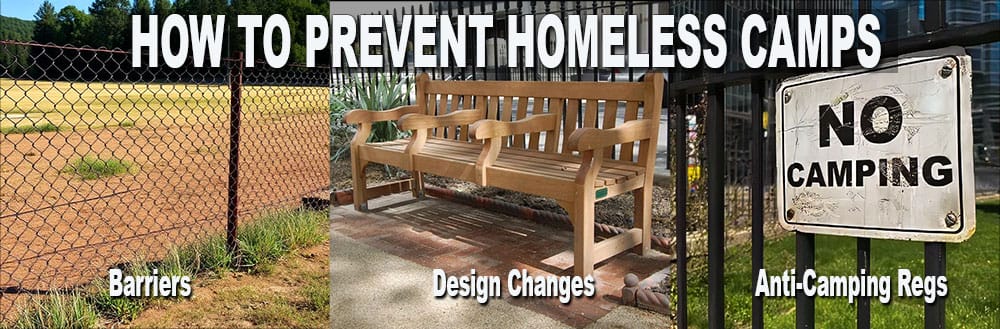
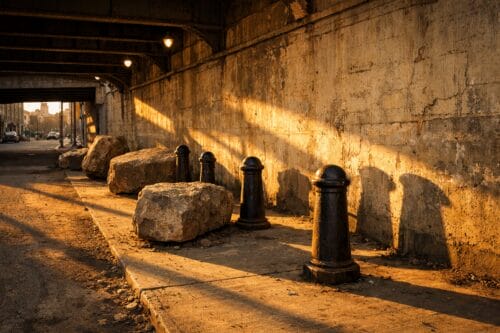
Physical obstruction is the blunt version and the most visible one. Fencing and gates close vulnerable lots. Bollards block vehicle access to vacant parcels and dead-end streets. Boulders and art installations fill the space under bridges and along alley walls. Bench redesigns with center armrests or sloped seats prevent lying down.
This is the category that draws criticism, and fairly so. It is worth being deliberate about what you install and where, because a wall of anti-sit hardware in a public plaza reads very differently than a bollard line on a freeway shoulder.
3. Lighting and sight lines
Concealment is the condition worth attacking first, because it is cheap to fix and it improves the space for everyone. Bright, maintained LED lighting on trails, alleys, and parking areas removes the dark pockets. Trimming trees up and shrubs down restores sight lines from the street. Cameras help mostly because they signal that someone is paying attention.
Research on street lighting and public safety has generally found a measurable effect on nighttime activity in treated areas, though the size of the effect varies a great deal by context. Treat it as one layer, not a fix.
4. Foot traffic and programming

The most underused approach is also the least adversarial: give the space a job. Markets, food vendors, recurring events, public art, seating, and connected bike or walking paths put people in a place continuously, and a location with steady eyes on it is rarely selected.
This is why an active plaza and a neglected one two blocks apart can have completely different outcomes with identical physical layouts.
5. Waterways, washes, and flood channels
Drainage corridors are the highest-risk locations in Southwest Riverside County. They are screened by brush, they are rarely patrolled, and in a storm event they are genuinely dangerous. Common measures are restricted-access gates at channel entries, riprap and steep bank treatments that remove flat ground, retaining walls, and clearing the overgrowth that provides cover.
Debris left in a channel is not only a nuisance. It blocks flow, and it ends up downstream. That is a large share of the safety risk associated with these sites.

6. Roads, underpasses, and medians
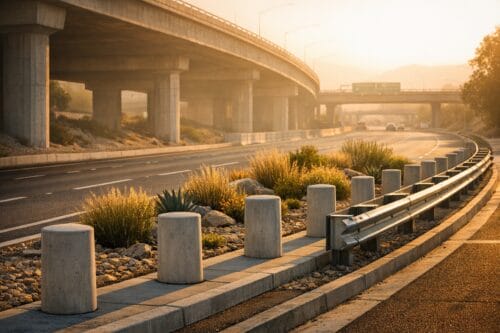
Transportation right-of-way produces more long-term camps than any other land type, because it is flat, sheltered, and owned by an agency that is not next door. The fixes are regrading or filling underpass shoulders, narrowing medians, planting embankments, adding guardrails, and putting walking paths through dirt strips that previously had no use.
On state right-of-way this is Caltrans work, so a property owner’s realistic move is to harden their own frontage and report the rest.
7. Buildings and public facilities
Building-scale changes are the small ones that add up: eliminating recessed doorways and alcoves, adding roll-down gates for after-hours, replacing deep porches with sloped entries, and designing transit stops with lean rails instead of benches. If you manage a commercial property, the recessed entry and the loading dock nook are almost always the first two spots to address.
Already have a camp on your property?
Hardening comes after the site is cleared. We handle the cleanout, the hauling, and the disposal so you can make the changes that keep it from coming back.
Where the law stands in California
The legal picture changed in June 2024. In City of Grants Pass v. Johnson, the Supreme Court held that enforcing a generally applicable public camping ordinance is not cruel and unusual punishment under the Eighth Amendment. That reversed the standard set by the Ninth Circuit in Martin v. Boise, which had limited enforcement when shelter beds were unavailable. Cities in California now have clearer authority to enforce, and many have updated their ordinances since.
The ordinances themselves are local and they vary. These are the four types you will encounter most often:
| Ordinance type | What it typically covers |
|---|---|
| Anti-camping | Prohibits sleeping, pitching tents, or living in a vehicle in designated public areas such as parks, sidewalks, and open space. |
| Sit-lie | Restricts sitting or lying on public sidewalks in commercial districts during posted hours. |
| Oversized vehicle parking | Limits or bans overnight street parking of RVs and oversized vehicles in residential areas. |
| Obstruction of right-of-way | Prohibits blocking sidewalks and public paths with belongings or structures. |
Not legal advice
Notice periods, property storage requirements, and abatement procedure differ by city and county, and they change. Confirm your local municipal code and talk to counsel before you enforce or remove anything.
What hardening does not solve
This is the part the design conversation usually skips, and it is the reason a lot of programs fail on their second year. Changing a site moves the activity. It does not end it. If a channel bank is fenced and lit and nothing else changes, the camp reappears three hundred yards away, often somewhere less safe and harder to reach.
Critics of defensive design make a fair point on this: hardware that makes a public space unusable for sleeping tends to make it less usable for everyone, and it can push people into exactly the hidden, unlit locations that are most dangerous. The version that works pairs site changes with the supply side, which means outreach workers who show up before a camp establishes, shelter and interim housing capacity, and behavioral health and substance use services people can actually access.
Removal without somewhere to go is a scheduling exercise. You are choosing when the cleanup happens, not whether.
Weston Molitor, OwnerNone of that is a junk removal company’s job, and we are not going to pretend otherwise. But it belongs in the plan, and if you are a city or an HOA budgeting for this work, the coordination piece is what determines whether you are doing it once or every quarter.
The part most owners skip
Design changes are a one-time spend. Maintenance is the recurring one, and it is what separates the properties that stay clear from the ones that cycle. A site that has been chosen once has already been evaluated and approved by everyone who passes it, which is why clearing without changing anything buys you a matter of weeks.
Clear the site properly
Full removal of structures, bedding, and debris, with sharps and biohazard handled correctly rather than bagged with the rest.
Change one physical condition the same week
Cut the brush, add the light, gravel the dirt, gate the access point. Anything less and the site is unchanged.
Set an inspection cadence
Weekly for known hotspots, monthly elsewhere. A camp caught at day three is a wheelbarrow. At day thirty it is a truckload.
Keep trash pickup ahead of accumulation
Standing debris signals that nobody is watching, and it is the reliable early indicator that a site is being re-established.

If you manage property in the Temecula Valley
We work with property managers, HOAs, and commercial owners on this regularly. See our encampment cleanup service, our cleanup strategy guide, or our commercial junk removal and tenant turnover pages. Pricing is posted on our rate card.
Who wrote this
Weston Molitor
Owner, Wild West Junk RemovalI started Wild West Junk Removal in Temecula in 2021. Encampment cleanup is a small share of what we do by volume and a large share of what we get asked about, mostly by property managers and commercial owners who have cleared the same lot twice and want to know why it keeps happening.
Everything above comes from what we see on those jobs. The pattern is consistent: the sites that stay clear got a physical change and a schedule, and the ones that do not got a cleanup and a hope.
Nine times out of ten the fix is brush and light. People spend on fencing first because it feels decisive, and the brush line is still there.

Sources and further reading
- supremecourt.govCity of Grants Pass v. Johnson (2024)Full opinion establishing that generally applicable public camping ordinances do not violate the Eighth Amendment.
- huduser.govHUD Annual Homeless Assessment Report to CongressThe federal point-in-time count and the standard national baseline for sheltered and unsheltered homelessness.
- ndc-md.orgUnderstanding hostile architecturePlain-language overview of defensive design techniques and the effects attributed to them.
- luskin.ucla.eduHow hostile architecture shapes our citiesUCLA urban planning perspective on how defensive design changes who can use public space.
- cambridge.orgAnti-homeless hostile design as wrongful discriminationPeer-reviewed argument against defensive design, useful for understanding the critique.
- ncbi.nlm.nih.govStreet lighting and public safety researchReview of the evidence on lighting interventions and nighttime activity in public space.
Frequently asked questions
Site hardening is the practice of changing a physical space so it is no longer comfortable or practical to sleep on. It covers landscaping, barriers, lighting, drainage work, and activity programming. It is a prevention tool, not a solution to homelessness, and it works best when it is paired with outreach and consistent maintenance.
Dense or thorny planting, raised planter beds, decorative boulders, gravel over bare dirt, and graded or sloped ground all remove the flat, soft, sheltered surfaces a tent needs. Clearing overgrowth matters just as much, because tall brush is what hides a camp from view in the first place.
In most cases yes. In June 2024 the Supreme Court held in City of Grants Pass v. Johnson that enforcing a generally applicable public camping ordinance does not amount to cruel and unusual punishment, which reversed the earlier Ninth Circuit standard from Martin v. Boise. Local ordinances and notice requirements still vary, so check your own city and county rules before acting.
Lighting alone will not clear a site, but low visibility is one of the strongest predictors of where a camp forms. Bright, well-maintained lighting combined with trimmed vegetation and open sight lines removes the concealment that makes a spot attractive, and it makes the area safer for everyone using it.
The property owner is. Cities can clear public land, but debris left on a private lot, an easement, or a commercial property is the owner's responsibility to abate, and code enforcement can cite you if it sits. That is the point where most owners call us.
Fast, if nothing else changes. A site that was chosen once will be chosen again, usually within weeks. The properties that stay clear are the ones that pair the cleanup with a physical change to the site and a schedule for checking it, rather than treating removal as a one-time job.
No, and it is not the most effective one on its own. Defensive design pushes activity somewhere else rather than ending it. Cities that get durable results combine site changes with outreach workers, shelter capacity, and rapid response cleanup, so people have somewhere to go when a location closes.
Yes. Wild West Junk Removal handles encampment cleanup and debris hauling across Temecula, Murrieta, Menifee, Wildomar, Lake Elsinore, and the surrounding Southwest Riverside County communities. Call or text (951) 837-8072, Monday through Saturday, 7AM to 7PM.
Clear it once. Then keep it clear.
Wild West Junk Removal handles encampment cleanup, debris hauling, and brush clearing across Temecula, Murrieta, Menifee, and Southwest Riverside County. Family owned, licensed, and insured.
Wild West Junk Removal
41713 Niblick Rd, Temecula, CA 92591
Mon–Sat 7AM–7PM · Sun Closed
Reviewed and updated August 19, 2026 by Weston Molitor. Educational information only, not legal advice.