
Home › Homeless Encampment Cleanup › Homeless Camp Safety Risks
Public Safety Risks of Homeless Camps in Temecula
Fire, sanitation, sharps, and untreated medical crises, separated from the claims that get repeated without a source. Written from what our crews find on encampment cleanups across Southwest Riverside County.
Family owned in Temecula since 2021 · Licensed and insured · Mon–Sat 7AM–7PM

Short answer
The genuine, documented risks around an encampment are fire, sanitation and communicable disease, hazardous materials including discarded syringes and fuel cylinders, and untreated medical and psychiatric crises. Those are real, and they are worst for the people living in the camp. The claims that tend to travel furthest, on the other hand, are usually the ones with no source attached: specific crime percentages, revenue losses and property value declines get quoted constantly and almost never trace back to a study. This page separates the two, and every figure below links to where it came from.
Key takeaways
- ✓
Sanitation is the root hazard. No water, no toilets and no trash service is what drives disease risk, pest pressure and contamination downstream.
- ✓
Fire is the risk that spreads. Open flame and propane inside dry brush is a vegetation fire waiting for wind.
- ✓
Discarded sharps are the hazard the public actually encounters, and California law bars putting them in a trash or recycling bin.
- ✓
Two-thirds of unsheltered people have a current mental health disorder, per a 2024 JAMA Psychiatry meta-analysis. That is a services problem, not a character problem.
- ✓
Temecula's own census counted 50 people in November 2024, down from 56. The local scale is smaller than the conversation implies.
- ✓
On private land, abatement is the owner's legal obligation, and doing it yourself is a bloodborne pathogen exposure.
On this page
Sanitation and communicable disease
Almost every downstream hazard at an encampment traces back to one missing thing: infrastructure. No running water, no toilets, no trash pickup. Everything a household normally routes through plumbing and a weekly bin has nowhere to go, so it accumulates on the ground within a few dozen feet of where people sleep.
California public health departments have tracked hepatitis A, hepatitis C, tuberculosis, gastrointestinal illness and skin and soft tissue infections in unsheltered populations. Transmission is driven by exactly what you would expect: no handwashing, shared needles, crowded sleeping conditions and interrupted treatment. The 2017 to 2018 hepatitis A outbreak that moved through San Diego and other California cities is the case most public health agencies still plan against.
The second-order problem is vectors. Food waste and human waste bring rats, mice, flies and mosquitoes, and those do not respect the camp boundary. They move into adjacent landscaping, storm drains and buildings, which is how a sanitation problem at one site becomes a pest problem for a whole block.

Runoff is the part that gets overlooked in this valley. Camps tend to form along flood control channels and creek beds because those corridors are flat, shaded and screened from the street. That is also where the first heavy rain carries everything left on the ground straight into the watershed.
Fire and hazardous materials
Of every risk on this page, fire is the one most likely to leave the site and affect people who were never near it.
Cooking and heating at a camp happen over open flame, propane bottles, camp stoves and improvised burn barrels, frequently inside or immediately beside a nylon tent. Put that in a Riverside County drainage corridor where the fuel load is cured for most of the year and a contained cooking fire becomes a vegetation fire on the first gust. Fire crews in this region respond to encampment-related vegetation fires as a recurring category, not an anomaly.
The materials left behind are their own problem. Propane cylinders with unknown remaining pressure, gas cans, car batteries, lithium cells from scooters and scavenged electronics, aerosols, and unlabeled containers all show up in the debris pile. None of it belongs in a dumpster, and several categories are classified as household hazardous waste that has to be routed to a county collection facility.
Discarded sharps
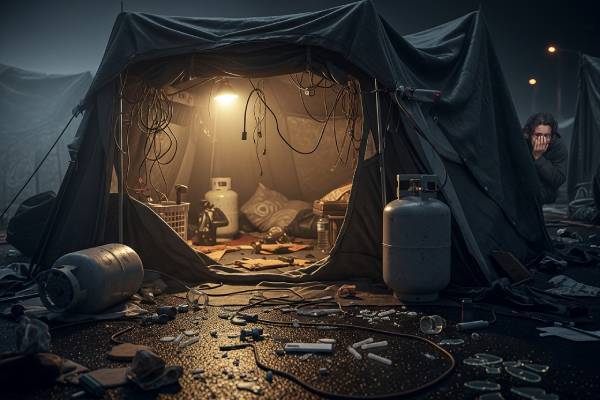
This is the hazard the public actually encounters, and the one people underestimate. Syringes turn up in park turf, landscaping beds, drainage channels and storm drain inlets, where children and dogs find them before adults do. Parents sweeping a sports field before a youth game is not a hypothetical in this valley.
Do not put sharps in a trash bin
California has prohibited disposing of home-generated sharps waste in household trash or recycling containers since September 1, 2008. Needles and lancets have to be sealed in an approved sharps container and taken to an authorized collection point such as a household hazardous waste facility or a participating pharmacy.
If you find sharps on your property, do not sweep, grab or crush them. Contain them with a rigid puncture-proof container and tongs, or call a crew that does this routinely.
Mental health and substance use
This is where careless writing does the most damage, so here is the actual evidence. A 2024 systematic review and meta-analysis published in JAMA Psychiatry pooled 85 studies covering more than 48,000 people experiencing homelessness and found a current prevalence of mental health disorders of 67 percent, with a lifetime prevalence of 77 percent.
Pooled across 85 studies and 48,414 participants. Substance use disorder was the most common category at 44 percent, followed by antisocial personality disorder at 26 percent, major depression at 19 percent, bipolar disorder at 8 percent and schizophrenia at 7 percent. Source: Barry et al., JAMA Psychiatry, 2024.

Two cautions on that number, both raised by the researchers themselves. First, it groups very different conditions under one heading, so it says nothing about any individual person. Second, the study measured prevalence, not causation. The relationship runs both ways: a psychiatric condition can push someone into homelessness, and sleeping outside for a year will worsen almost any psychiatric condition.
The practical consequence for a neighborhood is that untreated illness and active addiction produce behavior that is unpredictable rather than targeted, and medical crises that arrive as 911 calls rather than clinic visits. Riverside University Health System operates a mobile crisis team for exactly this reason, and Temecula pairs it with the city’s CORE outreach team.
Crime and calls for service
Where the numbers usually come from
You will find confident percentages online about crime increases near encampments, including on the earlier version of this page. We removed them, because they could not be traced to a police department report, a published study or any other citable source. If a figure matters enough to quote, it matters enough to link.
What can be said accurately is more limited and more useful. Homelessness itself is not a crime, and the strongest finding in the research literature is that unsheltered people are victimized at far higher rates than the housed population around them. Assault, theft of belongings and sexual violence inside camps are the dominant safety story, and they are chronically underreported.
Around a camp, the offenses residents and businesses report are mostly low-level and quality-of-life: trespassing, loitering, open intoxication, disturbances and property crime such as bike, tool and catalytic converter theft. Those calls are real, and they consume patrol time. What is not established is a clean causal number, because reporting behavior itself changes once people know a camp is nearby, which inflates apparent increases in ways that are hard to separate from actual increases.
Repeat medical and behavioral health calls are the more measurable strain. Overdose, exposure, untreated wounds and psychiatric emergencies generate high-frequency contact with the same individuals, which is expensive and displaces response capacity from other calls.
Where the law stands
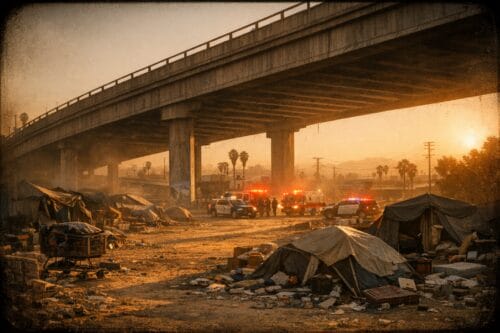
On June 28, 2024 the Supreme Court decided City of Grants Pass v. Johnson, holding 6–3 that enforcing a generally applicable public camping ordinance does not violate the Eighth Amendment’s prohibition on cruel and unusual punishment. That reversed the Ninth Circuit rule from Martin v. Boise, which had barred enforcement wherever shelter beds were outnumbered by unsheltered people. California cities now have clearer footing to enforce camping ordinances, though notice requirements, personal property storage rules and local ordinances still vary considerably. See our notice of removal overview before you post anything.
Effects on businesses and public spaces
The economic claims in this space are almost entirely unsourced, so treat any specific percentage you see with suspicion, including the ones this page used to carry. What business owners in Old Town and along the Jefferson and Rancho California corridors consistently describe is qualitative and still worth taking seriously.
- ✓
Added cleaning labor before opening, especially around back entrances, dumpster enclosures and landscaping.
- ✓
Higher spend on security hardware: cameras, lighting, fencing and enclosure locks.
- ✓
Customer complaints about access to entrances, sidewalks and parking areas.
- ✓
Staff reluctance to open, close or take out trash alone after dark.
- ✓
Repeat costs for graffiti removal and repairs to storefronts and outdoor seating.
Public space works the same way. Parks, trail heads and channel paths get used less once people perceive them as unsafe, and reduced use makes the space feel less watched, which makes it more attractive for camping. That loop is the practical argument for maintaining sight lines and lighting rather than waiting for a cleanup, which is the subject of our guide to preventing encampments before they form.
The site that gets cleaned once and changed in no other way is the site you will be cleaning again in six weeks.
Weston Molitor, Wild West Junk RemovalWhat Temecula’s own numbers show
Temecula runs a local census in addition to participating in the regional Point-in-Time count. City staff presented the results of the two-day November 2024 census to the City Council in January 2025.
Down from 56 the previous year, a decline of roughly 10 percent. City staff also reported that most people counted had long-term local ties, with a large majority having been homeless in Temecula for more than a year. Source: City of Temecula homeless outreach presentation to the City Council, January 2025.
That number is worth sitting with, because it cuts against the framing this topic usually gets. Temecula does not have a large encampment population by any regional standard. What it has is a small, largely local, highly visible population concentrated in a handful of predictable locations, which is a very different problem from the one implied by phrases like large-scale emergence.
Riverside County as a whole is the larger frame. The county’s 2023 Point-in-Time count identified 3,725 people experiencing homelessness countywide. Regional counts run on their own schedule and methodology, so compare them to each other rather than to a city census.
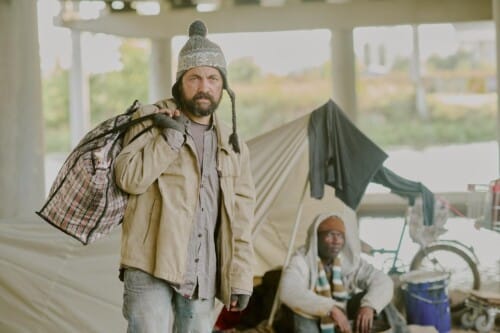
The practical implication for a property owner is encouraging. A problem this size is tractable with site changes and consistent maintenance. It does not require anyone to solve homelessness in order to keep a specific parcel clear.
If a camp is on your property
Responsibility splits cleanly along the property line, and a lot of owners find that out the hard way when the citation arrives.
| Situation | Who abates it | Your exposure |
|---|---|---|
| Public street, park or right of way | City or county crews, coordinated with outreach | None directly, though response times vary |
| Private commercial lot or building | Property owner | Code enforcement citations and daily accrual |
| Vacant residential parcel | Property owner | Citations plus weed abatement liability |
| HOA common area | The association | Board liability and member complaints |
| Easement or channel adjacent to your parcel | Depends on the recorded easement holder | Check the title before assuming it is not yours |
The order of operations
Document before you touch anything
Photograph the site with timestamps. If there is any dispute later about notice or personal property, this is the record that settles it.
Check your notice obligations
Requirements for posted notice and for storing personal property differ by jurisdiction. Confirm what applies to your parcel before scheduling a crew.
Coordinate with outreach first where you can
In Temecula, the CORE team and its nonprofit partners can make contact ahead of a cleanup. It is the right thing to do and it produces better outcomes on site.
Bring in a crew equipped for biohazard debris
Sharps, human waste, spoiled food and unlabeled chemicals are a bloodborne pathogen and hazardous materials job, not a hauling job. Cal/OSHA has a specific standard covering occupational exposure.
Change the site, then maintain it
Clear the brush, open the sight lines, light the space and put the parcel on an inspection schedule. Removal without site change resets in weeks.
Homeless Encampment Cleanup
Full debris removal with the protective equipment and disposal channels the job requires. Temecula, Murrieta, Menifee and surrounding areas.
Learn more ›Cleanup Strategies
How cities and property owners actually sequence outreach, removal and site change so the work holds.
Learn more ›Preventing Encampments
Site hardening, lighting, access control and the maintenance schedule that keeps a cleared lot clear.
Learn more ›Weed Abatement
Clearing overgrowth along fence lines and channels removes the concealment that makes a site attractive in the first place.
Learn more ›Property Manager Turnovers
Turnover and abandoned-property cleanouts for managers handling multiple parcels.
Learn more ›Commercial Junk Removal
Recurring debris, dumpster enclosure overflow and back-lot cleanup for Temecula businesses.
Learn more ›Who wrote this
Weston Molitor
Owner, Wild West Junk RemovalI started Wild West Junk Removal in Temecula in 2021, and encampment cleanup has been part of the work almost since the beginning. Most of what I have written above comes from showing up at these sites: the channel behind a shopping center, the dirt strip off a frontage road, the vacant parcel nobody has walked in two years.
The thing I wish more owners knew is how quickly a cleanup undoes itself. We can clear a site in a morning. If the brush stays, the lights stay off and nobody walks the lot, we are back before the invoice clears.
I also want to be careful about how this subject gets described. The people we encounter are almost always local, usually unwell, and far more likely to be hurt than to hurt anyone. The hazards on this page are real and my crews suit up for them, but the hazard and the person are not the same thing.

Frequently asked questions
Five categories cover most of it: sanitation and communicable disease, fire, hazardous materials including needles and fuel containers, untreated medical and mental health crises, and property crime in the surrounding area. The risks fall hardest on the people living in the camp, who are far more likely to be victims of violence than anyone walking past it.
Encampments generally have no running water, no toilets and no trash service, which is the condition that drives outbreaks. Public health agencies in California have tracked hepatitis A, hepatitis C, tuberculosis, gastrointestinal illness and skin and soft tissue infections in unsheltered populations. Standing waste also draws rodents and insects that can carry disease beyond the camp itself.
Cooking and heating happen over open flame, propane bottles, camp stoves and improvised burn barrels, often inside or beside a nylon tent and surrounded by dry brush. In Riverside County that combination sits next to fuel loads that stay dry most of the year, so a contained cooking fire can become a vegetation fire quickly.
Yes, and it is the hazard most people underestimate. Discarded syringes turn up in parks, drainage channels, storm drains and landscaping, where children and pets find them. California law has prohibited putting home-generated sharps in household trash or recycling since September 2008, so they cannot legally go in a bin. They have to be containerized and taken to an approved collection point.
The City of Temecula runs its own local census in addition to the regional count. City staff reported to the City Council in January 2025 that the two-day November 2024 census identified 50 unique people experiencing homelessness inside city limits, down from 56 the year before. That is a small number relative to Riverside County as a whole, and it matters, because the scale of the problem in Temecula is frequently described as much larger than the counts show.
A 2024 systematic review and meta-analysis published in JAMA Psychiatry, covering 85 studies and more than 48,000 people, found a current prevalence of mental health disorders of 67 percent and a lifetime prevalence of 77 percent. Substance use disorder was the most common at 44 percent. Those figures group very different conditions together, so they should not be read as a statement about any individual person.
In most cases yes. On June 28, 2024 the Supreme Court held in City of Grants Pass v. Johnson that enforcing a generally applicable public camping ordinance does not violate the Eighth Amendment, which reversed the Ninth Circuit standard from Martin v. Boise. Notice periods, property storage requirements and local ordinances still vary, so check your city and county rules before acting.
The property owner. Cities and the county handle public land, but debris left on a private lot, an easement, a commercial parcel or an HOA common area is the owner's obligation to abate, and code enforcement can cite you for leaving it. That is the point where most owners call us.
We would not recommend it. Encampment debris routinely includes syringes, human waste, spoiled food, propane cylinders and unlabeled chemicals, which is a bloodborne pathogen and hazardous materials problem rather than a hauling problem. There are also legal steps around notice and personal property storage that vary by jurisdiction. Hire a crew that carries the right protective equipment and disposal channels.
Yes. We handle encampment cleanup and debris hauling across Temecula, Murrieta, Menifee, Wildomar, Lake Elsinore and the surrounding Southwest Riverside County communities. Call or text (951) 837-8072, Monday through Saturday, 7AM to 7PM.
Sources
Every figure on this page comes from one of the following. Anything we could not source was removed rather than rewritten.
Reviewed and updated August 19, 2026.
Encampment debris on your property?
We handle the sharps, the biohazard and the haul-off, and we can tell you what to change so the site does not come back. Temecula, Murrieta, Menifee, Wildomar and Lake Elsinore.
Mon–Sat 7AM–7PM · Sunday closed · 41713 Niblick Rd, Temecula, CA 92591